Common ground and differences in coverage across the media analysed.
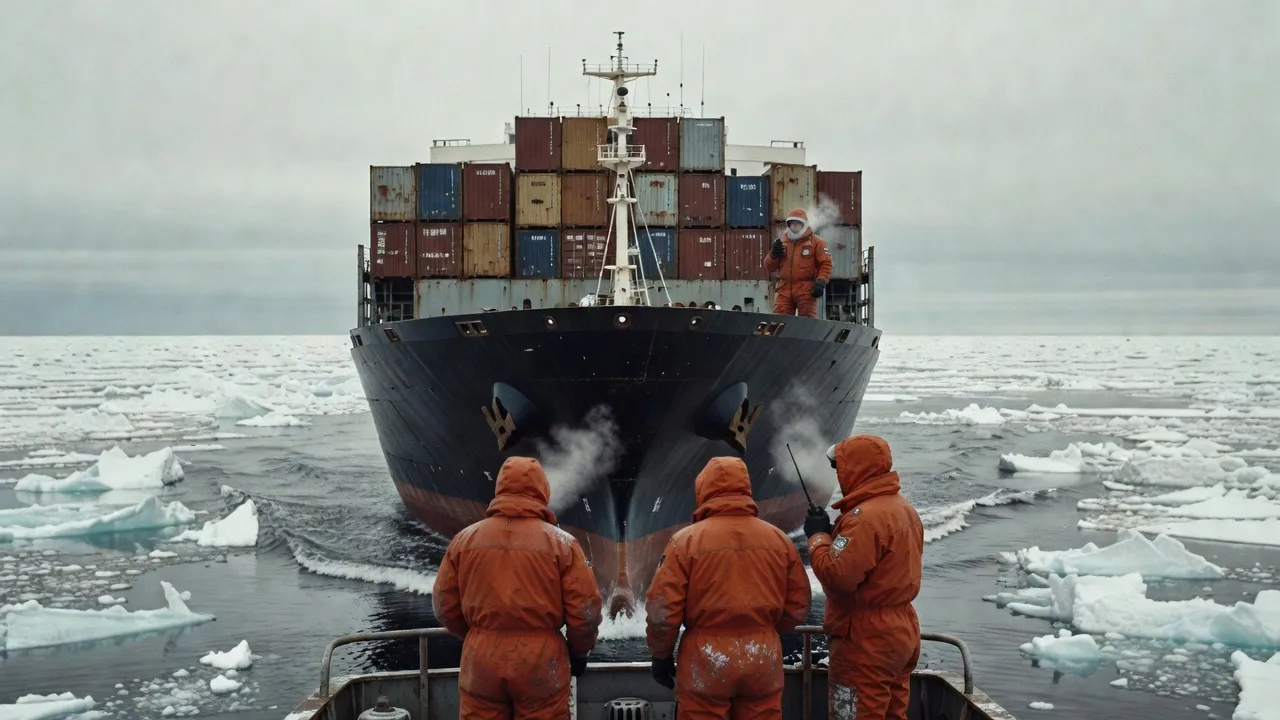
The South Korean container ship PanStar Acro left the port of Busan on Saturday, August 22, to head to Europe via the Northern Sea Route in the Arctic.
The ship is scheduled to make stops in Felixstowe, Rotterdam, and Gdańsk before reaching Europe.
This marks the first time a South Korean shipping company has taken this route, which is seen as a response to disruptions in the usual Hormuz-Suez corridor.
The need to obtain Russian permits to use the Arctic route is viewed differently: Russian media sees it as validation of its strategic corridor, while French media reports the discomfort of Western diplomats with the growing dependence on Moscow.
South Korea presents the Northern Sea Route as a viable alternative to the disrupted Middle Eastern corridors, while Malaysia cites experts highlighting its seasonal nature (August-October) and higher cost, requiring ice-class vessels.
Coverage aligned with this reading
Coverage that diverges
Figures on the time savings of the Arctic route vary by source: South Korean institutes mention a complete journey of around 45 days, saving about 10 days compared to the Suez route, while Russian media cites a crossing time to Europe of approximately 18 days.
Coverage aligned with this reading
Coverage that diverges
This grouping describes the publications analysed, not the position of these countries’ populations or of their governments.
What the coverage of each country leaves aside, while others put it forward.
Germany
Malaysia
Qatar
Preview: 3 of 6 media perspectives. Syntheses of the media analysed — not direct quotations. Method & limitations
Berlin is eyeing an unprecedented Arctic route that bypasses its own ports, favoring Rotterdam and Gdansk over Hamburg.
2 sources · View sources
France views this first Korean maritime move as a mixed signal: a welcome commercial parade to the Ormuz blockade, but at the cost of growing dependence on Moscow, which Western diplomats are already denouncing.
3 sources · View sources
Seoul is claiming a logistical milestone ten years after its last attempt, balancing commercial urgency with caution over Russian dependence.
3 sources · View sources
DOMINANT ANGLE
Berlin is eyeing an unprecedented Arctic route that bypasses its own ports, favoring Rotterdam and Gdansk over Hamburg.
ANALYSIS
Berlin, August 24, 2026.
DOMINANT ANGLE
France views this first Korean maritime move as a mixed signal: a welcome commercial parade to the Ormuz blockade, but at the cost of growing dependence on Moscow, which Western diplomats are already denouncing.
ANALYSIS
Paris, August 24, 2026.
DOMINANT ANGLE
Seoul is claiming a logistical milestone ten years after its last attempt, balancing commercial urgency with caution over Russian dependence.
ANALYSIS
Seoul, August 24, 2026.
DOMINANT ANGLE
Kuala Lumpur is weighing the logistical implications of an Arctic route that bypasses the Strait of Malacca, a historic mainstay of Asia-Europe trade.
ANALYSIS
Kuala Lumpur, August 24, 2026.
DOMINANT ANGLE
Doha is gauging the tangible cost of a potential closure of the Strait of Hormuz for global trade in the first South Korean Arctic passage
ANALYSIS
Doha, August 24, 2026.
DOMINANT ANGLE
Moscow sees this first South Korean transit as proof that the Northern Sea Route is emerging as a viable alternative to the Suez Canal, despite Western concerns over the risk of sanctions.
ANALYSIS
Moscow, August 24, 2026.
Explore every perspective on this subject across 6 countries.
Compare viewpoints and see where they diverge.
published on
countries
sources
articles
gap
The South Korean container ship PanStar Acro, operated by PanStar Line, left the port of Busan at around 9 p.m. on Saturday 22 August 2026 to reach Europe via the Northern Sea Route, in the Arctic. It is the first commercial trial run by a South Korean container ship on that itinerary, presented by the Ministry of Oceans as an alternative to the Middle East corridor since the closure of the Strait of Hormuz. The vessel, loaded with 837 TEU of cargo, is due to call at Felixstowe, Rotterdam and then Gdansk before returning to Busan, for a total voyage estimated at 45 days. According to the South Korean Ministry of Oceans and the Korea Institute for International Economic Policy, the route shortens the Asia-Europe journey by 7,000 kilometres and ten days compared with the Suez Canal.
The PanStar Acro is still en route to Europe, with this test journey, which is seasonal, dependent on Russian permits that Western diplomats view as problematic.
The passage requires Moscow's approval, which controls the route; Western diplomats express their discontent.
Isemar notes that the route is only navigable from August to October and requires reinforced, more expensive ships.
The Chinese container ship Dubai Tower, which set sail from Ningbo, had taken this Arctic route just a few days earlier.
No German port is included in the chosen route, while Rotterdam and Gdansk are part of it.
Measured with the previous method (distance between texts), on a different scale.