Common ground and differences in coverage across the media analysed.
All media confirm the figures: De la Espriella 43.77% (10.1 million), Cepeda 40.88% (9.4 million), Valencia 6.9% — runoff on June 21.
The collapse of institutional "Uribism" (Paloma Valencia at 6.9% versus 3.2 million at March primaries) is acknowledged from Bogotá to Madrid to Buenos Aires.
The explicit inspiration from Bukele (megaprisons, beard, cap), Milei (state reduction, symbolic animal) and Trump (anti-establishment rhetoric, withdrawal from multilateral organizations) is documented by all.
The Latin American press (Brazil, Mexico, Argentina) reads the vote as a piece of a continental bloc swinging right. The Anglo-Saxon press (US, UK) treats it as a bilateral event with Washington. Paris and Madrid foreground the "far-right international." Doha (Al Jazeera) alone refuses this grid and speaks of a domestic "punishment vote."
Coverage aligned with this reading
The United Kingdom (Guardian, former Registrar), the United States (Human Rights Watch, NBC) and Brazil (Folha) qualify Petro's allegations as "disinformation." France softens. Turkey (Bianet) and Mexico (El Siglo de Torreón) take the institutional Thomas Greg & Sons dimension seriously. Colombia itself (El Tiempo) is divided — the right-wing camp (Federico Gutiérrez) speaks of "aires de dictador."
Coverage aligned with this reading
Singapore treats the election as an investment variable (peso +3.75%, bonds, stock). Bloomberg as well. Italy, on the contrary, headlines only on democratic fragility ("by reason or by force"). France and Spain mix both. Brazil takes an aesthetic-cultural reading (national jersey, drone-tiger).
This grouping describes the publications analysed, not the position of these countries’ populations or of their governments.
What the coverage of each country leaves aside, while others put it forward.
United States
France
Qatar
Singapore
Preview: 3 of 12 media perspectives. Syntheses of the media analysed — not direct quotations. Method & limitations
Bogotá is living through a fractured electoral night: 43.77% for the Tiger, 40.88% for Cepeda, and a president who rejects the figures before midnight
2 sources · View sources
Washington reads the vote as a diplomatic victory ahead of time and a setback for cocaine diplomacy
5 sources · View sources
Paris sees in the Colombian sequence the regional diffusion of a Milei-Bukele-Trump model and the programmed end of the Petro experiment
4 sources · View sources
DOMINANT ANGLE
Bogotá is living through a fractured electoral night: 43.77% for the Tiger, 40.88% for Cepeda, and a president who rejects the figures before midnight
ANALYSIS
Colombia tilted Sunday night into a political sequence no one had prepared for.
DOMINANT ANGLE
Washington reads the vote as a diplomatic victory ahead of time and a setback for cocaine diplomacy
ANALYSIS
Washington treats De la Espriella's victory as a strategic fact before being a Colombian one.
DOMINANT ANGLE
Paris sees in the Colombian sequence the regional diffusion of a Milei-Bukele-Trump model and the programmed end of the Petro experiment
ANALYSIS
Paris describes the event with a grammar that is neither triumphalist nor accusatory — that of analyzing a continental shift.
DOMINANT ANGLE
Madrid reads Valencia's fall as the end of the Uribista cycle and the birth of "post-Uribism," while sounding the alarm on the TikTok and evangelical backing
ANALYSIS
Madrid follows the Colombian night as a family affair.
DOMINANT ANGLE
London watches the vote with the lucidity of the distant observer and dwells on the unprecedented mutual attacks between candidates
ANALYSIS
London handles the topic as a Latin American election specialist — a country with no major diaspora or direct energy stake, the United Kingdom has the freedom of angle that produces the most precise portraits.
DOMINANT ANGLE
Brasília grasps that it has just lost its last South American ally and reads the sequence through the Bolsonaro 2018 mirror
ANALYSIS
Brasília watches the Colombian result with the dread of the isolated player.
DOMINANT ANGLE
Mexico City hears Cepeda say "the poor first" as an echo of AMLO and watches the next piece of the Latin American right-wing domino rise
ANALYSIS
Mexico does not follow Bogotá as a mere foreign event — Mexican coverage is shot through with a precise narrative and political identification.
DOMINANT ANGLE
Buenos Aires watches Milei congratulate De la Espriella and reads the result as confirmation of its own regional offensive
ANALYSIS
Buenos Aires welcomes the Colombian result as a long-awaited political validation.
DOMINANT ANGLE
Doha rereads the vote as a "punishment vote" against the political class and raises the critical Global South voice on the war on drugs
ANALYSIS
Doha approaches the Colombian election with the methodology that characterizes Al Jazeera Latin America: structural analysis, voices of the Global South, skepticism toward imported models.
DOMINANT ANGLE
Ankara relays De la Espriella's direct appeal to the United States and inscribes the vote in the grammar of "war or peace"
ANALYSIS
Ankara approaches the Colombian vote from two successive angles that reveal the editorial duplicity of the Turkish press.
DOMINANT ANGLE
Singapore measures first the market effect — peso +3.75%, stock market +6.3%, 2042 bonds up — and reads the vote as an investment data point
ANALYSIS
Singapore approaches the Colombian sequence with the grammar of a regional financial center monitoring emerging markets.
DOMINANT ANGLE
Rome retains the Tiger's most radical formula — "democracy must be maintained by reason or by force"
ANALYSIS
Rome approaches the Colombian night through the Italian prism — a country that has its own Trump, its own Bukele, and that watches Latin America with crossed fascination.
Explore every perspective on this subject across 12 countries.
Compare viewpoints and see where they diverge.
published on
countries
sources
articles
gap
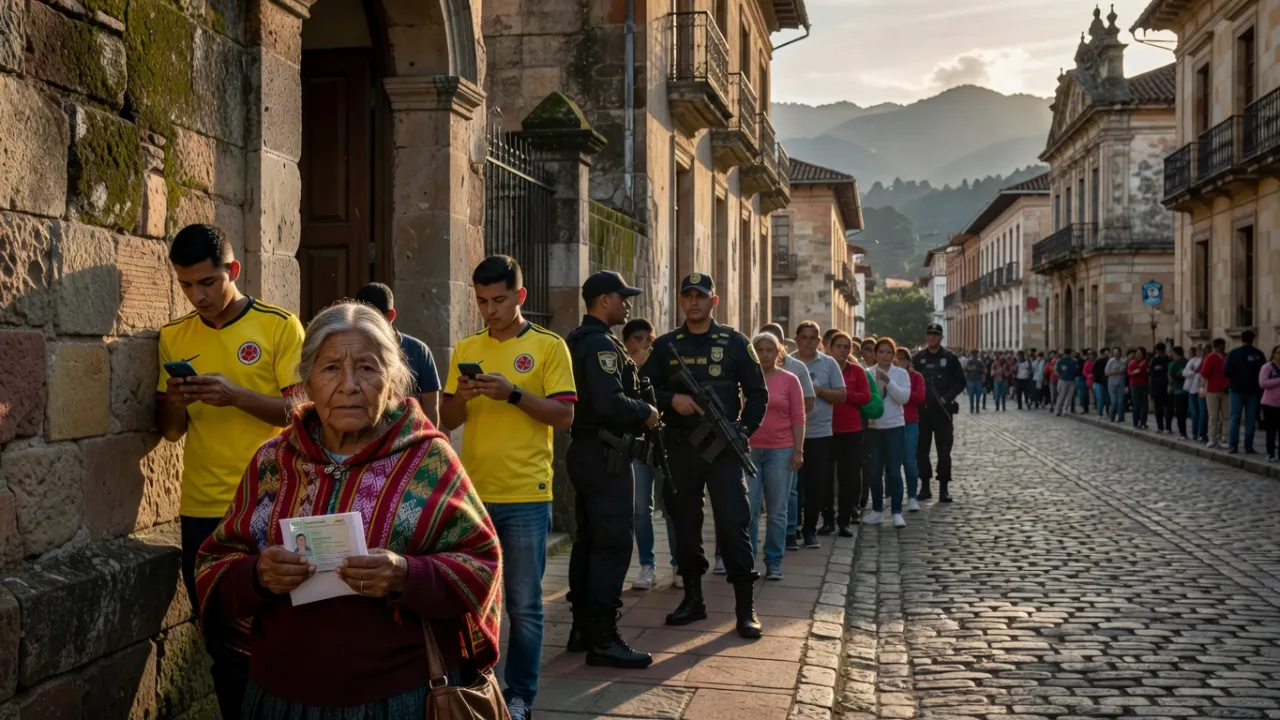
On 31 May 2026, the first round of Colombia's presidential election put Abelardo de la Espriella, a lawyer with no electoral experience, in the lead with 43.77% of the vote (10.1 million), ahead of Iván Cepeda, the candidate backed by outgoing president Gustavo Petro, at 40.88% (9.4 million). Paloma Valencia, a figure of the traditional right, drew only 6.9% — against 3.2 million votes in the March primaries — confirming the collapse of that current. A runoff is set for 21 June.
De la Espriella openly claims foreign references: the prison policy and imagery of El Salvador's Nayib Bukele, the rolling back of the state championed by Argentina's Javier Milei, and the anti-establishment rhetoric associated with Donald Trump, whose congressional allies in the United States voiced public support. His platform includes mega-prisons, withdrawal from multilateral organizations and the eradication of coca crops.
The vote fits into a regional cycle: elected in 2022 with the country's first left-wing president, Colombia was losing its last major continental ally after a string of leftist setbacks in Bolivia, Chile and Ecuador. Beyond the numbers, the stakes touch a country that signed in 2016 the main peace accord of its recent history, after six decades of conflict.
The outcome remains disputed. Petro refused to recognize the count before midnight, accusing — without supplying evidence — a service provider of having injected 800,000 identities, and called for waiting on the official tally by the judges. Cepeda first followed that line before walking back his words within twenty-four hours.
Opposition figures denounce an authoritarian drift, while other actors consider the accusations unfounded. The runoff will largely turn on the 3.6 million orphaned voters of the eliminated candidates and on abstainers.
Measured with the previous method (distance between texts), on a different scale.