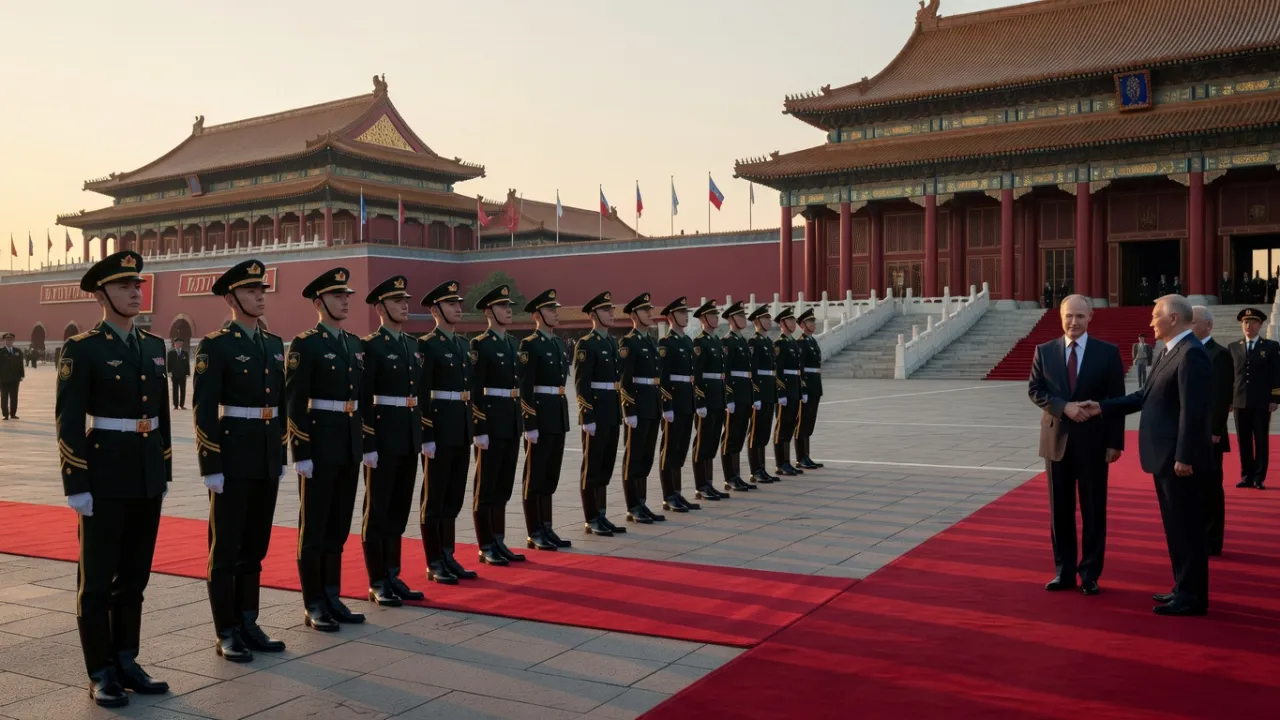
Common ground and differences in coverage across the media analysed.
Vladimir Putin is visiting Beijing on May 19-20, 2026, upon formal invitation from Xi Jinping; a joint statement and several government agreements are expected following the talks.
Putin's visit occurs less than 72 hours after Donald Trump's departure from Beijing, whose visit represents the first visit by a U.S. president to China in nearly a decade.
The Trump-Xi summit produced no formal breakthrough either on the Ukraine issue or on the Iran question.
Beijing and Moscow interpret the succession of visits as a demonstration of Chinese strategic autonomy and the solidity of the Sino-Russian partnership, while Kyiv and Paris see it as the consolidation of an axis unfavorable to Ukrainian and European interests.
Preview: 3 of 8 media perspectives. Syntheses of the media analysed — not direct quotations.
Beijing frames Poutine's visit as a natural consolidation of the Sino-Russian strategic partnership, continuing its recent summit with Donald Trump and signaling its capacity to engage simultaneously with Washington and Moscow.
1 source ·
Moscow frames Putin's visit to Beijing as a natural milestone in Russian-Chinese strategic partnership, contrasting it with Trump's visit which yielded no concrete breakthroughs.
2 sources ·
Kyiv watches with growing concern as the diplomatic sequence Beijing-Trump first, then Putin-unfolds, risking a peace deal brokered without Ukrainian consultation.
2 sources ·
China presents the summit as a demonstration of diplomatic sovereignty and a return to stability; Russia judges it as producing little for Washington. France, Ukraine, Singapore, and Pakistan emphasize the absence of concrete breakthroughs on major issues.
Beijing and Moscow emphasize China's declared neutrality and its calls for negotiation. Kyiv and Paris stress that Beijing has never condemned the Russian offensive and constitutes structural economic support for Moscow.
This grouping describes the publications analysed, not the position of these countries’ populations or of their governments.
What the coverage of each country leaves aside, while others put it forward.
Israel
Russia
China
published on
countries
sources
articles
gap
Vladimir Putin travels to Beijing on 19 and 20 May 2026, at the formal invitation of Xi Jinping. A joint declaration and several governmental agreements are expected at the close of the talks. The visit comes less than 72 hours after the departure of Donald Trump, whose trip was the first by a US president to China in nearly a decade. The Trump-Xi summit produced no formal breakthrough, neither on Ukraine nor on the Iranian question.
By receiving the American and Russian leaders within a few days of each other, Beijing underscores its role as a central interlocutor for both of the competing great powers. The China-Russia partnership, formalised in February 2022, has structurally deepened since Russia's entry into Ukraine: in the wake of Western sanctions, China has become Moscow's leading economic partner and absorbs the bulk of its hydrocarbon exports.
The China-US relationship, for its part, is in a phase of relative stabilisation after the 2025 tariff crisis, without any resolution of the underlying disputes over Taiwan, critical technologies or regional files. Negotiations on Ukraine are at a standstill, as Moscow has ruled out any ceasefire unless Kyiv accepts its demands regarding the occupied territories.
The reading of this sequence remains contested. Beijing and Moscow see it as a demonstration of Chinese strategic autonomy and of the strength of their partnership; Kyiv and Paris read it as the consolidation of an axis unfavourable to a fair settlement of the conflict. The extent of Russia's dependence on China, as well as China's role in the war, are likewise assessed in opposing ways by the various actors.
DOMINANT ANGLE
Beijing frames Poutine's visit as a natural consolidation of the Sino-Russian strategic partnership, continuing its recent summit with Donald Trump and signaling its capacity to engage simultaneously with Washington and Moscow.
ANALYSIS
Beijing, May 18, 2026.
DOMINANT ANGLE
Moscow frames Putin's visit to Beijing as a natural milestone in Russian-Chinese strategic partnership, contrasting it with Trump's visit which yielded no concrete breakthroughs.
ANALYSIS
Moscow, May 19, 2026.
DOMINANT ANGLE
Kyiv watches with growing concern as the diplomatic sequence Beijing-Trump first, then Putin-unfolds, risking a peace deal brokered without Ukrainian consultation.
ANALYSIS
Kyiv, May 18, 2026.
DOMINANT ANGLE
Singapore tracks the unfolding diplomatic sequence in Beijing closely: after the Trump-Xi summit, judged as solid but without major breakthrough, Putin's imminent visit on May 19 signals that China remains the central interlocutor for all major powers.
ANALYSIS
Singapore, May 16, 2026.
DOMINANT ANGLE
Paris reads the sequence of Beijing visits as a revealing indicator of geopolitical balances at stake: barely has Trump left without any tangible agreement, Putin arrives to consolidate a Moscow-Beijing axis that China intends to preserve as a strategic lever.
ANALYSIS
Paris, May 16, 2026.
DOMINANT ANGLE
Islamabad monitors closely the diplomatic sequence in Beijing: after Trump comes Putin, a succession that reveals China's central role in managing global equilibrium.
ANALYSIS
Islamabad, May 19, 2026.
DOMINANT ANGLE
Jerusalem closely monitors Iran-US nuclear negotiations amid conflicting signals from Tehran and persistent tensions around the Strait of Hormuz.
ANALYSIS
Jerusalem, May 18, 2026.
DOMINANT ANGLE
New Delhi monitors closely the diplomatic sequence in Beijing: Trump followed by Putin within 72 hours, a concentration of visits that reshapes power balances at a decisive moment for multiple issues where India has direct stakes.
ANALYSIS
New Delhi, May 18, 2026.
Explore every perspective on this subject across 8 countries.
Compare viewpoints and see where they diverge.
Measured with the previous method (distance between texts), on a different scale.