
Common ground and differences in coverage across the media analysed.
The numbers are not disputed: 73 missiles and 656 drones launched from the evening of June 1, at least 22 dead including two children in Dnipro.
Kyiv was the declared target, but Dnipro, Kharkiv, Odesa, Mykolaiv, Zaporizhzhia, Poltava, Sumy and Khmelnytskyi were also hit.
Zelensky immediately called on Washington to deliver more Patriot missiles and warned a fresh massive strike could come the following night.
Ukraine, Western Europe and North America call it a 'massive attack' deliberately targeting civilians. Moscow (RT, Sputnik) does not deny the scale but pivots coverage to the Crimea fuel crisis and the looming mobilization. Russia has not publicly admitted civilian targeting — it calls it retaliation against the Ukrainian military industry.
Kyiv and Eastern European capitals (Poland, Romania, Baltics) call for an independent European missile shield and more Patriots. Washington is muted, Trump has not commented. China, India and Japan cover the facts without political commitment.
Coverage aligned with this reading
Coverage that diverges
Bucharest brought it to the UN; 56 countries condemned Russia. Warsaw asked for Article 4 activation. The wider European summit remains cautious about collective commitments.
This grouping describes the publications analysed, not the position of these countries’ populations or of their governments.
What the coverage of each country leaves aside, while others put it forward.
Russia
United States
China
Turkey
Preview: 3 of 8 media perspectives. Syntheses of the media analysed — not direct quotations. Method & limitations
Kyiv draws the strategic conclusion: Europe must build its own missile shield, without waiting for Washington
2 sources · View sources
Moscow pivots attention to Crimea's fuel shortage and the planned autumn mobilization
2 sources · View sources
Paris documents the horror live but stays cautious on concrete military responses
4 sources · View sources
DOMINANT ANGLE
Kyiv draws the strategic conclusion: Europe must build its own missile shield, without waiting for Washington
ANALYSIS
Ukraine is counting its dead on the morning of June 2 and drawing a sharper political conclusion.
DOMINANT ANGLE
Moscow pivots attention to Crimea's fuel shortage and the planned autumn mobilization
ANALYSIS
Moscow avoids the human toll of the Kyiv strike head-on.
DOMINANT ANGLE
Paris documents the horror live but stays cautious on concrete military responses
ANALYSIS
Paris opens its newspapers Tuesday morning with a continuous live blog on Le Monde, France 24, BFMTV and Sud Ouest.
DOMINANT ANGLE
Berlin documents methodically and recalls the urgency of delivering Patriot missiles
ANALYSIS
Berlin covers the strike with a method that resembles embarrassment.
DOMINANT ANGLE
Washington documents the Ukrainian suffering but Trump stays silent — silence has become policy
ANALYSIS
Washington discovers the images of Kyiv from Times Square or from its morning news shows.
DOMINANT ANGLE
Warsaw calls for NATO Article 4 activation after the Romanian incident — Kyiv is now a Polish matter
ANALYSIS
Warsaw has turned the attack on Kyiv into an argument for its own security.
DOMINANT ANGLE
Bucharest takes the case to the UN and counts its own dead since the Galati incident
ANALYSIS
Bucharest carries the Ukrainian strike with particular intensity, because Romania became a direct actor in the conflict on May 30.
DOMINANT ANGLE
Tokyo covers the facts with Asian precision — no political engagement, just the numbers
ANALYSIS
Tokyo has a characteristic reading of the Ukrainian conflict: factual, distanced, without emotional posture.
Explore every perspective on this subject across 8 countries.
Compare viewpoints and see where they diverge.
published on
countries
sources
articles
gap
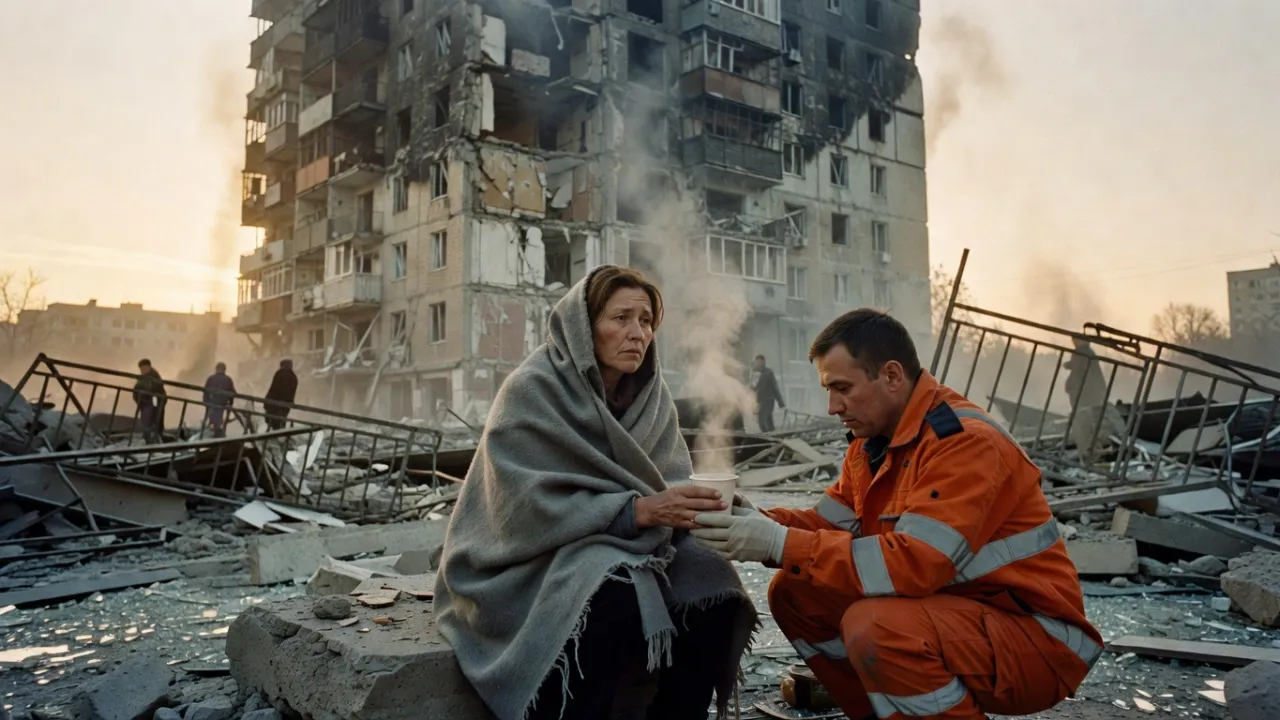
On the night of 1 to 2 June 2026, Ukraine endured an aerial assault of a scale unseen since the war began: 73 missiles (ballistic, cruise and anti-ship) and 656 drones launched within a few hours. Kyiv was the stated target, but the strikes also hit Dnipro, Kharkiv, Odessa, Mykolaiv, Zaporizhzhia, Poltava, Sumy, Chernihiv and Khmelnytskyi. At least 22 people were killed, including two children in Dnipro, where a four-storey building was destroyed. In Kyiv, a 24-storey residential tower partially collapsed.
Ukraine's air defence says it neutralised 40 missiles and 602 drones, a high interception rate but one insufficient against the sheer volume. In the aftermath, President Zelensky called for stepped-up deliveries of Patriot missiles and pressed for an independent European anti-ballistic shield, while warning that another massive attack could come the following night.
The episode unfolds within a long war: in May, Ukraine carried out its own strikes against Russian bombers deep inside Russian territory, and a Russian official has announced a new mobilisation for the autumn. The day before, a Russian drone had struck a building in Galati, Romania, prompting Warsaw to request the activation of NATO's Article 4.
The actors diverge less over the facts than over the response. Kyiv and several Eastern European capitals are demanding autonomous missile defence; Washington has not responded publicly and remains measured on new deliveries; Moscow, which does not deny the scale, speaks of retaliation against the military industry and steers its coverage toward other topics. The extent of collective commitment from NATO's eastern flank, meanwhile, remains under discussion.
Measured with the previous method (distance between texts), on a different scale.