Roland-Garros: World #1 Sabalenka Collapses to a 'Neutral' Russian, Italy Owns the Semifinal, and Ukraine's Kostyuk Dedicates Her Win to Kyiv
published on
countries
sources
articles
Measured with the previous method (distance between texts), on a different scale.
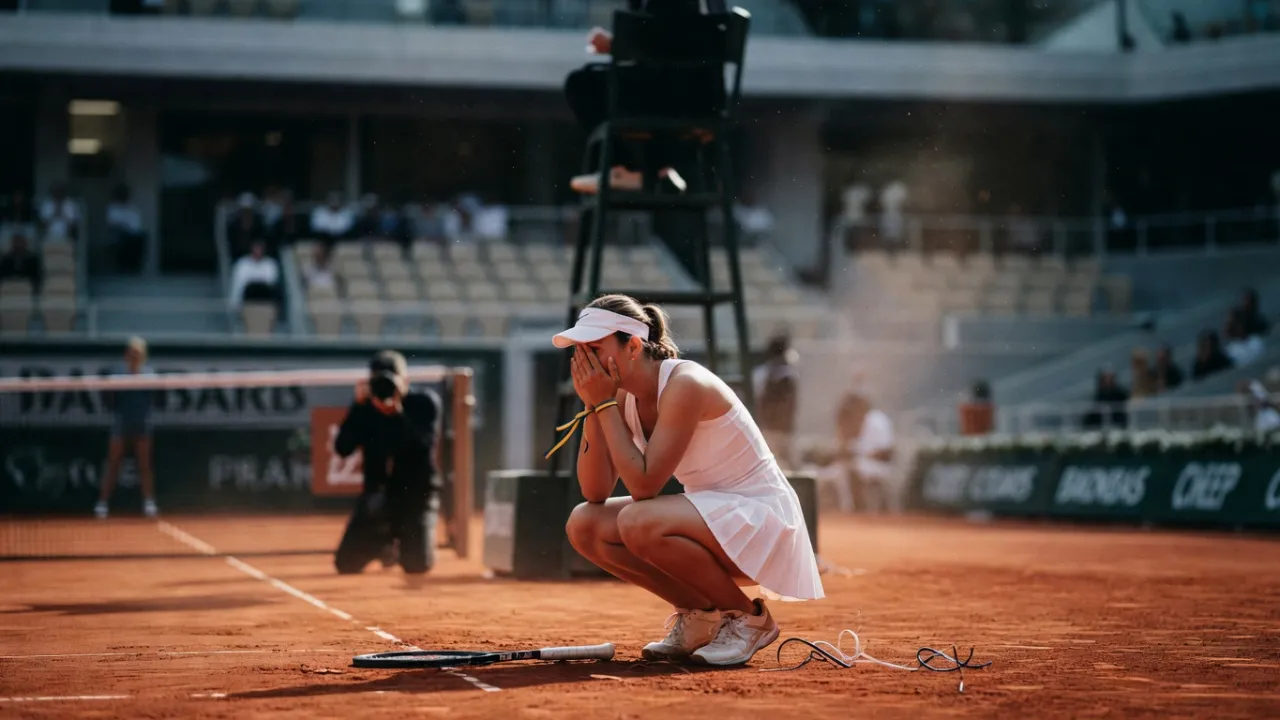
On 3 June 2026, the French Open quarter-finals shaped an exceptionally open edition. World number one Aryna Sabalenka, leading 6-3, 4-1, collapsed against Diana Shnaider (ranked 23rd), losing 3-6, 7-5, 6-0 on Philippe-Chatrier court in windy conditions, with 57 unforced errors. For the first time since 1977, no Grand Slam champion features in the semi-finals of a single tournament, men's and women's combined, after the early exits of Gauff, Swiatek, Alcaraz, Sinner and Djokovic.
The women's draw will therefore crown a first-time champion: Shnaider, Poland's Maja Chwalinska, a qualifier returning after a long break for depression, Ukraine's Marta Kostyuk and Russia's Mirra Andreeva have never won a major. In the men's draw, the Cobolli–Arnaldi semi-final will be the first all-Italian meeting at this stage of a Grand Slam in the Open era. Berrettini, hampered by injury, retired against Arnaldi.
Beyond sport, the tournament is read through the lens of the war between Ukraine and Russia. Kostyuk dedicated her win to Ukraine, struck the previous day by missile and drone fire. Shnaider, like Sabalenka, competes under neutral status, imposed since 2022.
Actors diverge on how to frame these results. Some amplify the Russian performance while omitting that neutral status; others foreground the political dimension and the Ukrainian dedication; still others treat the event in strictly sporting terms, celebrating the Italian feat or the run of young Brazilian João Fonseca. What remains disputed is how much weight to give the geopolitical context in a tournament that concludes on 7 June.
What the comparison reveals
Common ground and differences in coverage across the media analysed.
What the media report in common
World #1 Aryna Sabalenka lost in the quarters to Russia's Diana Shnaider (23rd WTA, neutral status) 3-6, 7-5, 6-0 after leading 6-3, 4-1.
An all-Italian men's semifinal (Cobolli-Arnaldi) is guaranteed — a first in the Open era for two Italians at this stage of a Grand Slam.
The women's draw will produce a maiden champion: none of the four semifinalists (Shnaider, Chwalinska, Kostyuk, Andreeva) has ever won a major.
Where media coverage diverges
How to frame the win of Diana Shnaider, a Russian player under 'neutral' status?
TASS calls her a 'Russian' player and amplifies the sporting context. Kyiv Post in mirror amplifies Marta Kostyuk's dedication to Ukraine. Japan Times leads with 'Shadow of war looms large over French Open'. European outlets (Le Monde, ANSA, La Repubblica) put 'neutral' in scare quotes. Latin American and Asian outlets evacuate the political dimension.
Is the tournament a human drama or a parade of upsets?
Channel News Asia foregrounds Chwalinska's depression-recovery story. Le Monde and 20 Minutes sell 'the parade of upsets'. La Repubblica and ANSA celebrate Italian triumph. Veja and G1 Globo cover Fonseca as historic Brazilian return. Asharq Al-Awsat and Al Jazeera publish neutral reports centered on Sabalenka.
What place for the geopolitical dimension in a sporting event?
Japan Times raises the question head-on ('Shadow of war looms large'). Kyiv Post turns Kostyuk into a political figure. TASS and RT document Russian wins without political context. Western media nuance. Latin American and Asian media evacuate.
This grouping describes the publications analysed, not the position of these countries’ populations or of their governments.
Blind spots
What the coverage of each country leaves aside, while others put it forward.
 Russia
- Shnaider's mandatory 'neutral' status since 2022 (mentioned by Le Monde and La Nación)
- Marta Kostyuk's dedication of her win to Ukraine
- The context of the war as a reading grid for the tournament (Japan Times)
 Ukraine
- Pure sporting caliber of the other semifinalists
- Chwalinska's depression-recovery narrative
 Brazil
- Geopolitical analysis of the Russia-Ukraine war filtering through the draw
- Detail of injuries and withdrawals (Berrettini, Sinner)
 United States
- Coverage of Sabalenka's exit — relative silence from US media absent from the pool
- American player preparation for the tournament
How each country reads it
Preview: 3 of 12 media perspectives. Syntheses of the media analysed — not direct quotations. Method & limitations
 France
Paris lives through the most unpredictable Roland-Garros 'parade of upsets' since 1977 — no French player left in the draw
3 sources · View sources
 Italy
ItalyRome lives a national ecstasy: an all-Italian semifinal, Berrettini in tears, Binaghi demands free-to-air TV
3 sources · View sources
- Ukraine
Kyiv makes Marta Kostyuk a political figure: dedication to a bombed Ukraine, 21 dead during her quarterfinal
1 source · View sources
The full text, country by country
France
DOMINANT ANGLE
Paris lives through the most unpredictable Roland-Garros 'parade of upsets' since 1977 — no French player left in the draw
ANALYSIS
Paris watches its national tournament with a curious detachment.
Italy
DOMINANT ANGLE
Rome lives a national ecstasy: an all-Italian semifinal, Berrettini in tears, Binaghi demands free-to-air TV
ANALYSIS
Rome celebrates a historic day.
Ukraine
DOMINANT ANGLE
Kyiv makes Marta Kostyuk a political figure: dedication to a bombed Ukraine, 21 dead during her quarterfinal
ANALYSIS
Kyiv turns Marta Kostyuk into a flag-bearer.
Russia
DOMINANT ANGLE
Moscow amplifies Shnaider without mentioning her neutral status — the win is 'Russian'
ANALYSIS
Moscow celebrates Shnaider without the slightest irony.
 Poland
DOMINANT ANGLE
Warsaw celebrates Chwalinska, qualifier returning from an 18-month depression — the heroine 'from nothingness'
ANALYSIS
Warsaw celebrates Maja Chwalinska with particular emotion.
Brazil
DOMINANT ANGLE
Brasília celebrates João Fonseca, 19, first Brazilian in the quarters since Guga Kuerten in 2004 — tennis audience record
ANALYSIS
Brasília makes João Fonseca the national sporting hero.
 Argentina
DOMINANT ANGLE
Buenos Aires leads with 'Bombazo' and reads the tournament as a cascade of upsets — Sabalenka, Sinner, Djokovic, Gauff
ANALYSIS
Buenos Aires approaches Roland-Garros through its favorite angle: the cascade of upsets.
 Mexico
DOMINANT ANGLE
Mexico City predicts two maiden champions: 'Roland Garros will have maiden champions after the fall of the favorites'
ANALYSIS
Mexico City approaches the tournament with an analytical reading.
 Japan
Japan
DOMINANT ANGLE
Tokyo asks the frontal question: 'Shadow of war looms large over French Open'
ANALYSIS
Tokyo publishes the most marked political angle of the Asian coverage.
 Singapore
DOMINANT ANGLE
Singapore amplifies Chwalinska's human story — vanquished depression as central narrative arc
ANALYSIS
Singapore publishes one of the tournament's longest human portraits.
 Qatar
Qatar
DOMINANT ANGLE
Doha covers Sabalenka as the last Grand Slam champion eliminated — factual angle without politics
ANALYSIS
Doha approaches the tournament with its usual precision.
 Saudi Arabia
DOMINANT ANGLE
Riyadh picks up the AFP wire word for word — standard sporting coverage without a Saudi angle
ANALYSIS
Riyadh covers Roland-Garros with a standardized posture.
Explore every perspective on this subject across 12 countries.
Compare viewpoints and see where they diverge.