Common ground and differences in coverage across the media analysed.
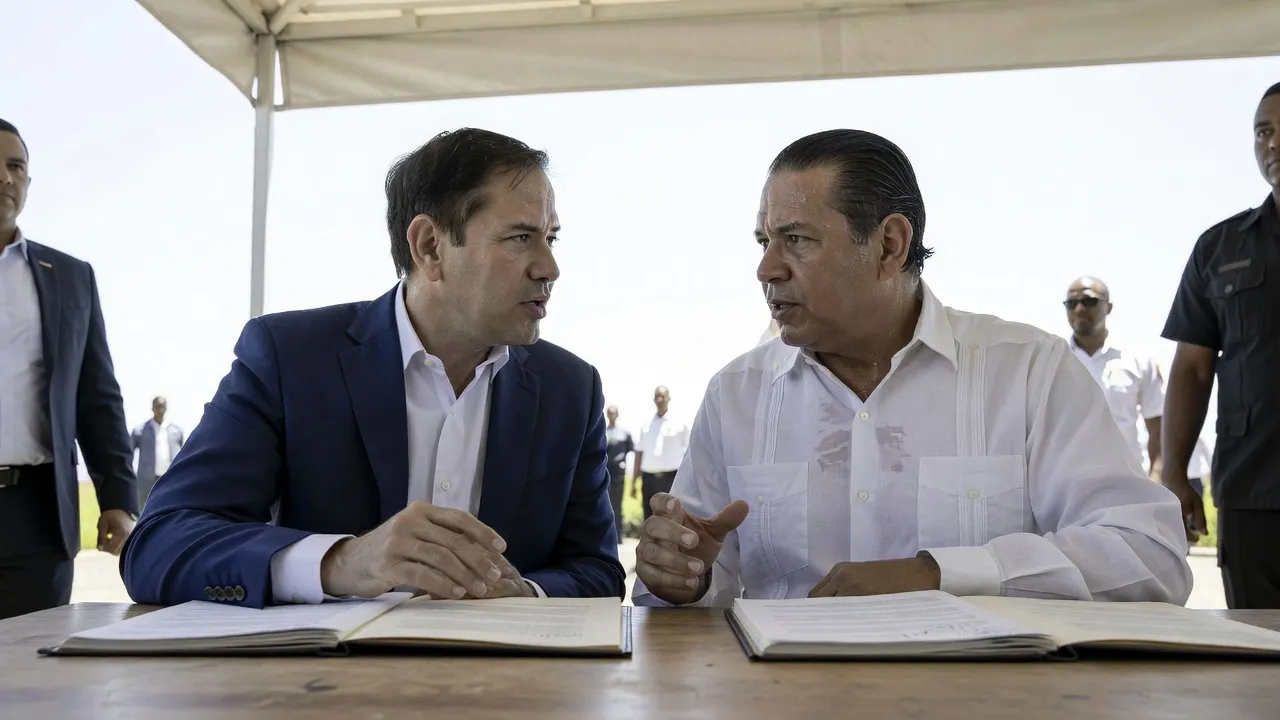
On Tuesday, September 8, 2026, Marco Rubio met with Colombian President Abelardo de la Espriella, who took office on August 7, 2026, in Barranquilla, for the first visit by a Trump administration official to Colombia since his inauguration.
Two memoranda of understanding were signed in Barranquilla, one on civil nuclear energy and the other on critical minerals, including lithium and copper, and not a binding treaty.
The visit marks the beginning of a three-day regional tour that continues in Ecuador with Daniel Noboa and then in Peru with Keiko Fujimori, until Thursday, September 10, 2026.
Some perspectives view the tour as a hegemonic takeover and a regional control doctrine by Washington, while others present it mainly as a bilateral technical and security cooperation without a geostrategic interpretive framework.
Coverage that diverges
The Colombian press links the visit to contested domestic measures (urban security blocks, resumed aerial spraying, lifting of the suspension of firearms) qualified by the opposition as a paramilitary drift, a aspect that other perspectives do not develop.
Coverage aligned with this reading
Brazil and Peru present the tour as an American offensive aimed at containing China's economic influence in the region, while Colombia and Ecuador emphasize an autonomous security cooperation without an explicit anti-Chinese framework.
This grouping describes the publications analysed, not the position of these countries’ populations or of their governments.
What the coverage of each country leaves aside, while others put it forward.
Colombia
United States
Preview: 3 of 10 media perspectives. Syntheses of the media analysed — not direct quotations. Method & limitations
Quito is measuring Rubio's visit in terms of its own security dividends: $45 million announced, another group classified as terrorist, seven former officials sanctioned, rather than in terms of the agreements signed in Barranquilla.
4 sources · View sources
Caracas views Rubio's tour as a tightening of security around Venezuela, where Bogotá promises to "guarantee regional stability" while Washington conditions the bilateral relationship on an end to the ELN's impunity.
4 sources · View sources
Buenos Aires sees Rubio's tour as proof that Washington is reshaping its regional alliances around aligned governments, leaving Brazil off the itinerary.
3 sources · View sources
DOMINANT ANGLE
Quito is measuring Rubio's visit in terms of its own security dividends: $45 million announced, another group classified as terrorist, seven former officials sanctioned, rather than in terms of the agreements signed in Barranquilla.
ANALYSIS
Quito, September 10, 2026.
DOMINANT ANGLE
Caracas views Rubio's tour as a tightening of security around Venezuela, where Bogotá promises to "guarantee regional stability" while Washington conditions the bilateral relationship on an end to the ELN's impunity.
ANALYSIS
Caracas, September 10, 2026.
DOMINANT ANGLE
Buenos Aires sees Rubio's tour as proof that Washington is reshaping its regional alliances around aligned governments, leaving Brazil off the itinerary.
ANALYSIS
Buenos Aires, September 10, 2026.
DOMINANT ANGLE
Brasília sees its absence from Rubio's itinerary as a sign of a regional realignment that bypasses Brazil, as Washington woos Bogotá, Quito, and Lima to counter Chinese influence in Latin America.
ANALYSIS
Brasília, September 10, 2026.
DOMINANT ANGLE
Bogotá is measuring what it has accepted to yield in terms of security to seal the renewed alliance with Washington, between new urban armed groups and the return of aerial spraying
ANALYSIS
Bogotá, September 9, 2026.
DOMINANT ANGLE
Madrid sees Rubio's visit to Colombia as a diplomatic reconstruction based on personal closeness as much as strategic interests, a method likely to be repeated in Ecuador and Peru while Brazil remains off the itinerary.
ANALYSIS
Madrid, September 10, 2026.
DOMINANT ANGLE
Paris sees Rubio's tour as the implementation of a "Donroe doctrine": Washington is tightening its grip on Latin America through new right-wing allies, leaving Brazil off its itinerary.
ANALYSIS
Paris, September 10, 2026.
DOMINANT ANGLE
Mexico City takes away from Rubio's South American tour the Barranquilla agreements, but also the warning issued from Quito: Mexico's anti-drug fight remains "far from sufficient".
ANALYSIS
Mexico, September 10, 2026.
DOMINANT ANGLE
Peru is navigating between the security alliance proposed by Washington through the "Bouclier des Amériques" and twelve years of its primary trade partnership with Beijing, which Marco Rubio has publicly questioned from Lima.
ANALYSIS
Lima, September 10, 2026.
DOMINANT ANGLE
The United States is tightening its regional grip on narcotics trafficking, framing Rubio's tour of Colombia, Ecuador, and Peru in terms of security cooperation rather than the economic memorandums signed in Barranquilla.
ANALYSIS
The United States is tightening its regional grip on narcotics trafficking, and it is through this lens that the Trump administration is framing Secretary of State Marco Rubio's tour of South America.
Explore every perspective on this subject across 10 countries.
Compare viewpoints and see where they diverge.
published on
countries
sources
articles
gap
US Secretary of State Marco Rubio met with Colombian President Abelardo de la Espriella on Tuesday, September 8, 2026, in Barranquilla, northern Colombia, who took office on August 7, 2026. The meeting, held at the Paraíso battalion in the presence of Foreign Minister Omar Bula Escobar, resulted in two memoranda of understanding, one on civil nuclear energy, the other on critical minerals including lithium and copper. This was the first visit by a high-ranking official of the Trump administration to Colombia since De la Espriella took office. The Colombian leg opened a three-day tour to be continued in Ecuador and then Peru, until September 10, without a stop in Brazil.
The two memoranda signed in Barranquilla remain non-binding; Rubio has set no schedule for a reduction in the 12.5% tariff on Colombian exports.
The two men have known each other since a wedding in Florida, before the Colombian's entry into politics.
Colombia has joined the A3C, a security alliance promoted by Washington, and authorized joint military operations.
In Quito, Rubio designated the Los Tiguerones gang as a terrorist organization and banned entry to seven former officials.
In Lima, Rubio formalized Peru's entry into the Americas Shield, a security alliance promoted by Washington.
More divergent than 47% of recent comparable stories (reference: 91 recent stories measured with the same method).