
Common ground and differences in coverage across the media analysed.
US Secretary of State Marco Rubio will meet Pope Leo XIV on Thursday in Rome, confirmed by the Vatican and Italian government sources
The visit follows Trump's public criticism of Pope Leo XIV, who had called the Iran war unjust
Rubio will also meet Vatican Secretary of State Pietro Parolin, Foreign Minister Tajani, and requested a meeting with Meloni
French and British press reads Rubio's mission as an admission that Trump created a diplomatic problem he cannot solve himself. American press (NYT, WaPo) presents it as demonstrating the administration's ability to manage multilateral tensions.
Coverage that diverges
This grouping describes the publications analysed, not the position of these countries’ populations or of their governments.
Preview: 3 of 10 media perspectives. Syntheses of the media analysed — not direct quotations. Method & limitations
The New York Times and Washington Post frame Rubio's mission as a diplomatic PR operation: Trump alienated a major symbolic ally (1.4 billion Catholics) by attacking the Pope, and Rubio — himself a Catholic — is the instrument chosen to repair the damage without Trump having to apologize
2 sources · View sources
Le Monde and France 24 read Rubio's visit as a diplomatic concession: if Trump were in a position of strength, he would not need to send his Secretary of State to make amends to a religious institution. Paris sees in Pope Leo a moral voice that Trump cannot afford to alienate indefinitely
2 sources · View sources
The Independent highlights that Rubio's visit coincides with the 5,000-troop Germany withdrawal announcement — signaling the Trump administration is simultaneously managing crises with multiple allies. The Vatican feud is seen as a symptom of broader diplomatic isolation
1 source · View sources
DOMINANT ANGLE
The New York Times and Washington Post frame Rubio's mission as a diplomatic PR operation: Trump alienated a major symbolic ally (1.4 billion Catholics) by attacking the Pope, and Rubio — himself a Catholic — is the instrument chosen to repair the damage without Trump having to apologize
ANALYSIS
American coverage structures around a dual narrative: the real diplomatic embarrassment Trump's Vatican feud represents for US international image; and the administration's ability to send reconciliation signals without the president modifying his own position.
DOMINANT ANGLE
Le Monde and France 24 read Rubio's visit as a diplomatic concession: if Trump were in a position of strength, he would not need to send his Secretary of State to make amends to a religious institution. Paris sees in Pope Leo a moral voice that Trump cannot afford to alienate indefinitely
ANALYSIS
Le Monde reconstructs the conflict cascade: Leo XIV's Iran war criticism, Trump's social media attack on the pope, Meloni defending the pope, Trump attacking Meloni — a diplomatic cascade exposing Washington's moral isolation in the Catholic world.
DOMINANT ANGLE
The Independent highlights that Rubio's visit coincides with the 5,000-troop Germany withdrawal announcement — signaling the Trump administration is simultaneously managing crises with multiple allies. The Vatican feud is seen as a symptom of broader diplomatic isolation
ANALYSIS
The Independent places Rubio's visit in a broader diplomatic context: the Roman mission arrives 'as the Pentagon recently announced a drawdown of 5,000 US soldiers from Germany, its largest European base' — signaling Trump is simultaneously fraying military and symbolic alliances.
DOMINANT ANGLE
N1 Serbia covers Rubio's Italy visit with an orthodox-diplomatic angle: the Trump-Pope feud is viewed from Belgrade as a division within Western Christianity, with implications for non-Catholic Christian communities observing US-Vatican relations
ANALYSIS
N1 Serbia covers Rubio's Italy visit with a detail others miss: in addition to the Pope and Vatican officials, Rubio will meet Italian government officials including FM Tajani and Defense Minister Crosetto.
DOMINANT ANGLE
The South China Morning Post reads Rubio's mission as confirmation that US diplomacy relies on damage-control operations rather than coherent strategy: Beijing notes with satisfaction that Washington must send its top diplomat to make diplomatic amends to a religious institution
ANALYSIS
The South China Morning Post publishes a sober article on Rubio's visit, citing Vatican and Italian sources confirming the 'thaw' objective.
DOMINANT ANGLE
National Post covers Rubio's mission with the Catholic reconciliation angle: Rubio, a devout Catholic, must convince the Pope that the Trump administration is not hostile to Catholicism per se, but in disagreement with the pontiff's political positions on the war
ANALYSIS
National Post covers Rubio's Rome visit with full institutional scope: the US Secretary of State will not only meet the Pope, but also Pietro Parolin (Vatican Secretary of State), Antonio Tajani (Italian Foreign Minister), and has requested a meeting with Giorgia Meloni.
DOMINANT ANGLE
The Korea Times covers the Rubio-Pope meeting as a major diplomatic event in global geopolitics: the pontiff represents 1.4 billion Catholics, and his feud with Trump reflects a global moral division on the Iran war that transcends Western Christian borders
ANALYSIS
Korea Times covers the meeting with factual precision: the Vatican officially confirmed Rubio would meet Pope Leo XIV on Thursday at 11:30 AM local time, per the Vatican media site calendar.
DOMINANT ANGLE
Vanguard Nigeria covers the Rubio-Pope meeting with the African Catholic community angle: Pope Leo XIV is a moral authority for 200 million African Catholics, and his feud with Trump over the war directly touches populations suffering the economic consequences of the conflict
ANALYSIS
Vanguard Nigeria relays the Vatican confirmation with a global Catholic coverage angle.
DOMINANT ANGLE
Gulf Times covers the Rubio-Pope meeting with the interest of an Arab Muslim country observing a fracture within the Western world: if the head of the world's largest Christian institution and the US president are in open quarrel over the Iran war, it is a powerful signal of Western fragmentation
ANALYSIS
Gulf Times covers the Rubio-Pope meeting from the diplomatic global angle of a Gulf mediating power.
DOMINANT ANGLE
Daily Sabah covers Rubio's visit with Turkey's habitual moral conscience vs. realpolitik angle: Trump attacked a religious institution for its pacifist positions — behavior Turkey, which presents Erdogan as a defender of the Islamic world, observes with interest as it validates its own moral posture vis-à-vis the West
ANALYSIS
Daily Sabah covers Rubio's visit with factual but geopolitically loaded tone.
Explore every perspective on this subject across 10 countries.
Compare viewpoints and see where they diverge.
published on
countries
sources
articles
gap
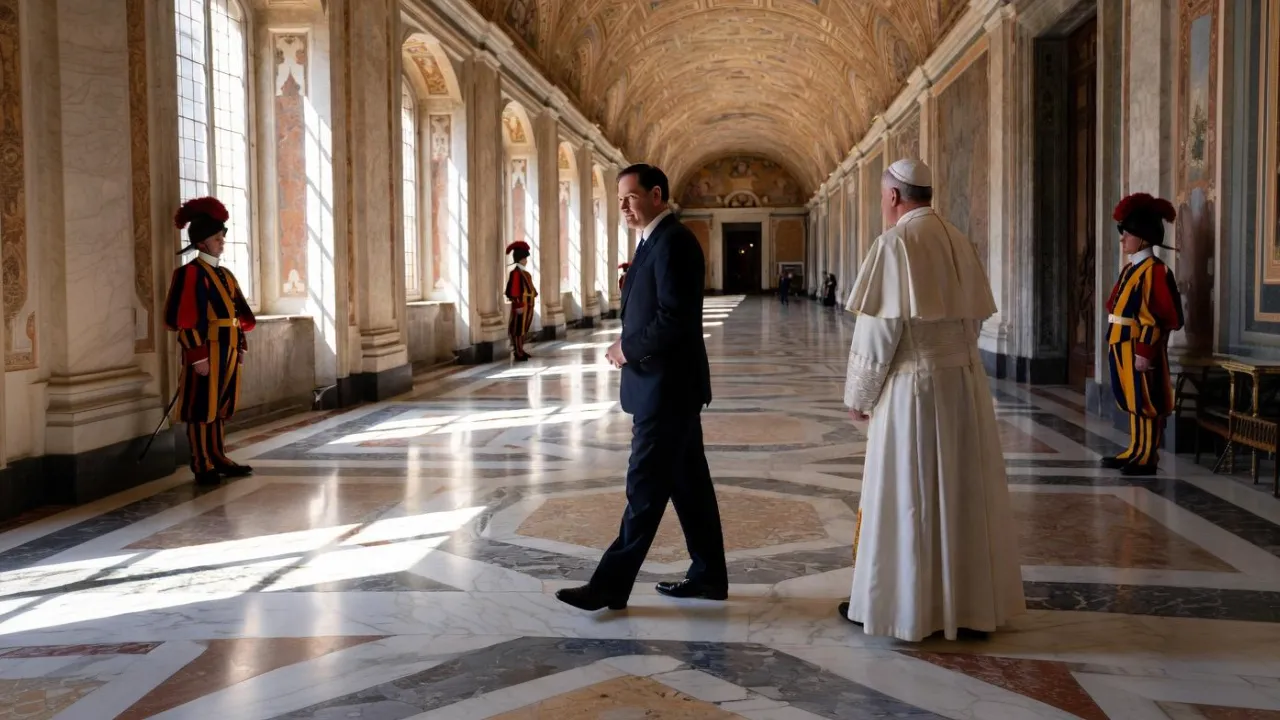
US Secretary of State Marco Rubio is set to meet Pope Leo XIV on Thursday in Rome, a meeting confirmed by the Vatican and by Italian government sources. Also on the agenda: talks with Vatican Secretary of State Pietro Parolin, a meeting with Italian Foreign Minister Antonio Tajani, and a requested conversation with Italian head of government Giorgia Meloni.
The mission comes after public criticism from Donald Trump aimed at Pope Leo XIV, who had described the war in Iran as "unjust." Italian media portray the trip as an attempt to "thaw" relations between Washington and the Holy See. One detail is universally noted: Rubio is a practicing Catholic, placing the envoy in a distinctive relationship with the pontiff he is coming to meet.
To grasp what is at stake, it helps to set the visit in a wider context. Since the start of the war in Iran in March 2026, several international institutions and European governments have voiced increasingly critical positions toward American strategy. Elected less than a year ago, Pope Leo XIV quickly established himself as a global moral voice on armed conflict, in continuity with his predecessor's stances — but this time facing a war directly waged by the United States.
The true significance of the trip remains contested. Some actors see it as a routine diplomatic operation, sending a qualified mediator to mend a damaged relationship and a signal of reconciliation. Others read it as an admission of a problem the administration created and cannot resolve alone. The disagreement also concerns the nature of the quarrel: a personal clash between two men, or a deeper structural tension between the Church's positions and Washington's agenda. On this point, no single reading commands consensus.
Measured with the previous method (distance between texts), on a different scale.