Common ground and differences in coverage across the media analysed.
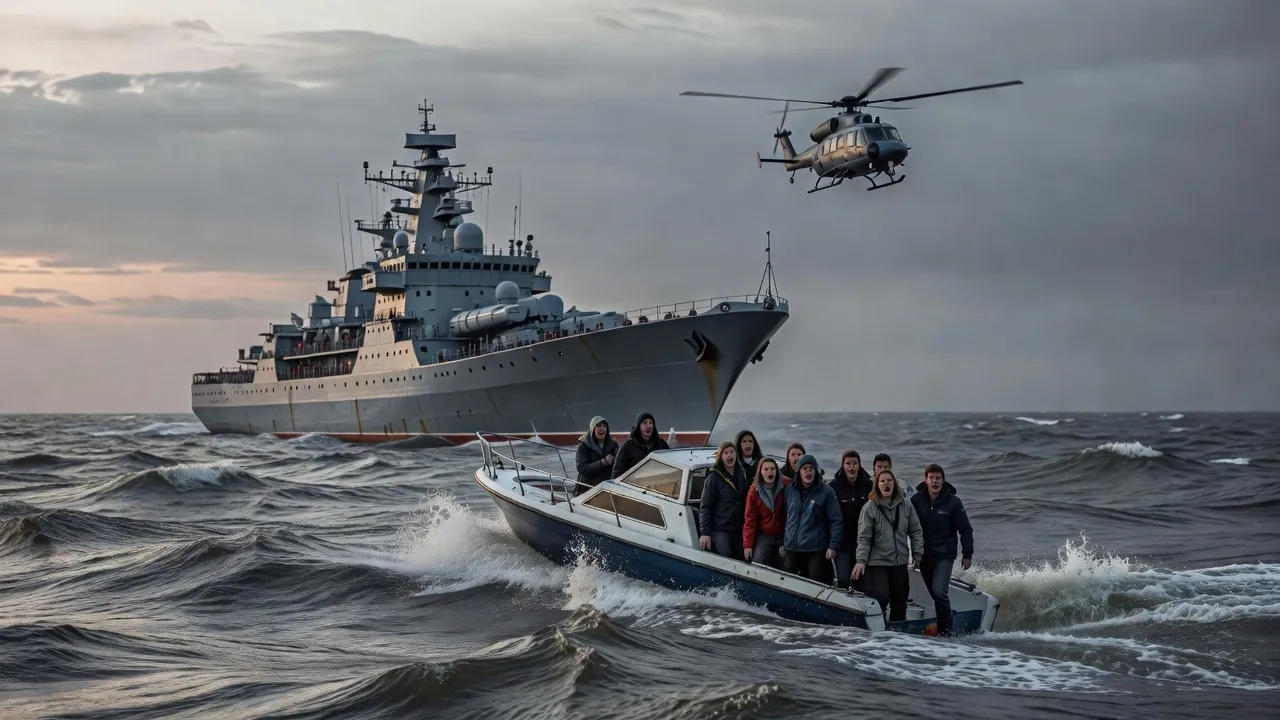
Russian frigate Admiral Grigorovich fired small-arms warning shots at the British civilian sailing vessel Bright Future on June 16, 2026, approximately 20 nautical miles south of the Isle of Wight, in waters outside British territorial jurisdiction.
The incident caused no casualties or material damage; the sailing vessel altered course and continued toward Cherbourg.
The British Ministry of Defence opened an official investigation and characterized the event as an isolated incident, while HMS Mersey was monitoring the Russian vessel at the time of the incident.
Moscow and its associated outlets present the gunfire as a proportionate response to a dangerous approach by the sailing vessel, consistent with international maritime regulations. Western and Ukrainian capitals tend to interpret it as deliberate intimidation, tied to Russia's presence escorting the shadow fleet.
Preview: 3 of 6 media perspectives. Syntheses of the media analysed — not direct quotations.
Ottawa frames the English Channel incident within a broader systemic threat: Russia's shadow fleet represents a coordinated maritime challenge that requires sustained sanctions enforcement, including on the high seas.
1 source ·
Berlin reads the English Channel incident as a deliberate signal from Russia's navy, revealing a broader strategy of shadowing phantom fleet tankers now operating in European waters.
3 sources ·
Paris examines the English Channel incident through two simultaneous angles: the danger posed by Russian naval activities at Europe's doorstep and the troubling timing with the G7 summit in Evian, where leaders were precisely debating intensified pressure on Moscow.
4 sources ·
Coverage aligned with this reading
Coverage that diverges
Ukrainian and Canadian perspectives emphasize the frigate's role in escorting sanctioned tankers and the direct link to Russia's war economy. Russian state media omits this connection; the British perspective characterizes the incident as isolated, without formal ties to the Smyrtos seizure.
Coverage that diverges
American media systematically link the incident to incendiary attacks attributed to Russian-speaking operators against properties of Keir Starmer and to 192 recorded sabotage acts since 2022, constructing a narrative of systemic pressure. Other perspectives do not establish this connection.
Coverage aligned with this reading
Coverage that diverges
This grouping describes the publications analysed, not the position of these countries’ populations or of their governments.
What the coverage of each country leaves aside, while others put it forward.
Russia
United Kingdom
United States
published on
countries
sources
articles
gap
On 16 June 2026, the Russian frigate Admiral Grigorovich fired small-arms warning shots toward the British civilian sailing yacht Bright Future, about 20 nautical miles south of the Isle of Wight, outside British territorial waters. The incident caused no injuries or damage: the yacht altered course and continued toward Cherbourg, under watch from HMS Mersey, which was present at the time.
The British Ministry of Defence opened a formal investigation and described the event as an isolated incident. The timing is notable: it came two days after the seizure, in the same shipping lane, of the tanker Smyrtos suspected of belonging to the Russian shadow fleet, and on the day of the G7 summit in Evian.
Since 2026, the English Channel has become a stage for naval tensions of an intensity unseen since the Cold War. The frigate's presence in this high-traffic corridor fits a broader strategy of escorting tankers designed to circumvent energy sanctions. The seizure of the Smyrtos by Franco-British commandos, the first such operation in the Channel, and a new sanctions package announced at the G7 reflect coordinated Western pressure on Russian exports.
Accounts remain contradictory. Moscow cites a dangerous approach by the yacht and a response consistent with international maritime rules; the crew disputes any collision risk. Several capitals read the act as deliberate intimidation tied to the shadow-fleet escort, while other actors treat the episode as isolated. The legal framework applicable in non-territorial waters, meanwhile, remains little discussed.
DOMINANT ANGLE
Ottawa frames the English Channel incident within a broader systemic threat: Russia's shadow fleet represents a coordinated maritime challenge that requires sustained sanctions enforcement, including on the high seas.
ANALYSIS
Ottawa, June 15, 2026.
DOMINANT ANGLE
Berlin reads the English Channel incident as a deliberate signal from Russia's navy, revealing a broader strategy of shadowing phantom fleet tankers now operating in European waters.
ANALYSIS
Berlin, June 15, 2026.
DOMINANT ANGLE
Paris examines the English Channel incident through two simultaneous angles: the danger posed by Russian naval activities at Europe's doorstep and the troubling timing with the G7 summit in Evian, where leaders were precisely debating intensified pressure on Moscow.
ANALYSIS
Paris, June 17, 2026.
DOMINANT ANGLE
Moscow defends the legitimacy of warning shots fired by the frigate Admiral Grigorovich in the English Channel, characterizing the incident as a proportionate response to a dangerous approach by a British civilian sailboat in international waters.
ANALYSIS
Moscow, June 18, 2026.
DOMINANT ANGLE
Kyiv views the Grigorovich frigate incident in the English Channel as a deliberate escalation signal, inseparable from the shadow fleet network Russia deploys to circumvent Western sanctions and finance its war against Ukraine.
ANALYSIS
Kyiv, June 16, 2026.
DOMINANT ANGLE
Washington analyzes the English Channel incident as one symptom among several of a systematic Russian intimidation campaign against Britain and European allies, at a moment when Moscow is multiplying provocations across multiple fronts simultaneously.
ANALYSIS
Washington, June 17, 2026.
Explore every perspective on this subject across 6 countries.
Compare viewpoints and see where they diverge.
Measured with the previous method (distance between texts), on a different scale.