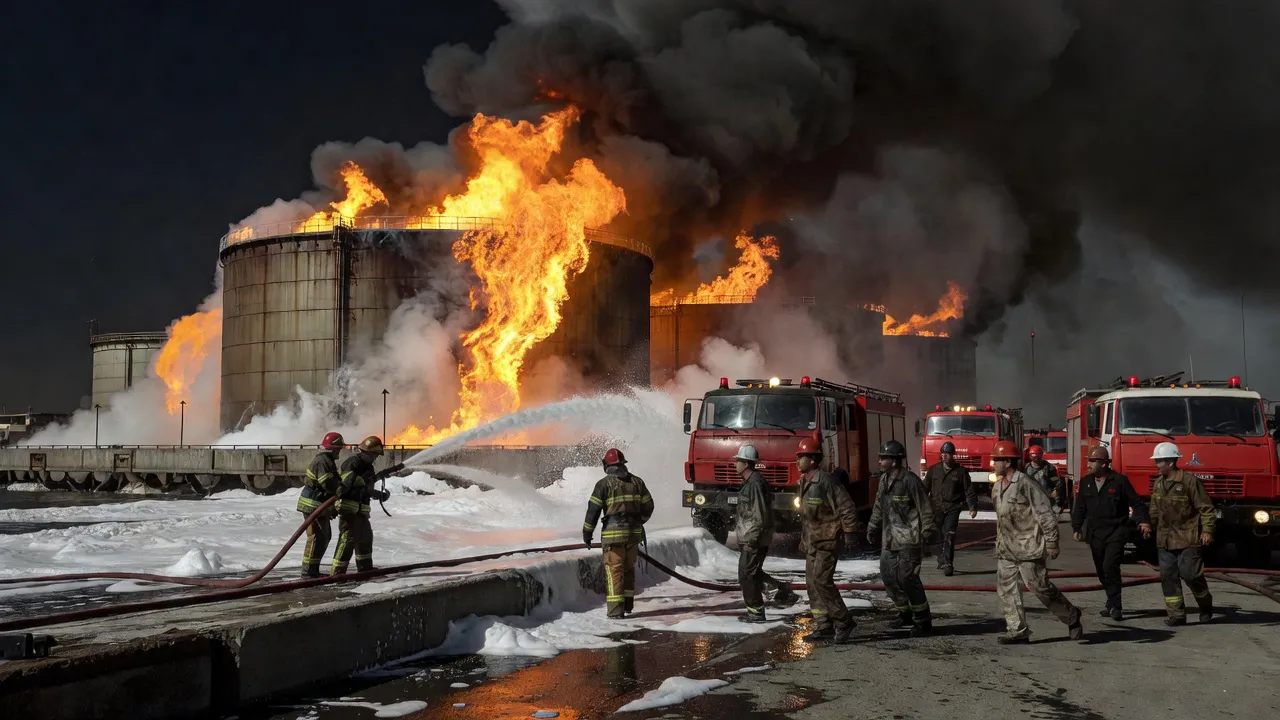
Common ground and differences in coverage across the media analysed.
What the media report in common
1
The Russian Ministry of Defense claims to have shot down 1,015 Ukrainian drones in one night.
2
The oil terminal in Saint Petersburg caught fire, with the Routchi depot according to most accounts; almost all perspectives make it the central target of the attack.
3
Governor Alexandre Beglov reports one death in Saint Petersburg.
Where media coverage diverges
Number of injured in Saint Petersburg
The issue is the human toll announced by the authorities. Five injured according to Governor Beglov in most accounts; fifteen in the dispatch reported in South Africa and according to Meduza, ten according to Vedomosti.
The issue is the number of drones shot down according to Governor Drozdenko. The perspectives give 126 (France, TASS), 127 (Lithuania, Sweden) or 135 (Finland, Vedomosti).
The issue is the source of the reported damage. Ukraine and Romania partly rely on Fire Point and Ukrainian tracking channels; most other perspectives cite the Russian governors and ministry.
Berlin describes a mutual escalation: the German press reports the Russian tolls of the attack on Saint Petersburg and notes that the "energy truce" is not holding, with strikes on the energy facilities of both sides.
Helsinki is gauging the attack on Saint Petersburg in light of its proximity: alerts in the Baltic region, restricted airspace in the Gulf of Finland, and flights rerouted to Helsinki-Vantaa.
Buenos Aires sees the night of drones as a test of Trump's energy truce, with Saint Petersburg on the front line and Washington in the background.
KEY POINTS
The Russian Defense Ministry claims to have shot down 1,015 drones; Governor Beglov reports one death and five injuries in Saint-Petersburg (Ámbito).
Two oil terminals caught fire, including Routchi, with a capacity of nearly 74,000 m³; Ozon and a VK data center were also hit (Clarín, Ámbito).
Kiev records 76 Russian attacks on energy targets since Trump's ceasefire announcement, according to Clarín.
ANALYSIS
Buenos Aires, October 18, 2026. Clarín and Ámbito report on the same night from two different angles: the first focuses on Saint Petersburg, the second on the global figure. Clarín writes that Ukraine "responded" on Sunday "to Donald Trump's latest decisions in favor of Russia" by launching "the largest attack of the war" against the second city of the neighboring country. The newspaper reports that around 150 drones targeted the birthplace of Vladimir Putin and the Leningrad region, aiming at the oil, logistics, and digital infrastructure.
A resident quoted by the EFE agency recounts: "I couldn't sleep all night. The battle between drones and anti-aircraft missiles took place literally above our heads." According to Clarín, the attack almost paralyzed a city of over five million inhabitants for several hours. Two oil terminals caught fire, including Routchi, the largest in the city, with a storage capacity of nearly 74,000 cubic meters, used to supply diesel.
Ámbito headlines an "escalation of the war in Europe": Ukraine allegedly launched over 1,000 drones against Russia. Governor Alexandre Beglov reports one death and five injuries; a logistics center of the retailer Ozon and a data center of VK were hit, which both companies confirmed. The Russian Ministry of Defense claims to have shot down 1,015 drones. The media adds that a Moscow offensive on Zaporizhzhia resulted in one Ukrainian casualty.
Both newspapers put the episode into perspective with Washington. Clarín recalls that Volodymyr Zelensky resumed strikes on Russian refineries on Thursday after Trump announced an energy truce that Russia allegedly ignored, with 76 Russian attacks on energy targets since, according to Kiev. It notes that the White House has just concluded an agreement with the Kremlin on the supply of Russian diesel to the United States and the international market, which has not yet come into effect. Ámbito points out that Zelensky questioned Trump about the suspension of sanctions against Russia, lifted for "national interest," and denounced an attack on Ukraine's energy sector.
Germany
DOMINANT ANGLE
Berlin describes a mutual escalation: the German press reports the Russian tolls of the attack on Saint Petersburg and notes that the "energy truce" is not holding, with strikes on the energy facilities of both sides.
KEY POINTS
The Russian Defense Ministry claims to have shot down 1,015 Ukrainian drones in one night over several regions (DW, Tagesschau).
Governor Beglov reports fires at the oil terminal, the oil depot, and in industrial halls, as well as one fatality; the Ozon logistics center is burning and the VK data center is targeted.
Peskov states that Kiev "cannot change the course of things" and announces systematic and large-scale strikes in response (Tagesschau, according to Tass).
ANALYSIS
Berlin, October 18, 2026. The German press reports on the Ukrainian attack on the Saint Petersburg region based on Russian reports, which it systematically attributes to the authorities. Tagesschau writes that Ukraine struck, "according to Russian reports," oil facilities and a logistics center, and that the Defense Ministry in Moscow claims to have shot down 1,015 Ukrainian drones over several regions during the night.
The governor of the Leningrad region, Alexander Drozdenko, announces 126 drones shot down and a "large-scale UAV attack" still being repelled, according to Deutsche Welle. Debris is said to have fallen on homes, cars, and power lines, causing power outages. The governor of Saint Petersburg, Alexander Beglov, speaks of a fire at the city's oil depot, which was already hit in June, and then, according to Tagesschau, a fire at the port's oil terminal and in several industrial halls.
The human toll differs depending on the headlines: one dead and five injured for DW, one dead and fifteen injured for Tagesschau, which cites Beglov. Both media outlets report the fire at the logistics center of the distributor Ozon and the attack claimed by VK against its data center, whose activity is continuing normally. Pulkovo Airport has suspended its operations, with Tagesschau citing the Tass agency; DW mentions passengers and employees being taken to a safe location. Tagesschau specifies that the exact extent of the damage remains uncertain: "The exact extent of the damage is still unclear."
Finland
DOMINANT ANGLE
Helsinki is gauging the attack on Saint Petersburg in light of its proximity: alerts in the Baltic region, restricted airspace in the Gulf of Finland, and flights rerouted to Helsinki-Vantaa.
KEY POINTS
The governor of Leningrad, Alexandre Drozdenko, announced 135 drones shot down (126 according to MTV), according to Yle and Helsingin Sanomat.
The Defence Forces have restricted the airspace and maritime area of the eastern Gulf of Finland just before three o'clock.
The Saint Petersburg oil terminal has an annual capacity of 12.5 million tonnes, according to MTV citing Kyiv Independent.
ANALYSIS
Helsinki, October 18, 2026. The Finnish press reports, on the night preceding Sunday, October 18, a vast attack by Ukrainian drones on Saint Petersburg. Yle, citing Kyiv Independent, speaks of large fires and explosions; according to the Russian agency Tass, Governor Alexandre Beglov indicates that the attack targeted the oil terminal and civilian infrastructure in four neighborhoods, with no casualties at this stage. Yle adds that it seems to be the largest this autumn.
The sources remain cautious. MTV Uutiset specifies that the information comes from Telegram channels following the war and that the facts have not been confirmed by independent sources; Yle says it was unable to verify the authenticity of the videos. The governor of the Leningrad region, Alexandre Drozdenko, announced 135 drones shot down according to Yle and Helsingin Sanomat, 126 according to MTV, which adds that the debris of an aircraft damaged a house.
MTV, citing Kyiv Independent, presents the oil terminal in the port as one of the largest Russian centers for fuel storage and export, with an annual capacity of 12.5 million tonnes. A data center of the VK network was also reportedly targeted, according to Fontanka; VK claims that users should not be affected, and the damage remains uncertain.
The civilian effects are being reported: power outages affecting, according to Helsingin Sanomat, tens of thousands of people, difficulties with telecommunications and transportation, and restricted traffic at Pulkovo Airport. Yle notes that residents of Saint Petersburg risk fines if they publish images or videos of the explosions.
France
DOMINANT ANGLE
Paris first notes the oil target: the fire at the Saint-Petersburg terminal is seen as a new blow to Russian hydrocarbons, at a time when Donald Trump is pressing Kiev to give them up.
KEY POINTS
Governor Alexandre Beglov reported fires "on the territory of the Saint Petersburg oil terminal" and restricted activity at Pulkovo Airport.
In the Leningrad region, Russian defense shot down 126 drones during the night, according to Governor Alexandre Drozdenko.
Volodymyr Zelensky accuses Russia of striking Ukrainian energy facilities 76 times since the "energy truce" announced by Donald Trump.
ANALYSIS
Paris, October 18, 2026. French media reported on Sunday, October 18, a Ukrainian drone attack on Saint Petersburg, Russia's second city, which caused a fire "on the territory of the Saint Petersburg Oil Terminal", according to the words of Governor Alexandre Beglov cited by BFMTV and Sud Ouest. The same official also mentioned fires on "civilian infrastructure" in three neighborhoods of the city.
The human toll is presented in contrasting ways. BFMTV and Sud Ouest initially relayed Mr. Beglov's version, which claimed there were no recorded casualties. France 24 wrote, in its English version, that the attack killed at least one person and hospitalized five, and that fires hit a refinery and an oil depot. Moscow's figures are attributed to their authors, without independent verification.
In the Leningrad region, Governor Alexandre Drozdenko indicated on Telegram that Russian air defense had shot down 126 drones during the night. Pulkovo Airport saw its activity "restricted" for security reasons. The social network VK reported an attack on a data center in the region, while ensuring that its services were functioning normally. BFMTV recalled that Kiev has been targeting several data centers since early October, including those of the giant Yandex.
The coverage emphasizes the energy and commercial dimension. BFMTV highlighted that Saint Petersburg and its region host infrastructure "essential for the hydrocarbon trade", a sector that Ukraine has been targeting for months in retaliation for Russian bombings. The same terminal had already been attacked in June, on the day of the opening of a major economic forum.
Hungary
DOMINANT ANGLE
Budapest is gauging the military scope of the night: 1,015 drones announced by Moscow, an oil terminal on fire and data centers targeted, compared to the record 1,951 drones in September.
KEY POINTS
The Russian Defense Ministry claims to have intercepted 1,015 Ukrainian drones between 8pm and 8am over 16 regions and the Black Sea (HVG, 444, Telex).
According to Governor Beglov, one civilian died and five people were injured in Saint Petersburg, with fires at the oil terminal and the Routchi depot; 12 residential buildings were damaged (444).
Approximately 20,000 people lost power after damage to two transformer stations in Ianino, and traffic at Pulkovo Airport was limited (HVG, Telex).
ANALYSIS
Budapest, October 18, 2026. Hungarian media are treating the attack as an event that is primarily military in nature, relying mainly on reports published by Russian authorities. HVG and Telex start with the same observation: a massive drone attack hit the oil terminal in Saint Petersburg and the civilian infrastructure of four districts, with several fires, according to Governor Alexandre Beglov, on Sunday. One civilian was killed and five people were injured in the city; in the Leningrad region, ten people were injured, including two women and five children who were hospitalized.
The central figure comes from the Russian Ministry of Defense: between 8 pm and 8 am, air defense allegedly intercepted 1,015 Ukrainian drones over 16 regions and the Black Sea. HVG and Telex recall that the TASS agency is talking about one of the strongest attacks of the year against Russia, the most massive being that of September 20, the day of the Russian legislative elections, with 1,951 drones and nine missiles. The two articles also quote Moscow Mayor Sergei Sobyanin: 512 drones destroyed in 24 hours heading for the capital, 2,730 in a week.
444 focuses on the targets. Beglov reports fires at the oil terminal, the Ruchyi depot, and industrial warehouses in the Kolpino district; 12 residential buildings and two houses were damaged. The port site is described as one of the largest Russian centers for fuel storage and export, with, according to reports, 12.5 million tons of annual capacity. The media outlet also mentions the VKontakte network's data center, a possible new blow to the Russian internet after recent strikes against Yandex data centers, and recalls Volodymyr Zelensky's promise to respond "in a similar way" to Russian attacks on Ukrainian data centers.
Lithuania
DOMINANT ANGLE
Vilnius is gauging the attack by its effects on the Russian oil apparatus: a terminal on fire in Saint Petersburg, at the same time as Kiev announces it will resume its strikes against refineries.
KEY POINTS
Governor Alexandre Beglov reports fires at the Saint Petersburg oil terminal and the Routchi depot, one death, five injuries, and twelve residential buildings damaged.
The governor of the Leningrad region, Alexandre Drozdenko, announces 127 drones shot down; Pulkovo Airport has restricted its activity.
Marco Rubio presents the suspension of sanctions and tariffs against Russia as a 60-day pause to "analyze" their effect on the global economy.
ANALYSIS
Vilnius, October 18, 2026. Lithuanian media report the attack of Ukrainian drones carried out overnight on the Saint Petersburg region, largely relying on statements from Russian authorities. Verslo žinios quotes Governor Alexander Beglov: fires broke out at the city's oil terminal, the Routchi oil depot, and industrial warehouses in the Kolpino district, in the south. "One person died and five others were injured and hospitalized," he said, adding that twelve buildings and two single-family homes were damaged.
The governor of the Leningrad region, Alexander Drozdenko, reports 127 drones shot down; debris damaged four cars in a parking lot and fires were reported in several locations. According to Russian state media, a VKontakte data center was also targeted. The economic daily recalls that Ukrainian forces have attacked several Yandex data centers in recent weeks. Pulkovo Airport restricted its activity as a security measure, and the TASS agency reports flight disruptions. The Kyiv Independent, cited by the newspaper, says it cannot independently confirm all the targets or the extent of the damage.
The link to energy structures the narrative. The two articles place the strike after Volodymyr Zelensky's announcement to the Financial Times: Kiev will resume its attacks on Russian refineries, emphasizing that it is defending a country exhausted by war as American aid decreases. The 15min feed, titled "Rusija skelbia netoli Sankt Peterburgo numušusi dešimtis Ukrainos dronų", counts drones in dozens and notes the damage to the oil terminal and disrupted flights at one of the country's busiest airports.
Romania
DOMINANT ANGLE
Bucharest is gauging the strike in light of the Saint Petersburg oil terminal, a key Russian export hub on the Baltic, and the tension it rekindles between Kiev and Washington.
KEY POINTS
The Russian Defense Ministry claims to have destroyed 1,015 Ukrainian drones over 15 regions (G4Media, according to the AP).
The Saint Petersburg oil terminal has more than 30 tanks, 441,000 m3 of capacity, and around 12.5 million tons per year (Mediafax).
Governor Alexandre Beglov reports one death, five injuries, and about a dozen damaged residential buildings (G4Media).
ANALYSIS
Bucharest, October 18, 2026. The Romanian press is treating the attack as a blow to Russia's oil export apparatus. G4Media, Mediafax, and Digi24 report that, in the night from Saturday to Sunday, Ukrainian drones struck the tank farm of the oil terminal in the port of Saint Petersburg, triggering a violent fire. Mediafax recalls that the complex spans around 37 hectares, has over 30 tanks with a capacity of 441,000 cubic meters, and processes some 12.5 million tons of petroleum products per year, a key point for Russian exports via the Baltic.
The official toll is based on reports from the Agerpres agency and the Associated Press agency. Governor Alexandre Beglov mentions one death and five injured, fires at the terminal and the Routchi depot, and around a dozen residential buildings damaged. According to the Russian Ministry of Defense, 1,015 drones were destroyed over 15 regions; G4Media notes that Kiev launched over 1,000 devices, "one of the most extensive air bombardments" carried out by Ukraine. The number of drones shot down in the Leningrad region varies according to the articles: 57, 127, and then 145 according to Governor Alexandre Drozdenko.
The articles also detail non-petroleum targets: the data center supporting VKontakte, the 330 kV Vostochnaya substation, a cable-stayed bridge, and an Ozon logistics center. G4Media notes that VKontakte traffic fell to 56% of its usual level and that neighborhoods in the city and its region lost power. Digi24, citing the Kyiv Independent, locates the city, with a population of 5.6 million, 856 kilometers from the Ukrainian border.
Russia
DOMINANT ANGLE
Moscow is counting the downed drones and the damage: 1,015 devices reported destroyed, but a human toll and regional figures that vary from one source to another.
KEY POINTS
The Defense Ministry claims to have destroyed 1,015 Ukrainian drones between 8pm on October 17 and 8am on October 18, over 14 regions and the Black Sea (RIA Novosti).
Governor Beglov reports fires at the oil terminal and the Routchi depot, one dead and five injured; a dozen residential buildings are damaged (Moscow Times, Meduza).
The figures differ: 126 drones shot down in the Leningrad region according to TASS, 135 and ten injured according to Vedomosti, fifteen injured according to Meduza.
ANALYSIS
Moscow, October 18, 2026. In the night from Saturday to Sunday, Ukraine launched drones on Saint Petersburg and the Leningrad region. According to the Russian Ministry of Defense, cited by RIA Novosti, air defense destroyed 1,015 drones between 8 pm on October 17 and 8 am on October 18, over the regions of Belgorod, Bryansk, Leningrad, Moscow, Crimea, and the Black Sea.
State agencies are reporting based on official statements. Interfax cites Governor Alexander Beglov: rescue teams are putting out fires in the Nevski, Krasnosselski, Krasnogvardeiski, and Moskovski districts, as well as at the "Saint Petersburg Oil Terminal", and the activity of Pulkovo Airport is limited. The initial message indicated "no casualties"; TASS is still reporting this. Later, Beglov announced one death and five injured (Moscow Times), damaged residential buildings, and fires at the Ruchyi depot and in warehouses in the Kolpino district (Interfax). In the Leningrad region, Governor Alexander Drozdenko spoke of 126 downed drones (TASS); Vedomosti later cited 135 drones, one death, and ten injured.
The affected companies are being cited at length. Ozon: "We quickly evacuated all employees, no one was injured", a fire broke out; the items from the affected center are being removed from the showcase and undeliverable orders will be canceled (Vedomosti, RIA). VK confirms the attack on its data center in Leningrad, specifying that its services are functioning normally. Meduza notes user complaints, without establishing a link to the strike, and recalls that Yandex's data centers were targeted three times the previous week and Sber's this week.
Sweden
DOMINANT ANGLE
Stockholm is measuring the attack from the angle of Baltic security: over a thousand drones, a burning oil terminal, and restricted Finnish airspace very close to Sweden.
KEY POINTS
Russian authorities claim that Ukraine launched over a thousand drones during the night from Saturday to Sunday (SvD).
The governor of the Leningrad region reports 127 drones shot down; one death in Saint Petersburg according to Alexandre Beglov (DN, SvD).
Finland has decreed a halt to traffic in the eastern part of the Gulf of Finland for security reasons (SvD).
ANALYSIS
Stockholm, October 18, 2026. The Swedish press reports on the Ukrainian attack of the night from Saturday to Sunday as a regional-scale military event. Dagens Nyheter describes a drone attack on the oil terminal and a data center in Saint Petersburg, launched at around 2:30 am local time, more than 850 kilometers from Ukraine. The newspaper notes that images on social media show the drones flying over the city and the Russian air defense opening fire. The governor of the Leningrad region reports 127 drones shot down, according to DN, and debris falling on parked cars.
Svenska Dagbladet emphasizes the experience of the inhabitants: woken up by a muffled noise, some took shelter in their bathtub, the newspaper reports according to the Fontanka website. Drones or their debris hit several buildings, fires broke out in parking lots, and thousands of households lost power. One person was killed, according to Governor Alexandre Beglov, who also confirms the fires at the terminal and a petroleum depot elsewhere in the region. SvD specifies that this terminal is one of the largest in the Baltic Sea.
The two newspapers repeat the figure put forward by the Russian authorities: over a thousand drones during the night. SvD adds, with the reservation of a conditional ("Om det stämmer"), that this would be one of the largest Ukrainian attacks to date, and that over 500 devices targeted Moscow according to Mayor Sergei Sobyanin. A VKontakte data center and an Ozon distributor warehouse are among the affected targets. Pulkovo Airport saw flights canceled or postponed.
Ukraine
DOMINANT ANGLE
Kiev details the night of October 18 as a strike on Russia's oil and digital capabilities, based on Fire Point's claims.
KEY POINTS
The Saint-Petersburg oil terminal has a capacity of 12.5 million tonnes per year, according to Ukrinform and NV Ukraine.
Fire Point claims its FP-1 drones hit the terminal, the Routchi depot, and a VKontakte data centre.
The VKontakte data centre had over 20,000 servers and 640 bays according to previous data cited by Ukrinform.
ANALYSIS
Kiev, October 18, 2026. The Ukrainian press is reporting on the night of October 18 through its economic and digital targets in Saint Petersburg and the Leningrad region. Ukrinform, citing the Russian service of the BBC, reports that Governor Alexander Beglov has announced a fire at the city's oil terminal and at other infrastructure in four districts.
The drone manufacturer Fire Point claims on Telegram that the Defense Forces hit the terminal with FP-1 drones. Ukrinform specifies that this is one of the largest facilities in the region, with a capacity of 12.5 million tons per year, "including for export". Fire Point writes that "fires broke out at the oil terminal and at the Routchi depot".
Ukrinform also relies on the Telegram channel Astra, which mentions the "Strumki" depot, with a capacity of 3,900 cubic meters, where AI-92, AI-95, and diesel fuel are stored. According to Astra, the residents of Saint Petersburg did not receive a drone alert, or received it very late.
The digital aspect occupies an equal place. A VKontakte data center in Novosergievka, in the Vsevolozhsk district, was targeted; according to previous data cited by Ukrinform, it had more than 20,000 servers and 640 bays. Fire Point reports serious damage and users are reporting disruptions, while VK claims that its services remain accessible. Astra adds that a substation was hit and a drone struck a cable-stayed bridge over the Korabelny channel.
United Kingdom
DOMINANT ANGLE
London sees the attack as a test for Trump's energy truce: the British press places Washington, between Kiev and Moscow, at the centre of the episode.
KEY POINTS
The Russian Defense Ministry claims to have shot down 1,015 Ukrainian drones over 15 regions.
In St. Petersburg, one dead and five injured, 12 buildings damaged, Pulkovo temporarily closed (Governor Beglov, BBC).
Zelensky claims Russia has targeted Ukraine's energy sector 76 times since Trump's announcement (BBC).
ANALYSIS
London, Sunday, 18 October 2026. The UK government reports an attack of rare scale: the Russian Ministry of Defense claims to have shot down 1,015 Ukrainian drones over 15 regions, annexed Crimea, and the Black Sea. In St. Petersburg, Governor Alexander Beglov reports one death and at least five injured, with fires at the city's oil terminal and the Routchi depot.
The UK details the civilian and logistical damage. Twelve residential buildings and two houses were damaged, Pulkovo Airport was temporarily closed, and a disruption to mobile internet was possible. A logistics center of Ozon, described by the UK as the "Russian Amazon", and a VK data center were targeted; VK assures that its services remain available "as usual".
The diplomatic context frames the narrative. Donald Trump had announced an "energy ceasefire" on 11 October, according to The Independent. According to the UK, Kiev suspended its strikes on Russian oil facilities for three days, while accusing Moscow of continuing, then resumed them this week, incurring Trump's anger, who demanded a truce to facilitate a diesel delivery agreement concluded with Vladimir Putin.
Volodymyr Zelensky stated on Saturday that Russia had targeted Ukraine's energy sector 76 times since the announcement. The UK reports growing tensions between Ukraine and Moscow and notes that a woman died and at least two people, including a 6-year-old girl, were injured in two Russian attacks on Zaporizhzhia.
United States
DOMINANT ANGLE
The United States is gauging the drone attack in light of Donald Trump's "energy truce": the American press sees it as a test for his diplomacy and for his relations with Kiev.
KEY POINTS
The Russian Defense Ministry says it has destroyed 1,015 Ukrainian drones over 15 regions; in St. Petersburg, one dead and five injured according to Governor Beglov.
Trump had announced on October 11 a "energy ceasefire" with no details; Zelensky accuses Moscow of at least 76 attacks on Ukrainian energy in one week (The Hill).
In the Leningrad region, two substations were hit and around 20,000 residents are without electricity, according to Governor Drozdenko.
ANALYSIS
The United States, October 18, 2026. The American media is covering one of the largest Ukrainian drone attacks of the war, which occurred on the night of Saturday to Sunday, October 18, and is immediately placing it in the context of Donald Trump's policy.
On the facts, the American media is repeating the Russian balance sheet. The Ministry of Defense claims to have destroyed 1,015 drones over 15 regions, the annexed Crimea, and the Black Sea. In St. Petersburg, Governor Alexandre Beglov reported one death and five injuries, with fires at the city's oil terminal and the Routchi depot. A logistics center of Ozon and a data center of VK were also targeted, which the two companies confirmed. In the Leningrad region, Governor Alexandre Drozdenko indicated that two electrical substations were hit, leaving approximately 20,000 inhabitants without power. The Hill cites Russian state television, which speaks of "one of the largest drone attacks of the year".
The heart of the story is political. Trump had announced on October 11, after a call with Vladimir Putin, an "energy ceasefire", without giving details. The Hill recalls that Russia struck a power plant in Kharkiv on the same day, and that Volodymyr Zelensky ordered the resumption of attacks against Russian refineries on Thursday. Zelensky, questioned on Sunday on NBC's "Meet the Press", accuses Moscow of at least 76 attacks on Ukrainian energy facilities in one week.
South Africa
DOMINANT ANGLE
Pretoria is relaying without comment the Reuters dispatch: a vast attack by Ukrainian drones on the oil, logistics, and digital facilities of Saint Petersburg, along with the Russian tolls.
KEY POINTS
The Russian Ministry of Defense claims to have shot down 1,015 Ukrainian drones over Russian regions during the night.
Governor Alexander Beglov reported fires at the oil terminal, an oil depot, and industrial warehouses in Saint Petersburg; one person was reportedly killed and 15 injured.
Dmitry Peskov, quoted by TASS: "The Kiev regime is resisting. But this cannot change the course of events."
ANALYSIS
Pretoria, October 18, 2026. The South African press reprinted on Sunday, October 18, a Reuters dispatch published identically by TimesLIVE and Business Day under the title "Ukraine unleashes drone attacks on St Petersburg and Leningrad region". It describes a large-scale drone attack targeting oil installations, logistics, and data centers in St. Petersburg and the Leningrad region, according to local authorities.
The governor of St. Petersburg, Alexandre Beglov, reported fires at the city's oil terminal, a fuel depot, and industrial warehouses. One person was reportedly killed and 15 injured, according to the text, which uses the conditional tense for this human toll.
The economic and technological aspect occupies a significant place. Russian online retailer Ozon indicated that its logistics center in St. Petersburg was on fire. Internet company VK stated that its data center in the Leningrad region had been targeted by drones, while specifying that services remained available to users as usual. Ukrainian drone manufacturer Fire Point, on the other hand, stated on Sunday that the Ukrainian army had struck a VK data center near St. Petersburg: it is the only Ukrainian source cited.
On the Russian side, the Ministry of Defense claims that air defense units shot down 1,015 Ukrainian drones over Russian regions during the night. The figure is presented as a statement from Moscow, without independent verification in the text.
Explore every perspective on this subject across 13 countries.
Russia: more than 1,000 Ukrainian drones set the St Petersburg oil terminal ablaze
published on
October 18, 2026
13
countries
35
sources
38
articles
69/100
gap
The accounts of the night of October 17-18 do not rely on the same sources: statements from Russian governors, messages from a Ukrainian manufacturer, and Telegram channels, and this summary follows these threads, then the American reading of the ceasefire and its effects on the Baltic neighborhood.
The balances remain those of the Russian authorities, with discrepancies between sources on the Leningrad region; Kiev has not commented and the energy truce is not detailed.
A tally that changes in the morning
The first message from Governor Alexandre Beglov stated "no casualties." BFMTV and Sud Ouest relayed this version, and TASS still reports it. Later, Beglov announced one death and five injured, according to the Moscow Times.
« We quickly evacuated all employees, no one was injured. »
Statement from Ozon, quoted by Vedomosti and RIA Novosti, October 18, 2026
Meduza has the longest list: the oil terminal at the port, the Routchi depot, the "Vostochnaïa" substation, the cable-stayed bridge of the Western Rapid Diameter, and the Vassilievski hospital. The media outlet reports one death and 15 injured in the city and region, and Pulkovo Airport was closed for eight hours. Interfax announces the partial reopening of the road axis.
The figures for the Leningrad region, attributed to Governor Alexandre Drozdenko, vary depending on the source. The Hungarian press reports 144 drones shot down (HVG, Telex) or 127 (444); the Romanian press cites 57, 127, then 145. Vedomosti reports 135 drones, one death, and ten injured.
The affected companies are also speaking out. Ozon says it evacuated its staff and announced that undeliverable orders will be cancelled. VK confirms the attack on its data center and states that its services are functioning normally.
Which documents the damage
Nine of the thirteen perspectives restate the count of 1,015 drones, either as is or as "over a thousand". This figure measures the circulation of the Russian Defense Ministry's statement in the corpus, not its accuracy: it is not corroborated by an independent source in the texts.
The Ukrainian press relies on other sources. Ukrinform cites the Telegram channel Astra, which mentions the "Strumki" depot, with a capacity of 3,900 cubic meters, where AI-92, AI-95, and diesel fuel are stored. According to Astra, residents would not have received an alert, or only very late. Ukrinform also reports, based on previous data, that the VKontakte data center had over 20,000 servers and 640 bays. These texts do not restate the Russian figure of 1,015 or the "energy truce".
Several media outlets point out their own limitations. MTV Uutiset specifies that its information comes from Telegram channels and is not independently confirmed; Yle says it was unable to verify the videos. The Kyiv Independent, cited by Verslo žinios, cannot confirm either all the targets or the extent of the damage.
Digi24 relays the tracking channels Exilenova+ and Supernova+. G4Media writes that VKontakte traffic has fallen to 56% of its usual level. Meduza notes user complaints, but writes that the link to the attack is not established.
The ceasefire as seen from Washington
The Hill and CBS recall that Donald Trump announced on October 11, after a call with Vladimir Putin, an "energy ceasefire". According to The Hill, Russia struck a power plant in Kharkiv on the same day, and Volodymyr Zelensky ordered on Thursday the resumption of attacks on Russian refineries.
The BBC writes that Kiev had suspended its strikes on Russian oil for three days, and that Trump was calling for a ceasefire to facilitate a diesel delivery agreement concluded with Vladimir Putin. Clarín specifies that this agreement has not yet come into effect. France 24 writes that neither side had said they would agree to the ceasefire.
Zelensky, interviewed on NBC on "Meet the Press", accuses Moscow of attacks on Ukrainian energy. Ámbito notes that he also questioned Trump about the suspension of sanctions against Russia. CBS quotes Trump saying he is negotiating peace, while criticizing Zelensky and the strikes on Russian oil.
Clarín presents the attack as a response from Ukraine to Trump's "latest decisions in favor of Russia". On the Moscow side, Tagesschau and a Reuters dispatch reported in South Africa, according to TASS, that Dmitri Peskov announces "systematic" and large-scale strikes in response.
Baltic neighbourhood and inhabitants
Finnish media report that late at night, their neighborhood was affected. According to Helsingin Sanomat, the Defense Forces restricted the airspace and maritime area of the eastern Gulf of Finland just before three o'clock. Citing Reuters, the newspaper adds that an air alert sounded in Lithuania, Kaunas airport closed, and NATO fighters were alerted. Latvia also issued an alert, which has since been lifted.
« I didn't sleep all night. The battle between drones and anti-aircraft missiles took place literally above our heads. »
A resident of Saint Petersburg, quoted by the EFE agency and reported by Clarín, October 18, 2026
Yle notes that a Nesma Airlines plane from Hurghada landed again at Helsinki-Vantaa, after a Red Sea Airlines flight on Saturday. The newspaper also reports that residents of Saint Petersburg risk fines if they publish images of the explosions.
Accounts from residents come mainly from non-Russian media. Svenska Dagbladet, according to the Fontanka website, reports that some people took shelter in their bathtubs. Clarín quotes a resident interviewed by the EFE agency and mentions around 150 drones over the city and region.
A detail is added from the Ukrainian side. CBS and The Independent report that two Russian attacks on Zaporijjia killed a woman and injured at least two people, including a six-year-old girl.
The oil terminal
More than 30 tanks and 441,000 m³ of capacity, according to Mediafax.
Fire Point
The manufacturer claims its FP-1 drones struck the terminal, Routchi, and VK's data center.
Leningrad Region
Drones downed: 126 (TASS), 127 to 135 according to other media; two substations hit, according to Drozdenko.
US sanctions
Marco Rubio describes the suspension of sanctions and customs duties against Russia as a 60-day pause.
Key figures
1,015
Ukrainian drones shot down according to the Russian Ministry of Defense, over 15 regions
On the Russian side, Kremlin spokesman Dmitry Peskov promises "systematic and large-scale" strikes in response and says, quoted by Tass: "The Kiev regime is resisting. But that cannot change the course of events." Both articles put the event in the context of the exchange of strikes: DW reports new Russian attacks, mainly by drones, against several Ukrainian regions, and Tagesschau reports that Kiev is reporting massive shelling of its energy facilities and deaths, under the subtitle "Energy ceasefire does not hold."
The coverage remains subdued and focused on the military escalation: the scope of the attack, energy targets, and announced retaliation. It gives little space to Western reactions or a quantified economic reading of the oil losses.
The specifically Finnish angle is the neighborhood. According to Helsingin Sanomat, citing Reuters, an air alert sounded in Lithuania, Kaunas Airport was closed, and NATO fighters were alerted; Latvia also gave the alert, which has since been lifted. In Finland, the Defense Forces restricted the airspace and maritime area of the eastern Gulf of Finland just before three hours, a measure still in effect and repeated this year as a precaution against a stray drone. Yle finally notes that a Nesma Airlines plane, coming from Hurghada to Saint Petersburg, landed again at Helsinki-Vantaa, a diversion airport, before departing; a Red Sea Airlines flight had done the same on Saturday.
The diplomatic aspect serves as a backdrop. According to Sud Ouest, Donald Trump has urged Kiev to stop its strikes against Russian refineries, which he claims contribute to the rise in oil and fuel prices. He had unilaterally announced an energy truce between Moscow and Kiev a week earlier. France 24 specified that neither party had agreed to it, that the truce quickly collapsed, and that Volodymyr Zelensky accused Russia of having struck 76 times at Ukrainian energy facilities since the announcement.
France 24 articles finally mention links with Washington "tense in recent days" and the weakening American support for Ukraine, which places the attack in a debate on the sustainability of the Western alliance as much as on the war itself.
The fallout for the population is reported without emphasis: Pulkovo Airport saw its traffic limited, two transformer stations were damaged in Ianino, leaving around 20,000 people without electricity, and the Ozon logistics warehouse was among the targets. The figures differ from one article to another: Drozdenko reports 144 drones shot down according to HVG and Telex, 127 according to 444. HVG adds that the Russian Investigative Committee has opened a criminal case for "terrorist act". The articles do not develop the American diplomatic context.
The same feed mixes this report with the issue of sanctions. Marco Rubio explains that Donald Trump has decided to suspend for 60 days the large-scale sanctions and customs duties targeting Russia, in order to "analyze" their effect on the global economy, citing the American war against Iran and Houthi attacks against Saudi Arabia, which weigh on oil and diesel prices. Lithuanian coverage thus links the strikes on Russian oil infrastructure to Washington's arbitration on the economic pressure exerted on Moscow.
The "energy truce" and the Kremlin's reaction do not occupy these two articles; Kiev has not claimed the operation in these texts.
The diplomatic context is relayed by G4Media based on the AP: the attack comes amid tensions between Ukraine and Washington, with Donald Trump criticizing Kiev for its strikes against Russian oil infrastructure. Kremlin spokesman Dmitri Peskov tells TASS that Ukraine cannot "change the current course of events". Romanian media also mention the Russian strike on Zaporizhia, which killed one person and injured at least two, including a six-year-old girl.
Several pieces of information come from Ukrainian monitoring channels, such as Exilenova+ and Supernova+, or the Ukrainian press, and are presented conditionally when they are not confirmed. Saint Petersburg is described several times as the birthplace of Vladimir Putin.
Meduza provides the most comprehensive report: the oil terminal of the port, the Ruchyi depot, the "Vostochnaya" substation, the Western High-Speed Diameter cable-stayed bridge, the Vasilievsky hospital, one death and 15 injured in the city and region, Pulkovo closed for eight hours. Interfax announces the partial reopening of the highway. Vedomosti, citing Finnish television Yle, notes that a Hurghada-Saint Petersburg flight landed in Helsinki due to the airport closure.
The regional dimension is evident in an SvD detail: like the previous nights, Finland has decreed a traffic ban in the eastern part of the Gulf of Finland for security reasons. DN recalls that Ukraine had already struck Saint Petersburg in July, including the same terminal, and that it has resumed its attacks on Russian energy facilities after a few days' pause granted to Donald Trump. SvD notes that the American president proclaimed a "energy truce" of his own initiative a week ago, without real effect on the ground.
The articles contain neither a reaction from Kiev nor a Swedish analysis of the strategic scope of the operation: the account remains factual, focused on the targets, the damage, and the diffuse threat that these drone flights pose to the Baltic airspace.
Ukrinform also notes the fire at a warehouse of the distributor Ozon, with no casualties. NV Ukraine summarizes the night in Russian: the drones targeted the Leningrad region and Moscow, with a fire at the Saint Petersburg oil terminal.
The three texts do not mention the figure of 1,015 drones shot down announced by the Russian Ministry of Defense, nor the "energy truce" mentioned by Donald Trump. The account remains focused on what burned and what it costs the Russian export capacities and digital services.
The UK recalls that Kiev presents these strikes as a means of limiting the main source of revenue for Moscow's war effort, that St. Petersburg has already been hit, its oil terminal having been targeted in July, and that regions close to Ukraine are more often threatened. Kiev had not commented at the time of publication.
CBS notes that Trump says he is "negotiating peace" despite the exchange of strikes, and that he is critical of Zelensky as well as the strikes on Russian oil, the press associating him with the rise in fuel prices. ABC and CBS describe growing tensions between Kiev and Washington, and CBS mentions uncertainty about new American sanctions against Moscow.
Kremlin spokesman Dmitri Peskov, cited via the Tass agency, says that Kiev "is resisting" but cannot "change the current course of events". On the Ukrainian side, CBS reports that two Russian attacks on Zaporizhzhia killed a woman and injured at least two people, including a six-year-old girl.
The dispatch finally cites the TASS agency, which reports the words of Kremlin spokesman Dmitri Peskov: Russia is responding permanently to Ukrainian attacks with "systematic" and large-scale strikes. Asked about the possible response after the attack on St. Petersburg, he stated: "The Kiev regime is resisting. But this cannot change the course of events."
The account remains factual and focused on the targets, fires, and official statements from both sides. It contains no editorial or commentary specific to South Africa: the treatment is that of a news agency wire relayed as is by two economic and generalist titles in the country.