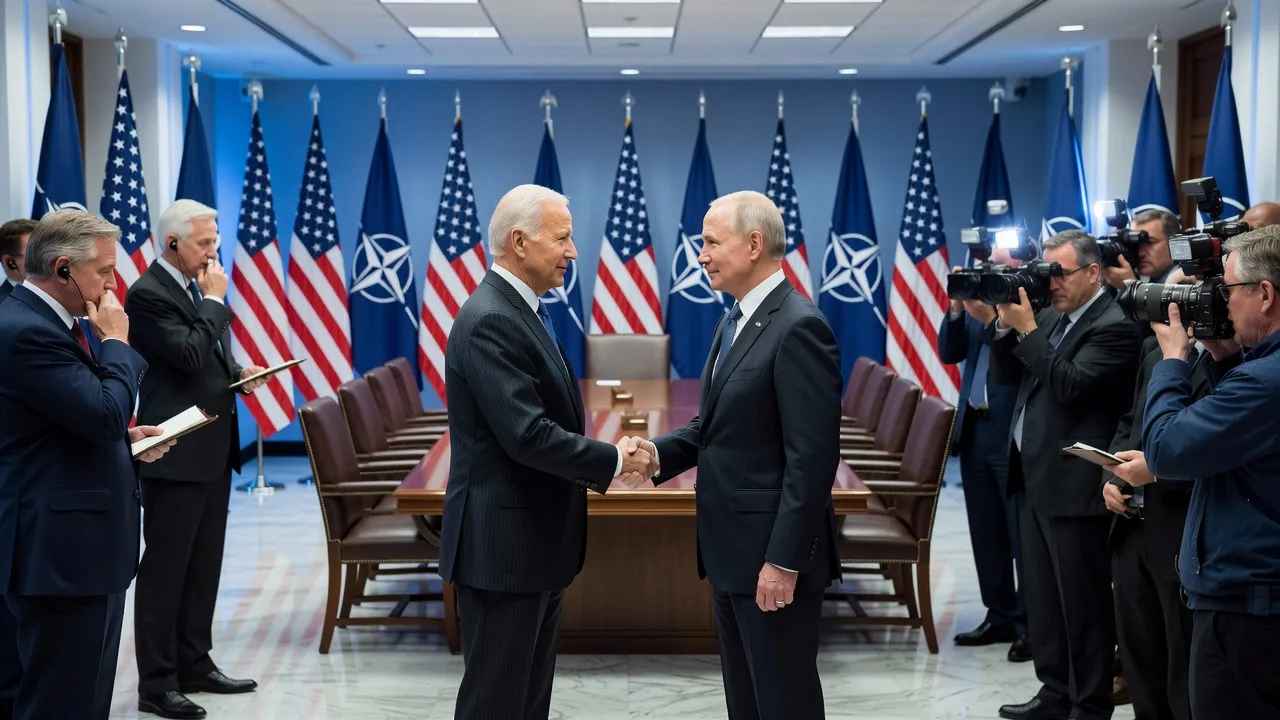
Rutte meets Trump ahead of July's NATO summit
published on
countries
sources
articles
Measured with the previous method (distance between texts), on a different scale.
In June 2026, NATO Secretary General Mark Rutte travelled to the White House to meet Donald Trump and prepare the Alliance summit scheduled for 7 and 8 July in Ankara. The meeting aimed to ease unusual transatlantic tensions, fuelled by disagreements over defence spending, the U.S. military presence in Europe and the war in Ukraine.
In the run-up to the summit, Trump publicly voiced frustration with European allies, faulting them for insufficient support during the war against Iran and for defence budgets seen as too low. In parallel, the Pentagon, led by Pete Hegseth, launched a six-month review of the U.S. military presence in Europe that could lead to reductions.
These exchanges come at a moment of structural strain for the Alliance. The U.S. administration's transactional approach — making security guarantees conditional on higher spending and on operational solidarity in theatres such as Iran — calls into question the principle of collective defence that has underpinned NATO since 1949. European capitals are accelerating their thinking on strategic autonomy while remaining dependent in intelligence, strategic transport and precision strike.
Several readings clash. Some actors frame the U.S. pressure as a legitimate sharing of the burden, others as a threat to the Alliance's credibility. The war in Ukraine remains in the background: Kyiv awaits firm commitments, while Moscow disputes NATO's claim to be a defensive actor and threatens countermeasures over its development in the Baltic. Turkey, the host country, intends for its part to reopen the F-35 aircraft file.
What the comparison reveals
Common ground and differences in coverage across the media analysed.
What the media report in common
Mark Rutte visited the White House to meet with Donald Trump in June 2026 to prepare for the NATO summit scheduled for July 7-8 in Ankara.
The Pentagon, under Pete Hegseth's leadership, launched a six-month review of U.S. military presence in Europe, potentially leading to reductions.
Trump publicly expressed frustration with European allies, criticizing their insufficient support during the conflict with Iran and defense spending deemed too low.
Where media coverage diverges
Nature of the NATO crisis
European perspectives interpret the Rutte-Trump meeting as crisis management on spending and military presence, while Moscow frames the same exchanges as confirmation of a planned offensive orientation by the Alliance.
Stakes of the summit for Turkey
Ankara views the summit primarily as a bilateral opportunity to rejoin the F-35 program and obtain engines for the Kaan, an angle largely absent from European and Ukrainian perspectives focused on collective defense.
Role of the United States as security guarantor
Washington and Ottawa present Trump's transactional logic as legitimate burden-sharing pressure, while German, French, and Polish perspectives analyze it as a structural threat to the Alliance's credibility.
Coverage aligned with this reading
This grouping describes the publications analysed, not the position of these countries’ populations or of their governments.
Blind spots
What the coverage of each country leaves aside, while others put it forward.
 Russia
- Erosion of public confidence in the United States among NATO member states
- Budget review of European defense spending and 2% of GDP targets
- Turkish F-35 dossier and intra-NATO dynamics
 Turkey
- Ukrainian calls for strong decisions at the Ankara summit
- European capability gaps in the event of U.S. withdrawal
- Tensions between Trump and allies over insufficient support during the conflict with Iran
 United States
- Russian warnings about countermeasures in case of NATO expansion in the Baltics
- Estimated cost of European escalation of strategic capabilities
- Turkey's pivot role in pre-summit negotiations
How each country reads it
Preview: 3 of 8 media perspectives. Syntheses of the media analysed — not direct quotations. Method & limitations
- United States
Washington calibrates NATO's value proposition with careful conditionality — Rutte seeks guarantees; Trump counters with demands for Europe's financial commitment before the July summit.
4 sources · View sources
 France
Paris watches Rutte's White House visit with concern: behind the damage-control diplomacy, what is at stake is the future of the US military presence in Europe, two weeks before a NATO summit under extreme tension.
4 sources · View sources
 Germany
Berlin gauges the widening transatlantic gap as the NATO summit in Ankara draws near: faced with American disengagement threats, mounting pressure on European defense spending, and Defense Minister Pistorius's warnings of capability shortfalls, the Atlantic Alliance enters the gathering in unprecedented fragility.
3 sources · View sources
The full text, country by country
United States
DOMINANT ANGLE
Washington calibrates NATO's value proposition with careful conditionality — Rutte seeks guarantees; Trump counters with demands for Europe's financial commitment before the July summit.
ANALYSIS
Washington, June 24, 2026.
France
DOMINANT ANGLE
Paris watches Rutte's White House visit with concern: behind the damage-control diplomacy, what is at stake is the future of the US military presence in Europe, two weeks before a NATO summit under extreme tension.
ANALYSIS
Paris, June 24, 2026.
Germany
DOMINANT ANGLE
Berlin gauges the widening transatlantic gap as the NATO summit in Ankara draws near: faced with American disengagement threats, mounting pressure on European defense spending, and Defense Minister Pistorius's warnings of capability shortfalls, the Atlantic Alliance enters the gathering in unprecedented fragility.
ANALYSIS
Berlin, June 24, 2026.
Russia
DOMINANT ANGLE
Moscow interprets the Rutte-Trump meeting as confirmation that NATO's purportedly defensive posture has given way to openly acknowledged military aggression, with the Alliance's own leadership now candid about its strategic orientation.
ANALYSIS
Moscow, June 24, 2026.
 Poland
DOMINANT ANGLE
Warsaw gauges the stakes of the Ankara NATO summit through the lens of its own strategic interests: consolidating the Eastern Flank, maintaining American military presence, and simultaneously navigating a diplomatic crisis with Kyiv.
ANALYSIS
Warsaw, June 24, 2026.
 Ukraine
DOMINANT ANGLE
Kyiv cautiously assesses Washington's warming stance: Ukrainian military successes on the ground appear to have shifted Trump's position ahead of the NATO summit, but Kyiv officials maintain measured expectations regarding concrete commitments.
ANALYSIS
Kyiv, June 24, 2026.
 Canada
DOMINANT ANGLE
Ottawa watches the July NATO summit with careful attention, recognizing that Alliance stability hinges on a prior understanding between Rutte and Trump — and that Canada itself sits squarely in the center of transatlantic turbulence.
ANALYSIS
Ottawa, June 24, 2026.
Turkey
DOMINANT ANGLE
Ankara perceives the Rutte-Trump meeting as a strategic opportunity: the NATO summit in July, which it hosts, becomes a first-order diplomatic lever to revive the F-35 file and solidify its central role within the Alliance.
ANALYSIS
Ankara, June 25, 2026.
Explore every perspective on this subject across 8 countries.
Compare viewpoints and see where they diverge.