Common ground and differences in coverage across the media analysed.
The central clause of the pact, cited by nearly all pools: 'any armed attack on one of the three states will be considered an attack on all of them.'
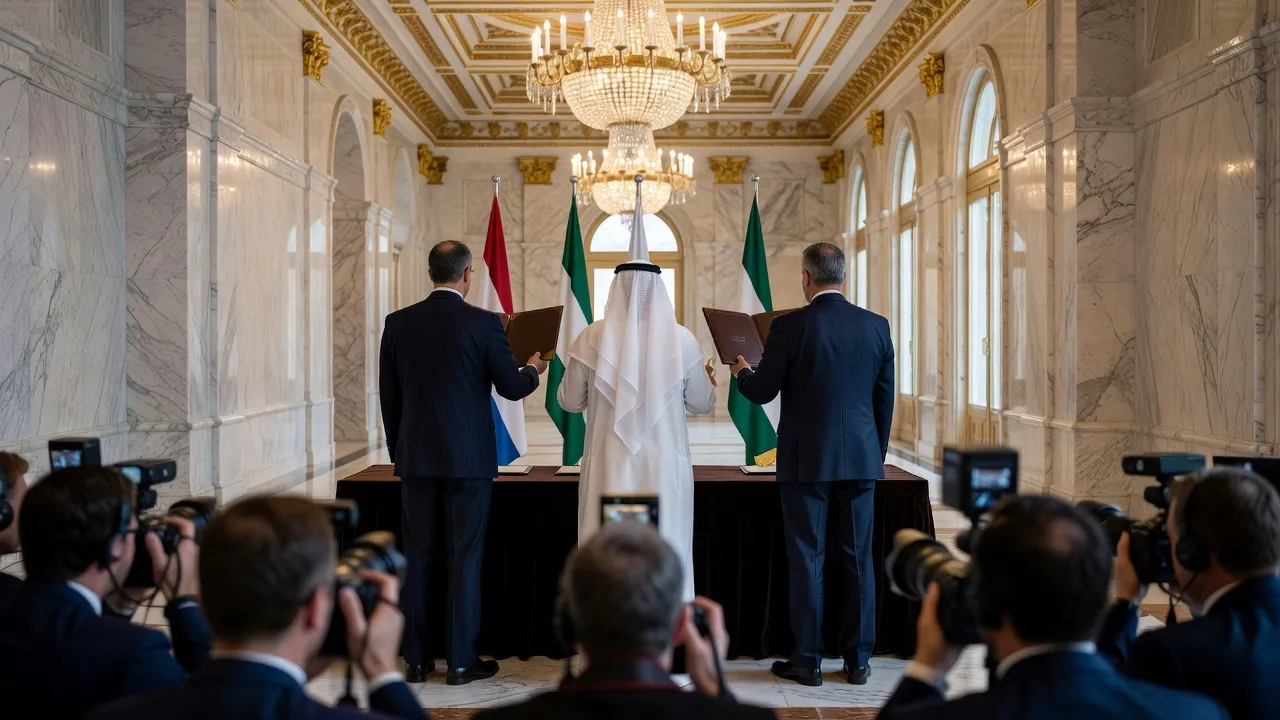
The signing took place at Al-Safa Palace in the presence of Mohammed bin Salman, Recep Tayyip Erdogan, and Shehbaz Sharif, the latter accompanied by Chief of Staff Asim Munir.
The agreement comes amid a war between the United States and Iran and Houthi attacks on Saudi Arabia, in a context of heightened regional tensions.
Riyadh claims the agreement does not target any country, but several interpretations see it as an alliance directed against Iran (critical analysis published in Turkey, reaction from the Iranian Parliament relayed by Russia) or a strengthening of nuclear-armed Pakistan against its Indian rival.
Coverage aligned with this reading
Ankara emphasizes that the agreement does not constitute an alternative to Turkish membership in NATO, while several Western and Chinese interpretations view it as a sign of distrust towards a US security umbrella deemed increasingly unreliable.
Riyadh rejects any confessional interpretation and describes the pact as 'neither a military axis nor a confessional bloc', when a Turkish analysis published by Cumhuriyet and the Bangladeshi press describe it as a Sunni defense pact.
Coverage aligned with this reading
Coverage that diverges
This grouping describes the publications analysed, not the position of these countries’ populations or of their governments.
What the coverage of each country leaves aside, while others put it forward.
Iran
Israel
United States
United Kingdom
Preview: 3 of 13 media perspectives. Syntheses of the media analysed — not direct quotations. Method & limitations
Moscow views the Mecca agreement as a calculated addition of national forces rather than a simple declaration of Islamic solidarity, and is relaying Tehran's anger without filter.
2 sources · View sources
Dhaka is closely watching Pakistan, the only Muslim country with nuclear capabilities, as it becomes a key player in the new Sunni defense pact sealed with Riyadh and Ankara.
2 sources · View sources
Brussels frames the signing of the pact as part of its ongoing narrative on the Middle East war, without giving it autonomous treatment.
2 sources · View sources
DOMINANT ANGLE
Moscow views the Mecca agreement as a calculated addition of national forces rather than a simple declaration of Islamic solidarity, and is relaying Tehran's anger without filter.
ANALYSIS
Moscow, August 8, 2026.
DOMINANT ANGLE
Dhaka is closely watching Pakistan, the only Muslim country with nuclear capabilities, as it becomes a key player in the new Sunni defense pact sealed with Riyadh and Ankara.
ANALYSIS
Dhaka, August 8, 2026.
DOMINANT ANGLE
Brussels frames the signing of the pact as part of its ongoing narrative on the Middle East war, without giving it autonomous treatment.
ANALYSIS
Brussels, August 8, 2026.
DOMINANT ANGLE
Ottawa views this pact in light of the declining reliability of its American ally in the Gulf, a division that Canadian media itself illustrates by situating the signing sometimes in Mecca, sometimes in Jeddah.
ANALYSIS
Ottawa, August 8, 2026.
DOMINANT ANGLE
Beijing frames the Mecca agreement as an extension of the US-Israeli war against Iran, rather than the narrative of Islamic solidarity presented by the three signatories.
ANALYSIS
Beijing, August 8, 2026.
DOMINANT ANGLE
Berlin views the Mecca pact as an alliance with anti-Iranian undertones, while also relaying the nuances from Riyadh and Islamabad regarding its actual scope.
ANALYSIS
Berlin, August 8, 2026.
DOMINANT ANGLE
France views the Mecca defense pact as a sign of growing distrust among Washington's Sunni allies towards an American partner deemed increasingly unreliable.
ANALYSIS
Paris, August 8, 2026.
DOMINANT ANGLE
New Delhi is scrutinizing the Mecca pact through its most sensitive aspect: the nuclear and military role of its rival, Pakistan, in a three-pronged alliance with Riyadh and Ankara.
ANALYSIS
New Delhi, August 8, 2026.
DOMINANT ANGLE
Pakistan's capital, Islamabad, is celebrating the Mecca agreement as a historic recognition of its defense capabilities, driven by the Shehbaz Sharif-Asim Munir duo.
ANALYSIS
Islamabad, August 8, 2026.
DOMINANT ANGLE
Doha views the Mecca agreement through the dual lens of its own media outlets, framing it as a sign of growing doubts towards Washington rather than a overtly anti-Iranian axis.
ANALYSIS
Doha, August 8, 2026.
DOMINANT ANGLE
Riyadhh immediately defuses the debate over the nature of the Mecca pact: neither a military axis nor a sectarian bloc, it emphasizes.
ANALYSIS
Riyadh, August 8, 2026.
DOMINANT ANGLE
Singapore is gauging the Mecca agreement in terms of the maritime routes it could disrupt, between the tense Strait of Hormuz and more expensive oil.
ANALYSIS
Singapore, August 8, 2026.
DOMINANT ANGLE
Ankara carefully distinguishes this Sunni pact from its NATO membership, while Cumhuriyet detects the risk of a rift with the West.
ANALYSIS
Ankara, August 8, 2026.
Explore every perspective on this subject across 13 countries.
Compare viewpoints and see where they diverge.
published on
countries
sources
articles
gap
On Friday, August 7, 2026, Saudi Arabia, Turkey, and Pakistan signed a joint defense pact at Al-Safa Palace in Mecca, officially known as the "Makkah Joint Defence Agreement". The document was signed by Saudi Crown Prince Mohammed bin Salman, Turkish President Recep Tayyip Erdoğan, and Pakistani Prime Minister Shehbaz Sharif, accompanied by Chief of Army Staff Asim Munir. Its central clause stipulates that an armed attack against any of the three signatory states will be considered an attack against all of them. The signing comes five months after the US-Israeli attack on February 28, 2026, against Iran, which disrupted maritime traffic in the Strait of Hormuz and the Red Sea.
Measured with the previous method (distance between texts), on a different scale.