Common ground and differences in coverage across the media analysed.
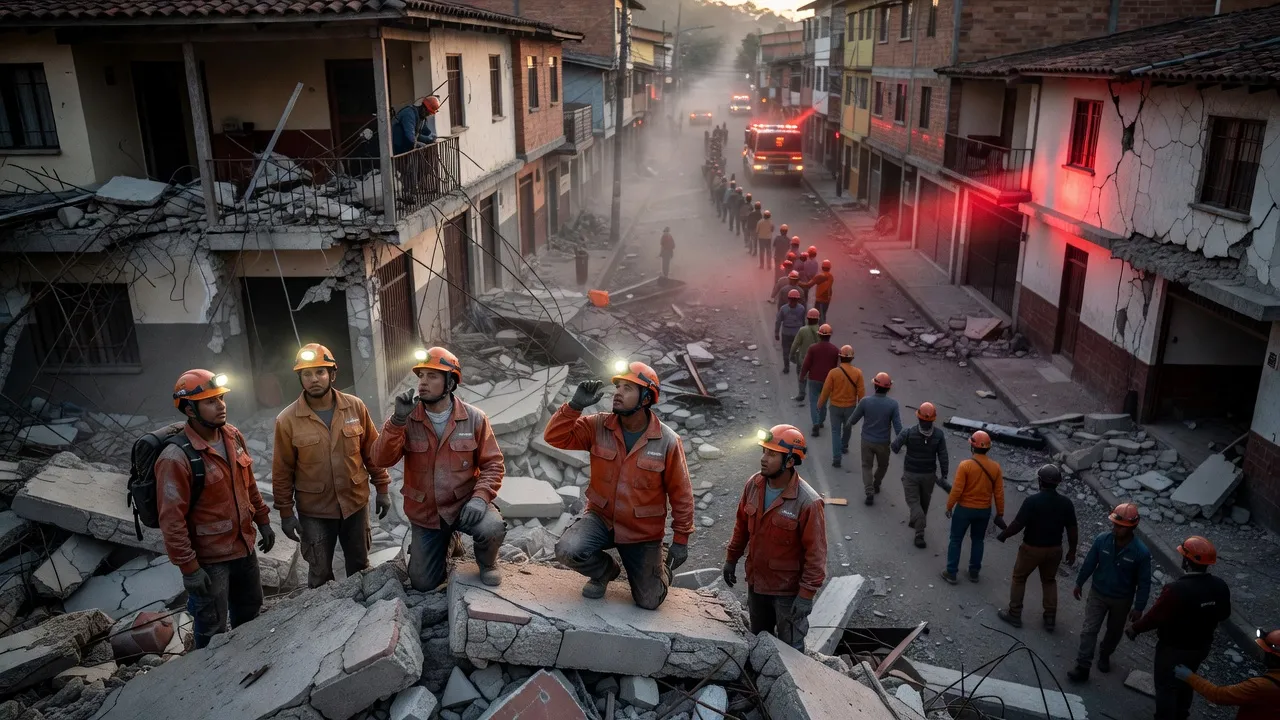
A 7.4-magnitude earthquake (after an initial lower estimate of 6.6/6.7 by the SGC or UNGRD, later confirmed by the USGS) struck western Colombia, with its epicenter near San José del Palmar, in Chocó.
The human toll evolved throughout the day without newsrooms agreeing on a final figure at the time of publication.
Colombian President Abelardo de la Espriella, who took office three days earlier, personally led the emergency response and secured approval for a national disaster declaration.
Depending on the time of publication and the source used, news outlets report a death toll ranging from 71 to 138; German media adds that over 2,000 people are registered as missing, while Indian media relays a warning from the USGS suggesting the death toll could exceed 1,000 victims.
Coverage that diverges
Colombian seismologists explicitly rule out any tectonic connection between this earthquake and the two recent tremors in La Guaira, while Venezuelan media and officials frame the event in the context of their own trauma and reject any political comparison between the two crisis management responses.
Most news outlets present the declaration of a national disaster as a deliberate power grab by the new president, while German media notes that this measure does not equate to a state of economic emergency that would allow for decree-based legislation, a move requested by allied lawmakers.
This grouping describes the publications analysed, not the position of these countries’ populations or of their governments.
What the coverage of each country leaves aside, while others put it forward.
Colombia
United States
India
Preview: 3 of 20 media perspectives. Syntheses of the media analysed — not direct quotations. Method & limitations
Spain is assessing the extent of the Colombian disaster and watching the first test of newly sworn-in President Abelardo de la Espriella.
4 sources · View sources
Bogotá is facing a double shock: a historic earthquake striking just three days after the inauguration of Abelardo de la Espriella, who is being called upon to prove his government's capacity to respond in an emergency.
3 sources · View sources
Caracas is gauging the Colombian earthquake in light of its own traumatic experience, walking a fine line between official solidarity and rejection of comparisons to the La Guaira disaster.
4 sources · View sources
DOMINANT ANGLE
Spain is assessing the extent of the Colombian disaster and watching the first test of newly sworn-in President Abelardo de la Espriella.
ANALYSIS
Madrid, August 11, 2026.
DOMINANT ANGLE
Bogotá is facing a double shock: a historic earthquake striking just three days after the inauguration of Abelardo de la Espriella, who is being called upon to prove his government's capacity to respond in an emergency.
ANALYSIS
Bogotá, August 11, 2026.
DOMINANT ANGLE
Caracas is gauging the Colombian earthquake in light of its own traumatic experience, walking a fine line between official solidarity and rejection of comparisons to the La Guaira disaster.
ANALYSIS
Caracas, August 11, 2026.
DOMINANT ANGLE
Quito is assessing the impact of the Colombian earthquake, which was felt as far as its own provinces, and welcomes the initial aid offered by Ecuador to its neighbour.
ANALYSIS
Quito, August 11, 2026.
DOMINANT ANGLE
Lima is closely watching a death toll that is rising by the hour and is relaying the voice of its Colombian community that is based there.
ANALYSIS
Lima, August 11, 2026.
DOMINANT ANGLE
Santiago is analyzing the Colombian earthquake through the lens of its own seismic expertise, comparing the quake to major Chilean tremors and ruling out any connection to neighboring Venezuelan earthquakes.
ANALYSIS
Santiago, August 11, 2026.
DOMINANT ANGLE
Buenos Aires is gauging this seismic event in terms of its own time difference with Bogotá and is closely watching the crisis management of a Colombian president who has been in office for just three days.
ANALYSIS
Buenos Aires, August 11, 2026.
DOMINANT ANGLE
La Paz is assessing the worsening toll of the Colombian earthquake while praising the immediate commitment of President Abelardo de la Espriella, who took office just three days before the disaster.
ANALYSIS
La Paz, August 11, 2026.
DOMINANT ANGLE
Montevideo is actively engaging in solidarity diplomacy with Bogotá while verifying that none of its own citizens were affected.
ANALYSIS
Montevideo, August 11, 2026.
DOMINANT ANGLE
Mexico City is actively engaging in crisis diplomacy with Bogotá and assessing the economic impact of the earthquake on Colombia's coffee industry.
ANALYSIS
Mexico, August 11, 2026.
DOMINANT ANGLE
The United States government confirms its support for Bogotá, just three days after pledging $1 billion in security aid to the new president, Abelardo de la Espriella, whose administration is facing its first major crisis.
ANALYSIS
The United States is among the first countries to offer support after a 7.
DOMINANT ANGLE
Ottawa is assessing the scope of the Colombian earthquake through a growing human toll that climbs by the hour and is closely watching the response of a president who took office just three days earlier.
ANALYSIS
Ottawa, August 11, 2026.
DOMINANT ANGLE
France is assessing the severity of a disaster that occurred just three days after Abelardo de la Espriella's inauguration, and through Emmanuel Macron, is relaying French solidarity to the Colombian people.
ANALYSIS
Paris, August 11, 2026.
DOMINANT ANGLE
Rome is assessing the impact of the earthquake that struck Colombia just three days after Abelardo de la Espriella's inauguration, amid a rising human toll and the new president's first governance test.
ANALYSIS
Rome, August 11, 2026.
DOMINANT ANGLE
Berlin is gauging the extent of the Colombian earthquake in light of seismic differences and welcomes the immediate mobilization of European aid.
ANALYSIS
Berlin, August 11, 2026.
DOMINANT ANGLE
Bern is reviewing the evolving human toll of the Colombian earthquake and examining the discrepancy between initial seismic estimates and the final magnitude of 7.4.
ANALYSIS
Bern, August 11, 2026.
DOMINANT ANGLE
London is grappling with the confusion over the conflicting human toll estimates, which its own newsrooms are struggling to reconcile, ranging from 111 to 132 fatalities, while also identifying a British national who was present in the affected area.
ANALYSIS
London, August 11, 2026.
DOMINANT ANGLE
Moscow coolly takes note of the extent of the Colombian earthquake, citing the toll of 132 dead and 570 injured relayed by local radio and the discrepancies between seismological institutes, without providing a geopolitical commentary.
ANALYSIS
Moscow, August 11, 2026.
DOMINANT ANGLE
Beijing is closely watching the new Colombian president's trial by fire, assessing crisis management based on the numerical damage reports rather than political rhetoric.
ANALYSIS
Beijing, August 11, 2026.
DOMINANT ANGLE
New Delhi is particularly concerned about the uncertainty surrounding the human toll and the USGS warning of a possible thousand casualties, amid on-the-ground accounts and reactions from global celebrities.
ANALYSIS
New Delhi, August 11, 2026.
Explore every perspective on this subject across 20 countries.
Compare viewpoints and see where they diverge.
published on
countries
sources
articles
gap
A magnitude 7.4 earthquake struck western Colombia on Monday 10 August 2026 at 7:34 a.m. local time, with its epicentre near San José del Palmar in the Chocó department, on the Pacific coast. The tremor was felt in Bogotá, Cali and Medellín, and as far as Ecuador, Panama and Venezuela. President Abelardo de la Espriella, in office for three days, declared a national disaster and set up a unified command post in Bogotá. No tsunami warning was issued.
Measured with the previous method (distance between texts), on a different scale.