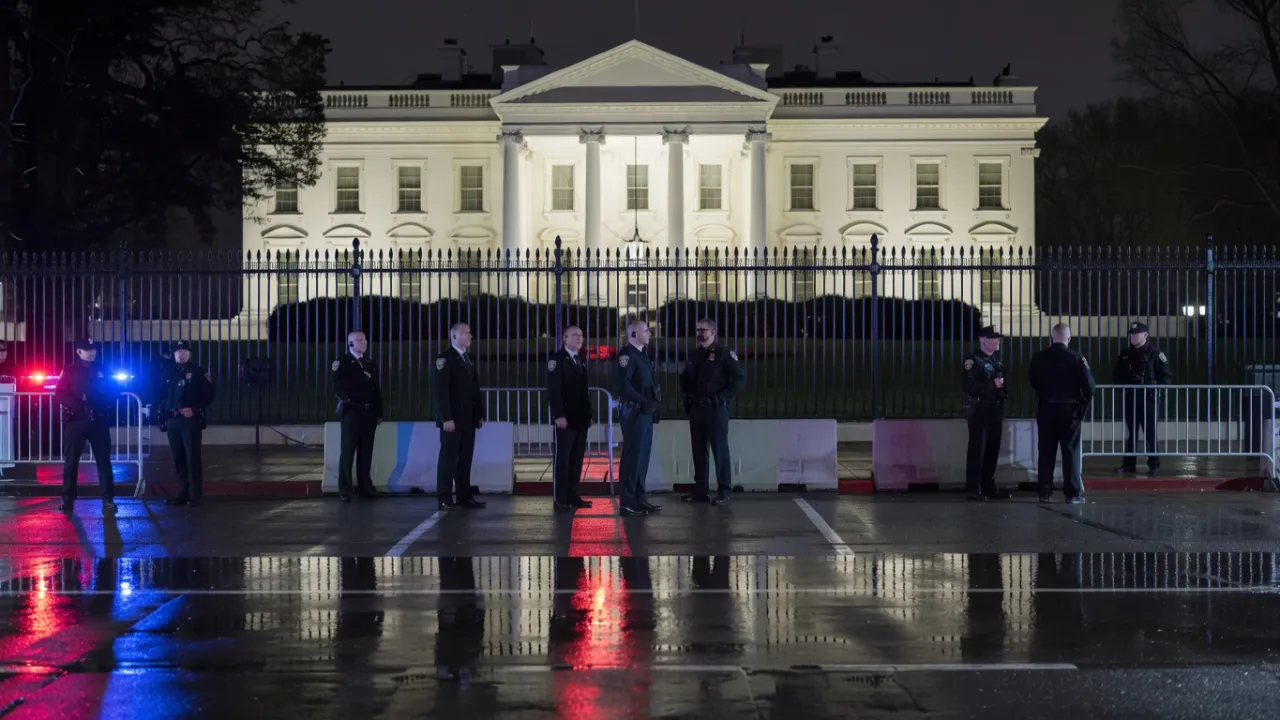
Common ground and differences in coverage across the media analysed.
Nasire Best, 21 years old from Maryland, opened fire on a Secret Service checkpoint at the intersection of 17th Street and Pennsylvania Avenue NW on May 24, 2026 around 6:00 PM.
The assailant was shot by Secret Service agents and pronounced dead at the hospital; President Trump, present in the White House, was not injured.
A civilian bystander was struck during the exchange of gunfire and hospitalized in serious but stable condition.
Some media outlets characterize the incident as the third violent episode in a month around the president, interpreting it as a signal of systemic instability; others treat the event in isolation without emphasizing the pattern.
Preview: 3 of 7 media perspectives. Syntheses of the media analysed — not direct quotations.
Washington reads the incident through the lens of protocol: the Secret Service neutralized the threat before any breach of the perimeter, and the chain of command functioned exactly as designed.
1 source ·
London assesses with measured restraint the third armed incident in one month near President Trump, underscoring growing concern about the normalization of violence at the White House perimeter.
1 source ·
New Delhi emphasizes the psychiatric profile of the shooter: a 21-year-old man with documented mental health issues, previously hospitalized involuntarily and convinced he was Jesus Christ, who opened fire Saturday evening at a security checkpoint near the White House.
2 sources ·

Coverage aligned with this reading
Coverage that diverges
Some newsrooms prioritize the assailant's mental health profile and human dimension (statement from the mother), while others focus on the effectiveness of the neutralization protocol.
Coverage that diverges
Several media outlets from countries with restrictive firearms legislation implicitly surface the question of firearm access without stating it explicitly; the American press does not address it.
Coverage aligned with this reading
Coverage that diverges
This grouping describes the publications analysed, not the position of these countries’ populations or of their governments.
What the coverage of each country leaves aside, while others put it forward.
United States
Australia
Israel
published on
countries
sources
articles
gap
On 24 May 2026, around 6:00 p.m., a 21-year-old man from Maryland, Nasire Best, opened fire on a Secret Service security checkpoint at the intersection of 17th Street and Pennsylvania Avenue NW, outside the White House. Agents returned fire: the attacker was shot and later pronounced dead at hospital. A civilian bystander, hit during the exchange of gunfire, was hospitalized in serious but stable condition. President Trump, who was inside the building, was unharmed.
The attacker was known to security services before the incident: he had a criminal record and documented psychiatric history. Afterward, the president publicly praised the Secret Service's response, calling the intervention swift and professional.
The episode comes amid heightened security tension around the U.S. presidency, with several incidents reported in the preceding weeks, while the administration was engaged in sensitive diplomatic negotiations linked to Iran. It highlights a structural tension: the coexistence of one of the world's most sophisticated protection systems and legal access to firearms for individuals already flagged by security services.
How the event should be read remains disputed. Some actors see it as the third violent episode in a month around the president, a sign of broader instability; others treat it as an isolated incident. Likewise, emphasis falls in some cases on the attacker's mental health profile and his family's words, and in others on the efficiency of the neutralization protocol. The question of firearm access surfaces for some without being stated explicitly.
DOMINANT ANGLE
Washington reads the incident through the lens of protocol: the Secret Service neutralized the threat before any breach of the perimeter, and the chain of command functioned exactly as designed.
ANALYSIS
Washington, May 24, 2026.
DOMINANT ANGLE
London assesses with measured restraint the third armed incident in one month near President Trump, underscoring growing concern about the normalization of violence at the White House perimeter.
ANALYSIS
London, May 24, 2026.
DOMINANT ANGLE
New Delhi emphasizes the psychiatric profile of the shooter: a 21-year-old man with documented mental health issues, previously hospitalized involuntarily and convinced he was Jesus Christ, who opened fire Saturday evening at a security checkpoint near the White House.
ANALYSIS
New Delhi, May 24, 2026.
DOMINANT ANGLE
Doha examines America's security response through a revealing incident: a lone gunman, persistent system gaps, and a president quick to praise his protective detail.
ANALYSIS
Doha, May 24, 2026.
DOMINANT ANGLE
Tokyo views with concern the third shooting incident near the White House in one month, perceiving it as a signal of security instability in the United States.
ANALYSIS
Tokyo, May 24, 2026.
DOMINANT ANGLE
Jerusalem reads the White House checkpoint incident through a familiar security lens: the neutralization of an armed attacker by close protection forces resonates in a nation accustomed to such emergency protocols.
ANALYSIS
Jerusalem, May 24, 2026.
DOMINANT ANGLE
Canberra views the May 24 incident through the lens of immediate U.S. security responsiveness: the Secret Service neutralized the threat while President Trump was inside the White House.
ANALYSIS
Canberra, May 24, 2026.
Explore every perspective on this subject across 7 countries.
Compare viewpoints and see where they diverge.
Measured with the previous method (distance between texts), on a different scale.