Common ground and differences in coverage across the media analysed.
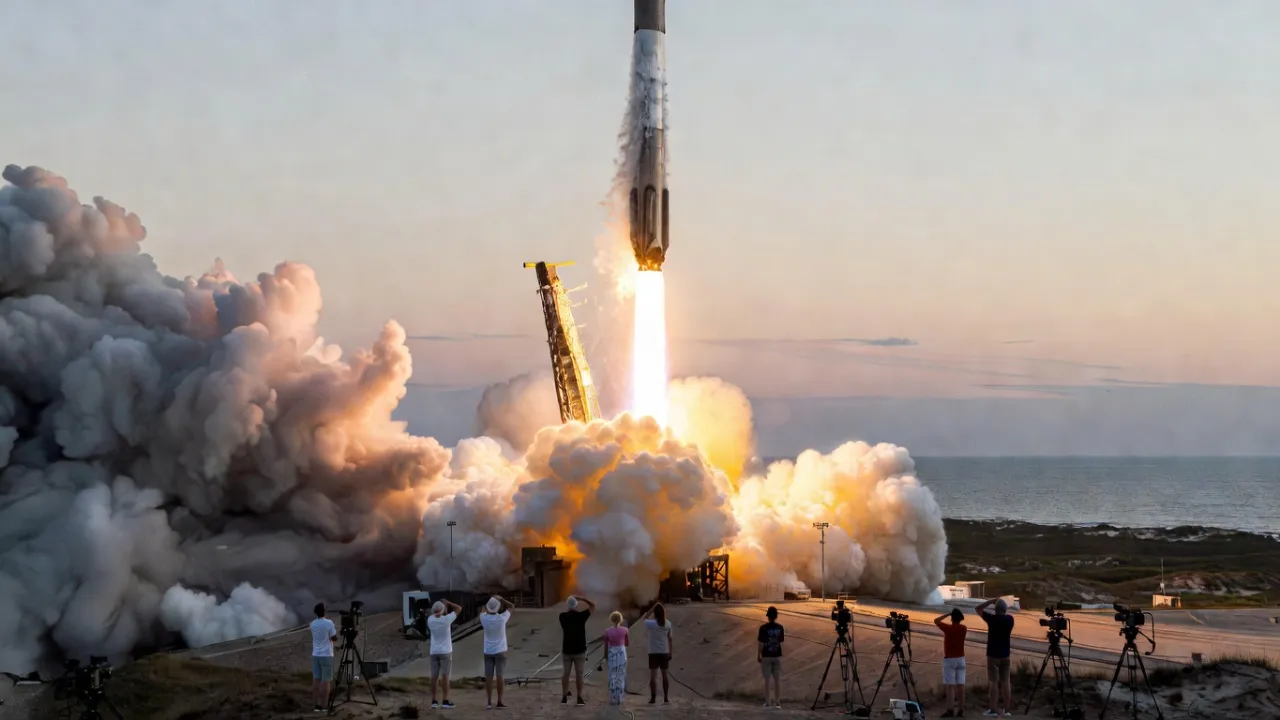
The Starship V3 measures 124 meters and is the largest rocket ever built; it is the 12th test flight of the program and the first of the V3 version.
One upper-stage engine failed in flight; the Super Heavy booster did not execute its controlled return maneuver and crashed uncontrollably into the Gulf of Mexico.
The primary flight objectives were achieved: deployment of simulated Starlink satellites, survival through atmospheric reentry, and landing in the Indian Ocean.
The majority of media outlets characterize the flight as a partial success or positive milestone, while Russian sources emphasize technical failures and the regulatory anomaly reported by the FAA.
Coverage aligned with this reading
Coverage that diverges
Five countries integrate SpaceX's IPO announcement as central context for the flight; Russian coverage makes no reference to it.
Coverage aligned with this reading
Coverage that diverges
Russian sources give standalone visibility to the FAA's opening of an evaluation regarding debris that fell in a hazard zone; this point is absent from British, South Korean, Australian, and Pakistani coverage.
Coverage aligned with this reading
Coverage that diverges
This grouping describes the publications analysed, not the position of these countries’ populations or of their governments.
What the coverage of each country leaves aside, while others put it forward.
Russia
United Kingdom
Pakistan
Preview: 3 of 6 media perspectives. Syntheses of the media analysed — not direct quotations. Method & limitations
Delhi gauges the magnitude of American technological advancement by analyzing the inaugural Starship V3 test flight through the lens of its own space ambitions and the colossal financial stakes of a record-breaking public offering.
4 sources · View sources
Moscow examines the technical flaws in Starship V3's test flight rather than celebrating the achievement, focusing on the anomaly flagged by the FAA and the booster failure in the Gulf of Mexico.
2 sources · View sources
London views Starship V3's inaugural flight through a dual lens: the technical achievement for NASA's Artemis lunar program and the financial logic of an IPO presented as the largest in Wall Street history.
2 sources · View sources
DOMINANT ANGLE
Delhi gauges the magnitude of American technological advancement by analyzing the inaugural Starship V3 test flight through the lens of its own space ambitions and the colossal financial stakes of a record-breaking public offering.
ANALYSIS
New Delhi, May 23, 2026.
DOMINANT ANGLE
Moscow examines the technical flaws in Starship V3's test flight rather than celebrating the achievement, focusing on the anomaly flagged by the FAA and the booster failure in the Gulf of Mexico.
ANALYSIS
Moscow, May 23, 2026.
DOMINANT ANGLE
London views Starship V3's inaugural flight through a dual lens: the technical achievement for NASA's Artemis lunar program and the financial logic of an IPO presented as the largest in Wall Street history.
ANALYSIS
London, May 23, 2026.
DOMINANT ANGLE
Seoul measures the technological gap with the United States following Starship V3's successful inaugural flight, and questions the implications for the Asian space race as KASA charts its lunar ambitions.
ANALYSIS
Seoul, May 23, 2026.
DOMINANT ANGLE
Canberra assesses the scope of a test flight that concluded in the Indian Ocean, the splashdown zone selected by SpaceX for its most powerful rocket ever built, and weighs the implications for the Artemis program to which Australia is committed.
ANALYSIS
Canberra, May 23, 2026.
DOMINANT ANGLE
Islamabad weighs the gap between its own space ambitions and the industrial power represented by the test flight of a privately-held American rocket company valued at 1.75 trillion dollars.
ANALYSIS
Islamabad registers, from Starship V3's inaugural flight on May 23, 2026, the image of an American private actor capable of launching a 124-meter rocket halfway around the Earth in one hour, then landing it in the Indian Ocean.
Explore every perspective on this subject across 6 countries.
Compare viewpoints and see where they diverge.
published on
countries
sources
articles
gap
Starship V3, standing 124 metres tall and now the largest rocket ever built, completed its inaugural test flight from Texas. It was the twelfth test flight of the programme and the first of this new version. The vehicle met most of its objectives: deploying simulated Starlink satellites, surviving atmospheric re-entry and splashing down in the Indian Ocean.
The flight also saw failures. An upper-stage engine cut out during flight, and the Super Heavy booster did not perform its controlled return manoeuvre, falling in an uncontrolled manner into the Gulf of Mexico. The test came two days after SpaceX announced an initial public offering, presented as potentially the largest in Wall Street history.
The stakes go beyond technical performance. Starship is the centrepiece of NASA's Artemis lunar programme, which aims to return astronauts to the Moon during the Artemis IV mission. The United States has chosen to entrust the heavy-lift capabilities needed for that return to private actors, a model that combines massive public funding with private market valuation.
This arrangement draws diverging readings. Some actors see a technological acceleration and a credible milestone, while others emphasise the failures and the opening of an FAA review concerning debris that fell into a declared danger zone. Also under debate is the concentration of the lunar contract in a single company, which some question and others treat as a settled fact. The simultaneous IPO announcement further blurs the line between scientific event and financial operation.
Measured with the previous method (distance between texts), on a different scale.