Common ground and differences in coverage across the media analysed.
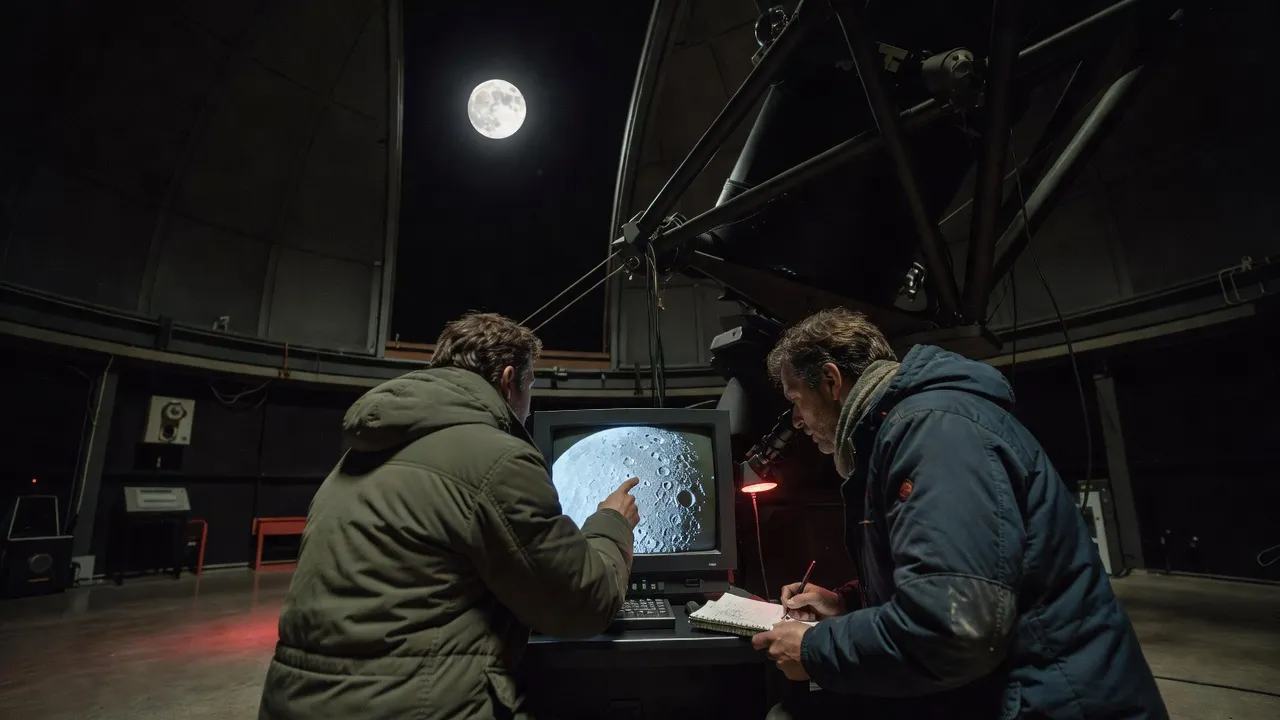
The upper stage of a SpaceX Falcon 9 rocket, weighing around 4,000 kg, accidentally collided with the Moon on August 5, 2026, at approximately 06:35 GMT, near the Einstein crater, at a speed of about 8,690 km/h.
The impact was predicted months in advance by astronomers and confirmed by the spectroscopic detection of sodium and lithium at the European Southern Observatory (ESO) telescope in Chile.
NASA, through its spokesperson Jimi Russell, asserts that there is no danger to Earth.

A majority of perspectives present the impact as a free, high-speed, and high-mass experience useful for lunar research, while a minority frames it as part of the structural problem of increasing congestion in lunar orbit and on the lunar surface.
China alone presents the accident as a demonstration of its own orbital surveillance capability, via its first dedicated satellite, while other perspectives do not link the event to a rivalry of capabilities between space powers.
Most perspectives relay the NASA's assurances without questioning them, while Mexico questions this version, Russia notes that SpaceX deemed the trajectory 'safe', and Switzerland links the incident to Musk's stock market ambitions for Starlink.
This grouping describes the publications analysed, not the position of these countries’ populations or of their governments.
What the coverage of each country leaves aside, while others put it forward.
United States
South Korea
Japan
India
Preview: 3 of 12 media perspectives. Syntheses of the media analysed — not direct quotations. Method & limitations
Moscow is scrutinizing the incident with a wealth of technical details and notes in particular that SpaceX had deemed its trajectory "safe according to existing rules" before the impact.
2 sources · View sources
Bucharest views the lunar crash of Falcon 9 as an international scientific windfall rather than an incident to be investigated.
2 sources · View sources
Buenos Aires views the incident as an unexpected scientific windfall, echoing NASA's assessment of a risk-free impact that holds valuable lessons for future lunar missions.
2 sources · View sources
DOMINANT ANGLE
Moscow is scrutinizing the incident with a wealth of technical details and notes in particular that SpaceX had deemed its trajectory "safe according to existing rules" before the impact.
ANALYSIS
Moscow, August 7, 2026.
DOMINANT ANGLE
Bucharest views the lunar crash of Falcon 9 as an international scientific windfall rather than an incident to be investigated.
ANALYSIS
Bucharest, August 7, 2026.
DOMINANT ANGLE
Buenos Aires views the incident as an unexpected scientific windfall, echoing NASA's assessment of a risk-free impact that holds valuable lessons for future lunar missions.
ANALYSIS
Buenos Aires, August 7, 2026.
DOMINANT ANGLE
Canberra is weighing the cost of space congestion: the impact of the Falcon 9 on the Moon has reignited debate over the debris accumulating in orbit and on the lunar surface.
ANALYSIS
Canberra, August 7, 2026.
DOMINANT ANGLE
Brussels is initially focusing on the Belgian portion of the scientific investigation, between spectroscopy confirmation in Chile and South Korean images of the impact.
ANALYSIS
Brussels, 7 August 2026.
DOMINANT ANGLE
Ottawa views the incident as part of a broader structural issue: the increasing pollution of the lunar orbit, whereas Canada's English-language press is sticking to the factual account provided by NASA.
ANALYSIS
Ottawa, August 7, 2026.
DOMINANT ANGLE
Switzerland is simultaneously reviewing two SpaceX files: the growing clutter of the lunar space by rocket debris, and Elon Musk's oversized ambitions for Starlink, which have been met with skepticism from investors.
ANALYSIS
Berne, August 7, 2026.
DOMINANT ANGLE
Beijing is using an American space accident to demonstrate its own orbital surveillance capabilities.
ANALYSIS
Beijing, August 7, 2026.
DOMINANT ANGLE
Helsinki is closely monitoring the lunar impact minute by minute, from the initial alert to the scientific confirmation from the ESO.
ANALYSIS
Helsinki, August 7, 2026.
DOMINANT ANGLE
Paris views the impact more as a confirmed scientific experiment backed by a European instrument than as an incident, while the technological fallout primarily benefits the lunar ambitions of NASA.
ANALYSIS
Paris, August 7, 2026.
DOMINANT ANGLE
Mexico City is questioning the official NASA account, which frames the lunar impact as a "safe event" and an accepted method for disposing of material in low Earth orbit.
ANALYSIS
Mexico, August 7, 2026.
DOMINANT ANGLE
Stockholm is gauging the scientific windfall of a space accident, with its own researchers, from Uppsala to the European Southern Observatory, among the first to seek to capitalize on it.
ANALYSIS
Stockholm, August 7, 2026.
Explore every perspective on this subject across 12 countries.
Compare viewpoints and see where they diverge.
published on
countries
sources
articles
gap
The upper stage of a SpaceX Falcon 9 rocket, launched on January 15, 2025, with two lunar landers on board, crashed into the Moon on August 5, 2026, at around 6:35 GMT, in the northern hemisphere near the Einstein crater. The object, weighing about 4,000 kg, struck the lunar surface at 8,690 km/h after drifting in space for approximately 18 months. NASA stated that the collision posed no danger to Earth. The European Southern Observatory's telescope in Chile detected sodium and lithium spectral lines confirming the impact, and South Korea's Danuri orbiter photographed the site in the following days.
Measured with the previous method (distance between texts), on a different scale.