Common ground and differences in coverage across the media analysed.
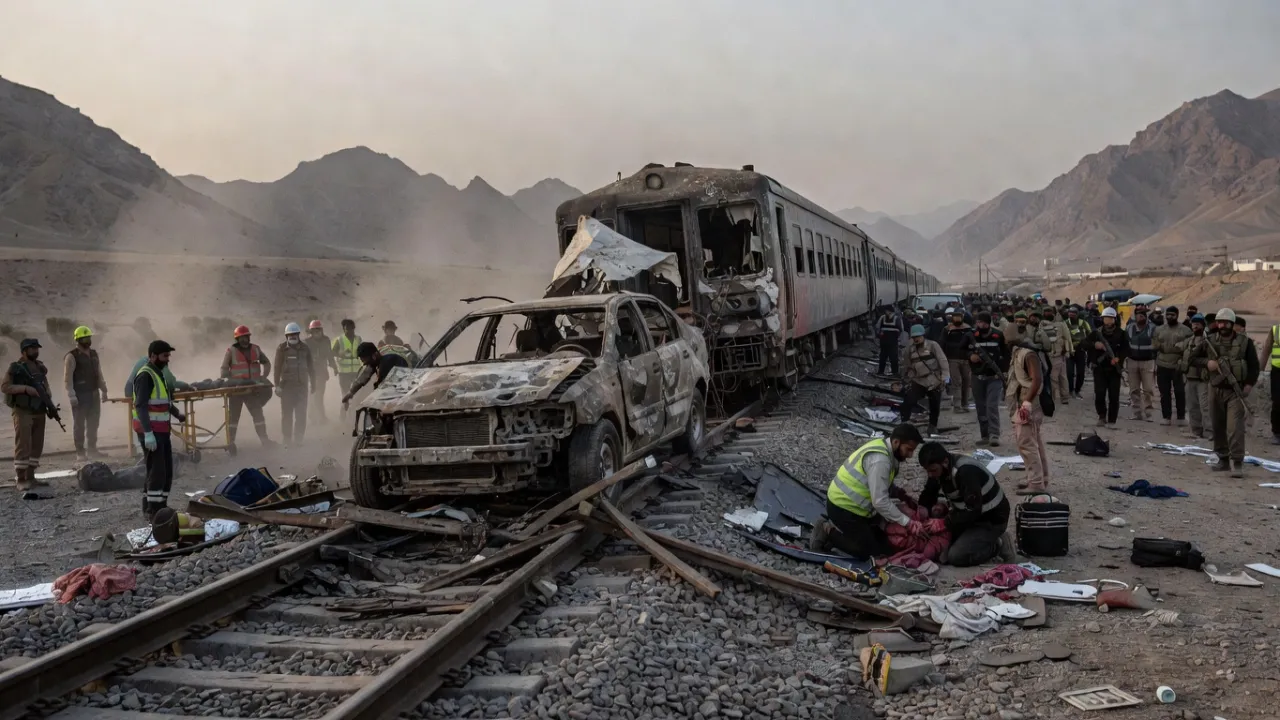
A suicide car bombing targeted a train in Quetta (Balochistan, Pakistan) on Sunday, May 24, 2026, causing numerous fatalities and injuries among passengers and nearby residents.
The explosion occurred at the Chaman Phatak/Pattak level crossing, causing the derailment and ignition of several railway cars.
The Balochistan government characterized the act as terrorism and declared a state of emergency in Quetta hospitals.
The Balochistan government reports at least 14 dead and 20 wounded; international media outlets (France, Qatar, Russia, Brazil, United States) report 23 to 24 fatalities and 50 to 70 wounded according to news agency sources.
Preview: 3 of 7 media perspectives. Syntheses of the media analysed — not direct quotations.
Islamabad condemns the Quetta attack vehemently, calling the assault on a commuter train a deliberate attempt to destabilize Balochistan province.
1 source ·
Paris examines the scale of a deadly suicide bombing targeting a military personnel train in Quetta, underscoring the persistence of separatist violence in Balochistan and the vulnerability of civilian and military infrastructure in Pakistan.
2 sources ·
Doha reads the Quetta attack as evidence of an intensifying Baloch insurgency, now targeting military forces during Eid.
2 sources ·

Coverage aligned with this reading
Coverage that diverges
All international perspectives mention the claim of responsibility by the Balochistan Liberation Army (BLA); the Pakistani perspective does not mention any group and reports no claim of responsibility.
Coverage aligned with this reading
Coverage that diverges
Pakistan presents the train as a civilian shuttle train frequented by ordinary families; perspectives from France, Qatar, Britain, the United States, and Brazil emphasize that the convoy primarily carried military personnel and their families.
Coverage aligned with this reading
Coverage that diverges
This grouping describes the publications analysed, not the position of these countries’ populations or of their governments.
What the coverage of each country leaves aside, while others put it forward.
Pakistan
Brazil
United States
published on
countries
sources
articles
gap
On Sunday 24 May 2026, a suicide car bomb struck a train at the Chaman Phatak level crossing in Quetta, in Pakistan's Balochistan province. The blast derailed and set ablaze several carriages, killing and wounding many among the passengers and bystanders. Provincial authorities described the act as terrorism and declared a state of emergency in the city's hospitals.
The attack belongs to a long-running conflict. Balochistan, the country's largest yet least developed province, has for decades been the scene of a separatist insurgency and recurring attacks on infrastructure and security forces. The region holds significant natural resources (gas, minerals) and is home to segments of the China-Pakistan economic corridor, regularly targeted by armed factions that denounce what they see as an inadequate sharing of local wealth.
Several points remain disputed. The toll differs depending on the actors: provincial authorities report at least 14 dead and 20 injured, while international sources put forward a markedly higher figure. A claim of responsibility attributed to a separatist group is cited by foreign actors but is not reported by Pakistani authorities. The nature of the target is also debated: described as a civilian commuter train by the authorities, it is elsewhere portrayed as a convoy carrying mainly military personnel and their families.
Finally, the weight given to the regional context varies from one reading to another. Some actors link the instability to the porous border between Pakistan and Afghanistan, while others confine themselves to the internal security frame alone. Pakistan, a nuclear power bordering Afghanistan, Iran and India, sees its domestic stability closely watched by major powers, each projecting its own interests onto it.
DOMINANT ANGLE
Islamabad condemns the Quetta attack vehemently, calling the assault on a commuter train a deliberate attempt to destabilize Balochistan province.
ANALYSIS
Islamabad, May 24, 2026.
DOMINANT ANGLE
Paris examines the scale of a deadly suicide bombing targeting a military personnel train in Quetta, underscoring the persistence of separatist violence in Balochistan and the vulnerability of civilian and military infrastructure in Pakistan.
ANALYSIS
Paris, May 24, 2026.
DOMINANT ANGLE
Doha reads the Quetta attack as evidence of an intensifying Baloch insurgency, now targeting military forces during Eid.
ANALYSIS
Doha, May 24, 2026.
DOMINANT ANGLE
Moscow reads the Quetta bombing as another milestone in Balochistan's chronic destabilization, a province accounting for nearly one-third of Pakistan's total terrorist violence.
ANALYSIS
Moscow, May 24, 2026.
DOMINANT ANGLE
Brasilia measures the scope of the Pakistani tragedy through figures reported by the São Paulo press: at least 24 dead and 50 wounded in an attack claimed by the BLA, the Balochistan separatist group.
ANALYSIS
Brasilia, May 24, 2026.
DOMINANT ANGLE
Washington reads the Quetta bombing through the lens of the persistent Baloch separatist insurgency, emphasizing the BLA's claim and the vulnerability of Pakistani military targets.
ANALYSIS
Washington, May 24, 2026.
DOMINANT ANGLE
London reads the Quetta bombing as evidence of a structured separatist insurgency, deliberately targeting military families during Eid holidays.
ANALYSIS
London, May 25, 2026.
Explore every perspective on this subject across 7 countries.
Compare viewpoints and see where they diverge.
Measured with the previous method (distance between texts), on a different scale.





