Common ground and differences in coverage across the media analysed.
What the media report in common
1
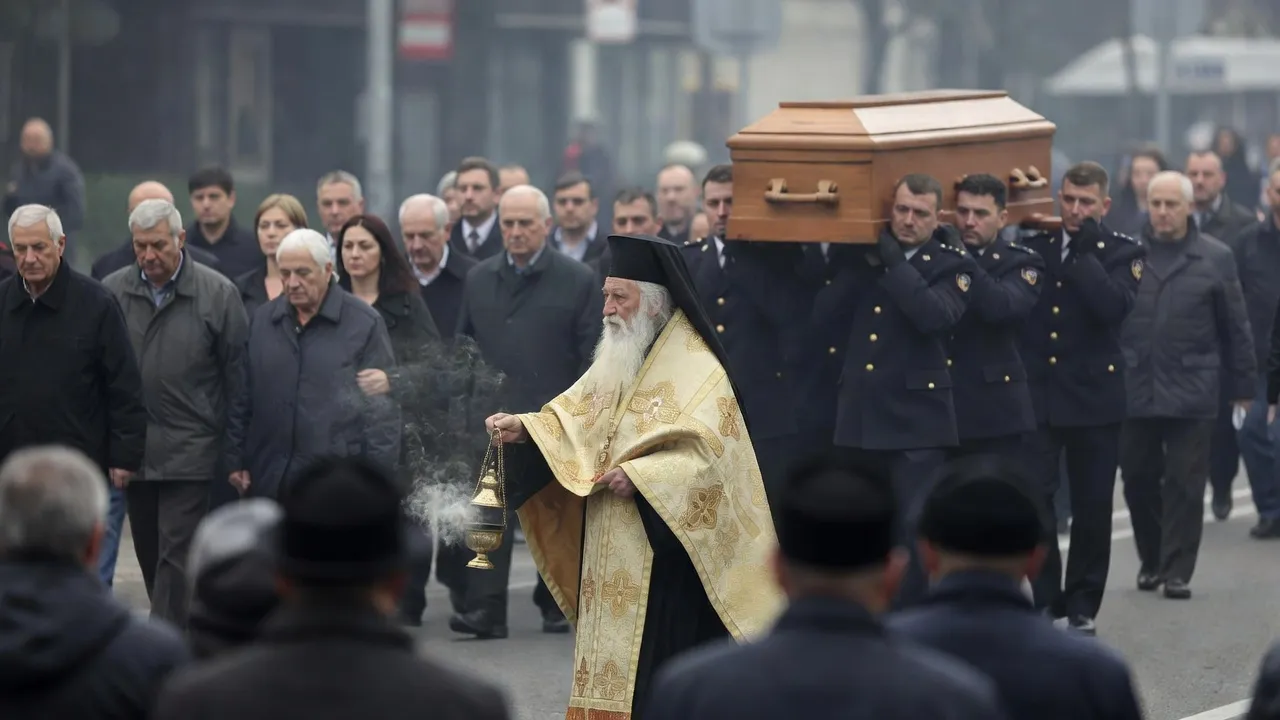
Thousands of people gathered in Belgrade on Monday, September 7, 2026, for the funeral of Ratko Mladić, with a religious service held by Serbian Patriarch Porfirije at the Church of Saint Luke before his burial at Topčider cemetery.
2
Ratko Mladić, who died on August 27, 2026, at the age of 84 in the United Nations prison in The Hague, had been sentenced to life in prison by the ICTY for genocide, war crimes, and crimes against humanity, including the Srebrenica massacre in July 1995.
3
European Commissioner for Enlargement Marta Kos cancelled her planned visit to Serbia on September 9, 2026, deeming the 'glorification' of Mladić incompatible with the values of the European Union.
Where media coverage diverges
Honors at the burial
Accounts differ on the nature of the honors actually paid: some report military or state honors, while others claim the ceremony took place without official honors after the initial announcement by the Justice Minister.
The German press presents the funeral compromise as a cynical electoral calculation by Vučić ahead of early elections, while the Italian and Serbian presses describe it in more analytical terms, as a prudent management of a sensitive issue.
The French press characterizes the gathering as 'fascist and revisionist', when the Serbian and Russian presses describe it in more neutral terms, as a popular mourning or a reported fact without explicit moral judgment.
4 different framings across 8 countries · 3 of 8 countries share the same framing
Pair by pair: same frame or different frames
Each square pairs two countries. Filled: both countries' coverage uses the same frame. Empty: their frames differ. The map describes framings without evaluating them.
Pairs with the same frame: 5 of 28
same frame
different frames
Blind spots
What the coverage of each country leaves aside, while others put it forward.
Russia
The number of victims of the Srebrenica massacre (around 8 000) and the details of Mladić's conviction for genocide by the ICTY
Germany
The judicial repercussions in Bosnia and Herzegovina, where more than 76 000 complaints were filed in one week for glorifying war criminals
These funeral proceedings come as Serbia negotiates its accession to the European Union and Aleksandar Vučić faces early legislative elections. The ceremony has revived an old regional divide between Belgrade, where a segment of public opinion continues to celebrate Mladić as a national hero, and Sarajevo, which has responded by recalling its diplomatic staff. The presence of Republika Srpska officials and Russian diplomats alongside Serbian officials highlights alliances that span the fault lines of former Yugoslavia, while Brussels views this as a test of Belgrade's commitment to its European path.
Understand the context
AUG 27, 2026
Death of Ratko Mladic in the United Nations prison in The Hague, at 84 years old
AUG 28, 2026
The Serbian Minister of Justice announces military and state honors
SEP 6, 2026
Supporters deploy a banner with Mladic's likeness at Marakana stadium
SEP 7, 2026
Funeral in Belgrade; Bosnia announces the recall of its diplomatic staff
How each country reads it
Preview: 3 of 8 media perspectives. Syntheses of the media analysed — not direct quotations. Method & limitations
Berlin sees the Marakana stadium as the true indicator of these funerals: in the same stands where hooligans became militiamen and then soldiers in the 1990s, a banner featuring Mladic's likeness brought together fans of Red Star and Partizan, proof that a national memory has never been laid to rest.
Belgrade is striking a fragile compromise between military honors and state honors, just weeks ahead of early elections in which Aleksandar Vučić is staking part of his political survival.
ANALYSIS
Belgrade, September 8, 2026.
Italy
DOMINANT ANGLE
Rome is examining the political calculation of Vučić, who was personally absent from the funeral but discreetly ensured they received state honors, just a month ahead of early elections.
ANALYSIS
Rome, September 8, 2026.
Russia
DOMINANT ANGLE
Moscow views the funeral of Ratko Mladic as a new episode in the standoff between Belgrade and Brussels, where the discreet presence of its ambassador signals the continuity of Russian-Serbian ties in the face of European pressure.
ANALYSIS
Moscow, September 8, 2026.
Hungary
DOMINANT ANGLE
Budapest is first assessing the European cost of these funerals for Belgrade, amid condemnation from Brussels, Croatian anger and an announced rift with Sarajevo.
ANALYSIS
Budapest, September 8, 2026.
Finland
DOMINANT ANGLE
Helsinki views the burial of Ratko Mladic less as an isolated tribute than as a symptom of a collective Serbian memory shaped by three decades of nationalism and a sense of being alone against the world.
ANALYSIS
Helsinki, September 8, 2026.
Brazil
DOMINANT ANGLE
Brazil clearly distinguishes the popular tribute paid in Belgrade from the intact verdict of The Hague, recalling that the 2017 genocide conviction was not overturned by the crowd that hailed Ratko Mladic as a hero.
ANALYSIS
Brasília, September 8, 2026.
Explore every perspective on this subject across 8 countries.
Thousands attend Ratko Mladic's funeral in Belgrade as Sarajevo recalls its embassy staff
published on
September 8, 2026
8
countries
21
sources
26
articles
82/100
gap
On Monday, September 7, 2026, several thousand people attended the funeral of Ratko Mladic in Belgrade, the former commander of the Bosnian Serb army who died on August 27 at the age of 84 in the United Nations prison in The Hague, where he was serving a life sentence for genocide, war crimes, and crimes against humanity. The Serbian Patriarch Porfirije officiated the funeral service at the Saint-Luc church before the burial at the Topcider cemetery, alongside Mladic's daughter, who died in 1994. Bosnian Foreign Minister Elmedin Konaković announced the recall of almost all staff from the Bosnian embassy in Belgrade. European Commissioner for Enlargement Marta Kos canceled her planned visit to Serbia on September 9.
The rupture is not total: Sarajevo recalled almost all of its diplomatic staff, but its ambassador and consul remain in place in Belgrade.
The disputed honours
Minister Nenad Vujić had promised military and state honours, an announcement that Vučić later downplayed.
The Marakana stadium
The previous day, at the Marakana stadium, fans of Red Star and Partizan chanted Mladic's name.
The nickname given to Mladic
The press calls him, depending on the country, "the Butcher of the Balkans" (France) or "the Butcher of Bosnia" (Brazil, Italy).
The electoral calendar
Early legislative elections are expected to take place in Serbia on October 25, 2026, according to Deutsche Welle.
Key figures
16,000
People who followed the funeral procession in Belgrade, according to a video count
5 sources · figures differ
Basis of comparison: Estimates of the number of people gathered in Belgrade on September 7, 2026, for Ratko Mladić's funeral (church, cemetery and/or procession).
Estimates vary widely depending on the cited source, ranging from "several thousand" unquantified to sixteen thousand people according to a video count, with no independent figure achieving consensus.
From 8 000 (Italy) to 16 000 (Serbia). 3 countries give none. · see the detail
… "IspraÄaju tela Ratka MladiÄa, bivÅ¡eg komandanta VRS i osuÄenog ratnog zloÄinca pred MKSJ, prisustvovalo je 16.000 ljudi. Procena je uraÄena brojanjem ljudi na video-snimku, napravljenom izmeÄu 11 i 14h na mernom mestu …
… dove l'apologia di criminali di guerra è un reato penale, in soli sette giorni sono state presentate ben 76.000 denunce, sulla base delle quali sono stati avviati oltre 930 procedimenti penali, contro persone che …
… also chanted in Mladic’s honor during a Europa League match last month, prompting UEFA to fine the club €90,000 ($105,000). Bosnia’s FK Borac Banjaluka was also fined €39,500 over similar chants and other fan offenses. 🫡 …
Exact passage from the article, in its original language, where this number was found during the pre-publication check.
Other figures compared across countries
Number of victims of the Srebrenica massacre (July 1995)
Basis of comparison: Number of Muslim Bosnian men and boys killed under the command of Ratko Mladić in Srebrenica in July 1995, as retained by the ICTY and recalled in the coverage of his death and funeral.
All media outlets citing a figure converge around approximately 8,000 victims, indicating a documentary consensus on this toll established by the international tribunal, while several others do not mention any in their coverage of the funerals.
Values by country (8)
France · around 8,000 Muslim men and adolescentsLe Monde