Common ground and differences in coverage across the media analysed.
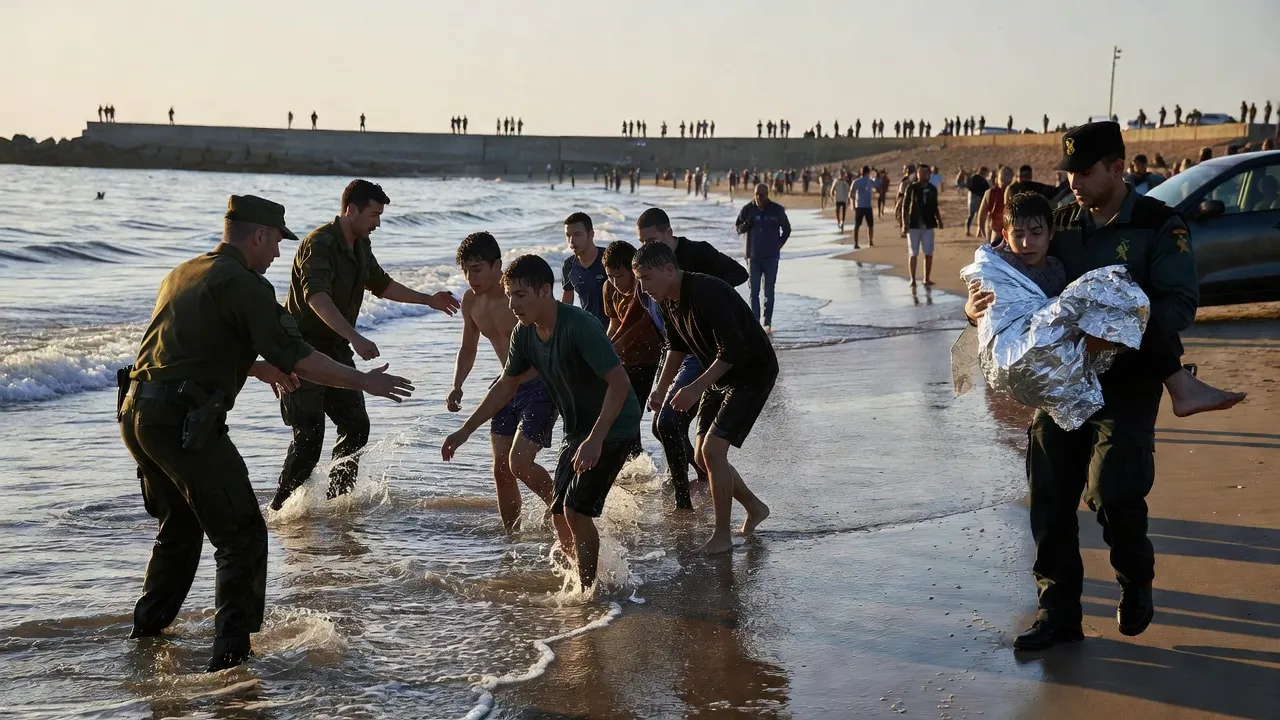
Thousands of migrants, predominantly Moroccan, crossed the border into Ceuta from Morocco over several days in late July, often swimming, in what local authorities describe as absolute chaos.
The human toll is heavy: at least nine deaths were recorded on Thursday, July 30, a figure that is part of a larger series of deaths since the beginning of the year on this shoreline.
The Spanish government deployed the army to reinforce the Guardia Civil, whose local forces were deemed overwhelmed by the scale of the influx.
The United States and Russia attribute the influx to deliberate political failure on the part of the Spanish government, deemed too permissive, while Spain and Germany explain it primarily through a technical judicial decision by the Supreme Court limiting immediate deportations of migrants who arrived by sea.
Coverage aligned with this reading
Russia relays the most extreme estimates, mentioning up to 30,000 migrants massed on the Moroccan side and comparing the event to the fall of Rome, while Spain, France and the United Kingdom stick to more measured official figures, between 1,500 and 3,000 arrivals.
Coverage aligned with this reading
Coverage that diverges
For Spain, Germany, the United Kingdom, the United States and Russia, the crisis is primarily a security matter, centered on the collapse of border control and military response, while Turkey and Argentina favor a humanitarian reading focused on the death toll and social urgency.
Coverage aligned with this reading
This grouping describes the publications analysed, not the position of these countries’ populations or of their governments.
What the coverage of each country leaves aside, while others put it forward.
United States
Russia
Germany
Preview: 3 of 9 media perspectives. Syntheses of the media analysed — not direct quotations. Method & limitations
Madrid faces its most severe migration crisis since 2021 at Ceuta, balancing humanitarian needs with military deployment.
5 sources · View sources
Berlin regards the Ceuta crisis as an alarm signal for the entire EU's external borders, while Madrid mobilizes the military amid the largest migration surge since 2021.
4 sources · View sources
Paris reads the Ceuta crisis as a lens revealing fractures within Europe over immigration, between cautious solidarity toward Madrid and open tensions with Rome.
6 sources · View sources
DOMINANT ANGLE
Madrid faces its most severe migration crisis since 2021 at Ceuta, balancing humanitarian needs with military deployment.
ANALYSIS
Madrid, July 31, 2026.
DOMINANT ANGLE
Berlin regards the Ceuta crisis as an alarm signal for the entire EU's external borders, while Madrid mobilizes the military amid the largest migration surge since 2021.
ANALYSIS
Berlin, July 31, 2026.
DOMINANT ANGLE
Paris reads the Ceuta crisis as a lens revealing fractures within Europe over immigration, between cautious solidarity toward Madrid and open tensions with Rome.
ANALYSIS
Paris, July 31, 2026.
DOMINANT ANGLE
London reads in the Ceuta crisis an additional signal of migration pressure on Europe's external borders, a theme that resonates with the UK's own debate over Channel crossings.
ANALYSIS
London, 31 July 2026.
DOMINANT ANGLE
Canberra measures the unprecedented scale of the migrant surge into Ceuta through the shocking figure of 2,000 to 3,000 crossings in a single day
ANALYSIS
Sydney, July 31, 2026.
DOMINANT ANGLE
Washington frames Spain's migration crisis as confirmation of its own border doctrine, with the White House positioning the Ceuta surge as evidence of the consequences of permissive immigration policies.
ANALYSIS
Washington, July 31, 2026.
DOMINANT ANGLE
Buenos Aires monitors the Ceuta crisis minute by minute, driven by linguistic and cultural proximity to Spain, measuring the severity of an influx compared to 2021.
ANALYSIS
Buenos Aires, July 31, 2026.
DOMINANT ANGLE
Moscow reads the Ceuta migrant surge as evidence of structural migratory chaos in Europe, attributing it to political choices by Madrid and Brussels rather than external circumstances.
ANALYSIS
Moscow, July 31, 2026.
DOMINANT ANGLE
Ankara frames Ceuta's migrant crisis as evidence of Europe's inability to manage borders collectively, comparing the situation to Turkey's own experience as the world's largest refugee host and drawing attention to the lack of EU solidarity on migration despite a decade-long partnership agreement.
ANALYSIS
Ankara, July 31, 2026.
Explore every perspective on this subject across 9 countries.
Compare viewpoints and see where they diverge.
published on
countries
sources
articles
gap
Several thousand migrants have crossed from Morocco into the Spanish enclave of Ceuta in recent days, many of them swimming from Tarajal beach. The Spanish government recorded at least nine deaths on Thursday 30 July and announced the deployment of soldiers, a diving unit and a navy vessel to reinforce the Guardia Civil. It is the largest migration surge recorded in the enclave since the May 2021 crisis. Prime Minister Pedro Sanchez and Interior Minister Fernando Grande-Marlaska are due to travel to Ceuta on Friday 31 July.
Measured with the previous method (distance between texts), on a different scale.