
Common ground and differences in coverage across the media analysed.
Ezzedine Al-Haddad, leader of Hamas's military wing (Al-Qassam Brigades) in Gaza, was killed on May 16, 2026 in an Israeli airstrike on a residential building in the Rimal neighborhood of Gaza City, confirmed by the Israeli military, Shin Bet, and Hamas officials.
Al-Haddad took command of Hamas's armed wing in Gaza following Mohammad Sinwar's death in May 2025; all perspectives describe him as one of the last senior Hamas military commanders directly linked to planning the October 7, 2023 attacks.
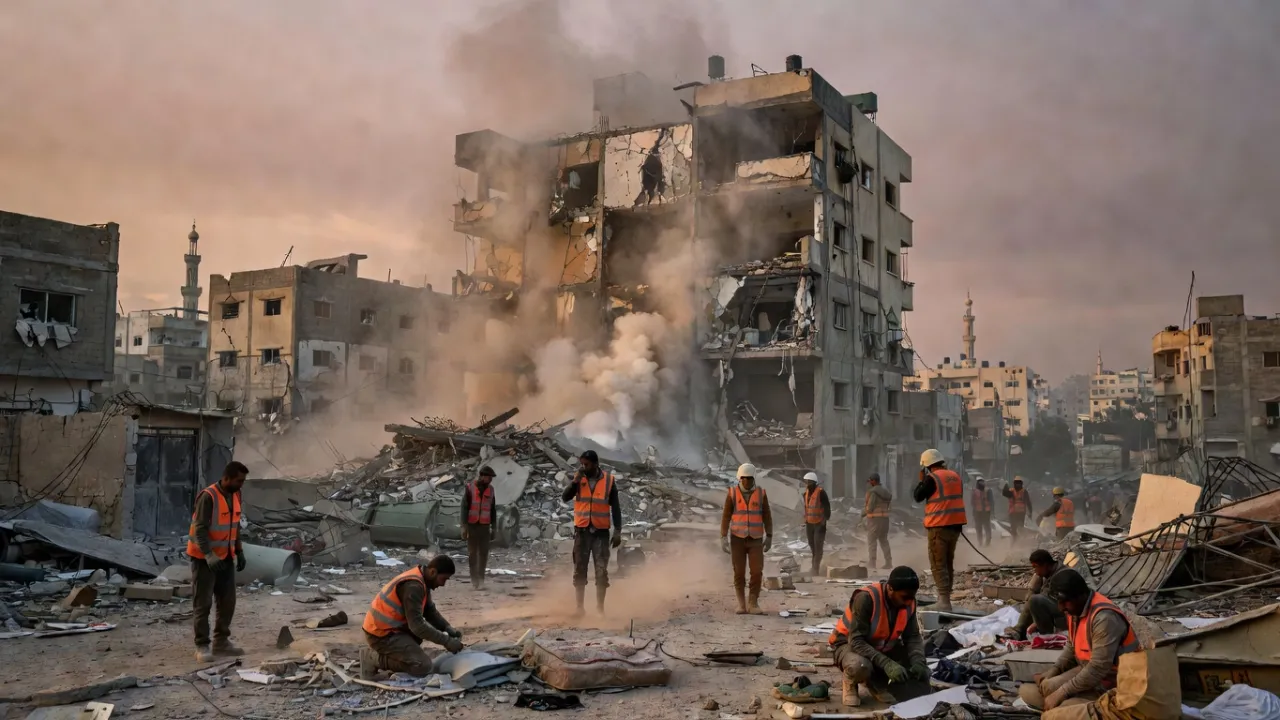
The strike also resulted in the deaths of at least seven Palestinians, including Al-Haddad's wife and daughter, and wounded dozens of people, according to Gaza medical authorities.
Qatar, Brazil, and Canada perspectives place central emphasis on collateral civilian casualties (wife, daughter, baby, building residents), while Australia, Singapore, and France address this toll more briefly in favor of military-strategic dimensions.
Qatar's perspective, reflecting Hamas and Al Jazeera reporting, presents the strike as an explicit violation of the ceasefire agreement. Other perspectives (France, Germany, Canada, Australia, India, Singapore, Brazil) describe it as occurring within fragile truce context without taking a legal position.
Canada, India, Singapore, and Germany incorporate the figure of 72,700 deaths since conflict onset according to Gaza Health Ministry, noting its reliability. France and Australia omit this cumulative figure, focusing on the immediate strike toll.
This grouping describes the publications analysed, not the position of these countries’ populations or of their governments.
What the coverage of each country leaves aside, while others put it forward.
France
Qatar
Australia
Preview: 3 of 8 media perspectives. Syntheses of the media analysed — not direct quotations. Method & limitations
Paris covers the elimination of Hamas's military chief with factual rigor, reporting without ambiguity the cross-confirmed Israeli and Palestinian statements, while documenting the civilian toll of the strike.
2 sources · View sources
Ottawa frames the removal of Hamas's military chief through a dual lens: recognition of a military milestone for Israel and consistent emphasis on the human cost of the Gaza conflict, supported by numerical data presented as reliable by the international community.
2 sources · View sources
Canberra frames the death of the Hamas military chief as a major operational development against the backdrop of stalled indirect negotiations, emphasizing both the strike's immediate tactical scope and its limited implications for a broader crisis resolution.
2 sources · View sources
DOMINANT ANGLE
Paris covers the elimination of Hamas's military chief with factual rigor, reporting without ambiguity the cross-confirmed Israeli and Palestinian statements, while documenting the civilian toll of the strike.
ANALYSIS
Paris, May 16, 2026.
DOMINANT ANGLE
Ottawa frames the removal of Hamas's military chief through a dual lens: recognition of a military milestone for Israel and consistent emphasis on the human cost of the Gaza conflict, supported by numerical data presented as reliable by the international community.
ANALYSIS
Ottawa, May 16, 2026.
DOMINANT ANGLE
Canberra frames the death of the Hamas military chief as a major operational development against the backdrop of stalled indirect negotiations, emphasizing both the strike's immediate tactical scope and its limited implications for a broader crisis resolution.
ANALYSIS
Canberra, May 16, 2026.
DOMINANT ANGLE
Berlin monitors al-Haddad's elimination with factual attention, emphasizing the direct connection to October 7, 2023 and persistent tensions over ceasefire compliance.
ANALYSIS
Berlin, May 16, 2026.
DOMINANT ANGLE
New Delhi follows the elimination of Hamas military leader with close attention to documented facts and figures, presenting information from both sides without taking a stance in the Israeli-Palestinian conflict.
ANALYSIS
New Delhi, May 16, 2026.
DOMINANT ANGLE
Doha, the seat of ceasefire mediation efforts, frames the elimination of the Izz al-Din al-Haddad, Qassam Brigades chief, as a breach of the standing agreement, emphasizing civilian casualties—women, children, Remal neighborhood residents—rather than the military profile of the target.
ANALYSIS
Doha, May 16, 2026.
DOMINANT ANGLE
Singapore views Al-Haddad's elimination as an operational milestone in Israel's decapitation campaign against Hamas leadership, while noting the persistence of violence despite the October ceasefire.
ANALYSIS
Singapore, May 16, 2026.
DOMINANT ANGLE
Brasilia tracks the elimination of Hamas military commander with focus on civilian casualties and persistent obstacles to ceasefire negotiations.
ANALYSIS
Brasilia, May 16, 2026.
Explore every perspective on this subject across 8 countries.
Compare viewpoints and see where they diverge.
published on
countries
sources
articles
gap
On 16 May 2026, an Israeli airstrike hit a residential building in the Rimal district of Gaza City, killing Ezzedine Al-Haddad, the head of Hamas's military wing (the Al-Qassam Brigades) in Gaza. His death was confirmed by the Israeli military, the Shin Bet and Hamas officials. Al-Haddad had taken command of the armed wing after the death of Mohammad Sinwar in May 2025; he was described as one of the last senior commanders directly tied to the planning of the 7 October 2023 attacks.
According to Gaza medical authorities, the strike also killed at least seven Palestinians — including Al-Haddad's wife and daughter — and wounded several dozen people. The operation came while a ceasefire had been in force since October 2025, under American mediation, whose fragility is widely emphasised.
The event fits into an Israeli strategy of removing the movement's leaders: Al-Haddad is the third head of the armed wing eliminated since 7 October 2023, after Mohammed Deif and Mohammad Sinwar. Since the truce, Israel has maintained targeted strikes against Hamas figures while indirectly negotiating a post-war peace plan backed by the Trump administration. Hamas, which has not carried out the disarmament foreseen in the second phase of the deal, and Israel accuse each other of repeated violations.
Several points remain disputed. Some actors, including Hamas, frame the strike as an explicit breach of the ceasefire, while others place it within a context of a fragile truce without ruling on its legal classification. The weight given to the immediate civilian toll, to the cumulative figure of more than 72,700 deaths cited by Gaza health authorities, and to the deadlock in post-war negotiations varies markedly from one account to another.
Measured with the previous method (distance between texts), on a different scale.