
Common ground and differences in coverage across the media analysed.
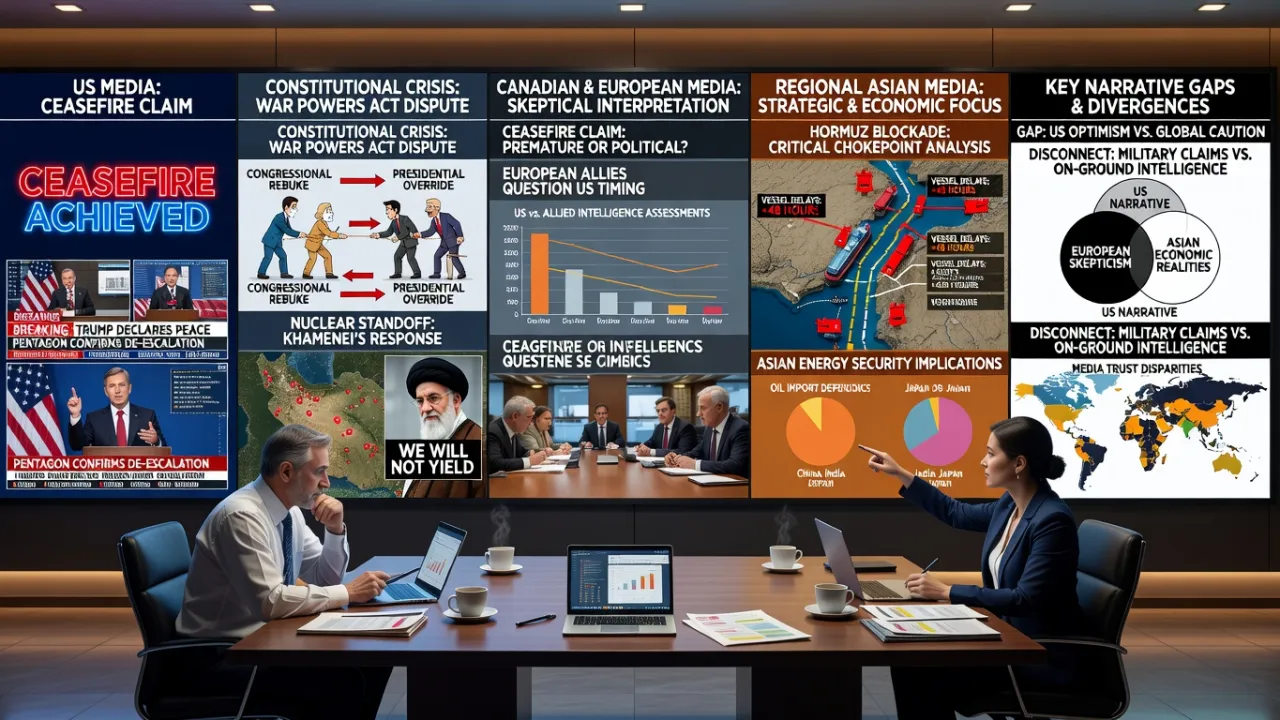
The 60-day War Powers Act deadline has been reached, triggering an unprecedented constitutional crisis not seen since Vietnam
Khamenei has rejected any dismantlement of Iran's nuclear program as a precondition for a deal
The Hormuz blockade keeps oil prices at historic highs (above $125/barrel), with global economic ripple effects
US conservative media backs Trump's claim that the truce 'closes' the conflict and exempts him from a congressional vote. Liberal US media, Canada, and Europe consider this interpretation illegal and dangerous for democracy.
Coverage aligned with this reading
Coverage that diverges
Israel and the US demand full dismantlement. Iran, with rhetorical backing from Russia, frames it as a non-negotiable sovereign right. Japan, Pakistan, and India call for a diplomatic solution without preconditions.
Coverage that diverges
Singapore, South Korea, and Japan — energy-import-dependent economies — describe the blockade as an economic catastrophe. Qatar/Al Jazeera frames it as a tool of imperial domination. Washington presents it as legitimate strategic pressure.
Coverage aligned with this reading
Coverage that diverges
This grouping describes the publications analysed, not the position of these countries’ populations or of their governments.
Preview: 3 of 15 media perspectives. Syntheses of the media analysed — not direct quotations. Method & limitations
France fears a prolonged crisis: Hormuz strangled, Trump's Strait
2 sources · View sources
Ottawa tracks the US constitutional crisis: Iran war without legal end
2 sources · View sources
Berlin under Trump's fire: Merz accused of 'interfering' in Iran
2 sources · View sources
DOMINANT ANGLE
France fears a prolonged crisis: Hormuz strangled, Trump's Strait
ANALYSIS
From Paris, the Iran-Trump war is primarily an economic and humanitarian crisis.
DOMINANT ANGLE
Ottawa tracks the US constitutional crisis: Iran war without legal end
ANALYSIS
Canada views the Iran-Trump war through two simultaneous lenses.
DOMINANT ANGLE
Berlin under Trump's fire: Merz accused of 'interfering' in Iran
ANALYSIS
Germany experiences the Iran-Trump war as an additional transatlantic humiliation.
DOMINANT ANGLE
New Delhi between Hormuz and BRICS: India tests its leadership under pressure
ANALYSIS
India watches the Iran-Trump war with the double anxiety of an emerging power caught between two fires.
DOMINANT ANGLE
Tehran: resistance victory, the nuclear program is sacred
ANALYSIS
From Tehran, the message is unambiguous: Iran resists and will not capitulate.
DOMINANT ANGLE
Jerusalem: Iran's nuclear threat is now the IDF's absolute priority
ANALYSIS
For Israel, day 60 of the war is not enough of a victory.
DOMINANT ANGLE
Tokyo diplomat: Takaichi calls Tehran to guarantee free passage
ANALYSIS
Japan is on the front line of the energy shock from the Hormuz blockade.
DOMINANT ANGLE
Seoul: the Iran war through a North Korean and energy lens
ANALYSIS
Korea Times and Yonhap cover the Iran-Trump war with particular vigilance tied to the Korean security context.
DOMINANT ANGLE
Islamabad as mediator: diplomacy under maximum pressure
ANALYSIS
Pakistan lives day 60 as an existential test of its diplomacy.
DOMINANT ANGLE
Al Jazeera: the real cost of the war, Congress bypassed, Somalia destabilized
ANALYSIS
Al Jazeera and Gulf Times provide the most comprehensive and critical coverage of the war.
DOMINANT ANGLE
Moscow: sovereign Iran vs. declining empire — RT amplifies resistance narrative
ANALYSIS
RT and TASS consistently build a meta-narrative: Iran is sovereign, America is in decline.
DOMINANT ANGLE
Singapore stands strong: PM Wong on Hormuz, resilience and maritime anxiety
ANALYSIS
Singapore — a global maritime hub — is acutely exposed to the Hormuz blockade.
DOMINANT ANGLE
London: Hegseth before the Senate, the Royal Navy warns on Hormuz
ANALYSIS
British media combines two narrative threads.
DOMINANT ANGLE
Washington: war 'terminated' by decree, Congress outraged
ANALYSIS
US coverage is deeply polarized on the constitutional question.
DOMINANT ANGLE
Beijing: Iran oil sanctions, military denials, and Korean naphtha realignment
ANALYSIS
China sits at the center of the parallel economic war around the Iran-Trump conflict.
Explore every perspective on this subject across 15 countries.
Compare viewpoints and see where they diverge.
published on
countries
sources
articles
gap
Sixty days after the start of the American strikes against Iran, the conflict crosses a legal threshold as much as a military one. The sixty-day deadline set by the 1973 War Powers Act has been reached: this law, drafted after the Vietnam War to limit a president's use of force, normally requires the White House to obtain a vote from Congress beyond that point. Donald Trump argues that hostilities are "over" and that a truce makes such a vote unnecessary; Congress and many constitutional scholars dispute this reading, seeing it as a way of bypassing the rule.
On the diplomatic front, Ayatollah Mojtaba Khamenei has rejected any dismantling of Iran's nuclear program as a precondition for an agreement. The truce declared in Washington is not recognized by Tehran, which refuses to accept its terms. Both sides thus hold irreconcilable positions, one speaking of the end of the conflict, the other of a continuing confrontation.
The repercussions are global. The Strait of Hormuz remains partially blocked, keeping the price of oil above 125 dollars a barrel, a historically high level that weighs first on energy-importing economies. The actors involved disagree on the very nature of this blockade, described variously as strategic pressure, an economic disaster, or a tool of domination.
Several uncertainties remain. The true cost of the war is the subject of estimates that diverge widely, and the scale of the human consequences as well as the outcome of mediation channels remain disputed. It is this overlap of an internal constitutional crisis, a nuclear standoff, and an energy shock that makes the situation as unstable as it is hard to read.
Measured with the previous method (distance between texts), on a different scale.