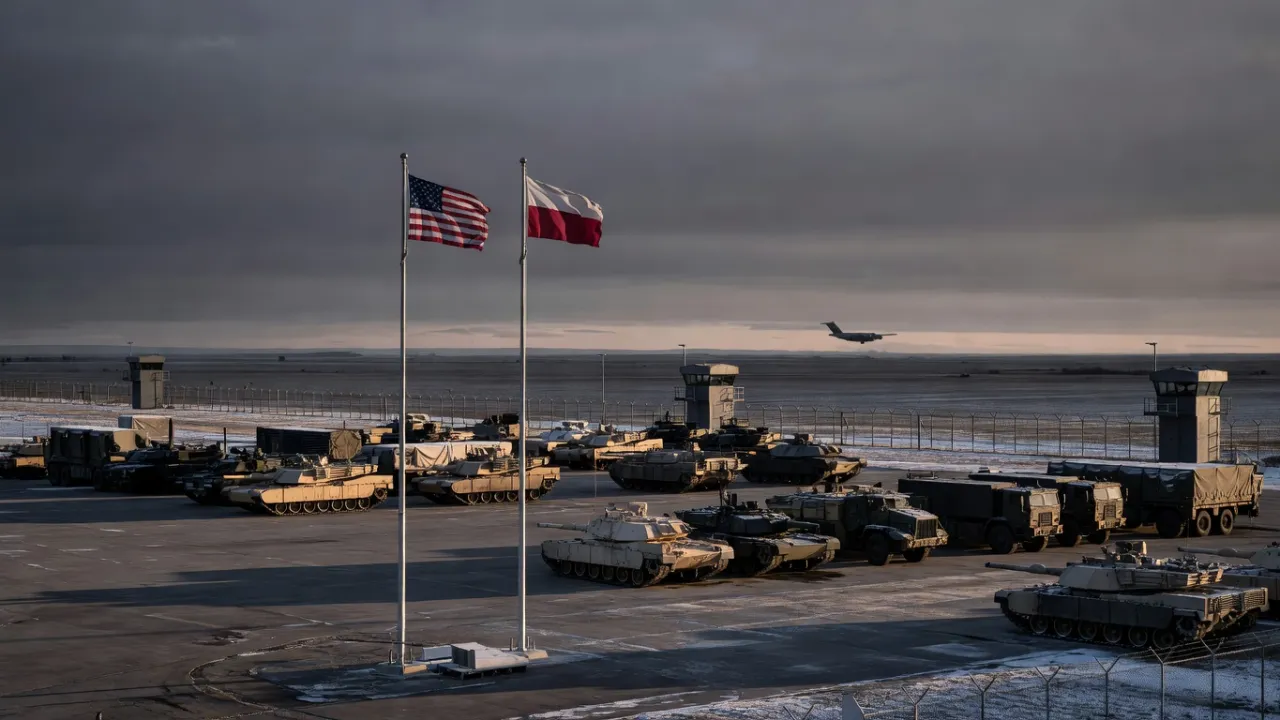
Trump says US will send additional 5,000 troops to Poland
published on
countries
sources
articles
Measured with the previous method (distance between texts), on a different scale.
On 21 May 2026, Donald Trump announced on Truth Social the deployment of an additional 5,000 U.S. troops to Poland. He justified the decision by citing his personal relationship with Polish president Karol Nawrocki, whom he had backed during the Polish presidential election. The announcement came a few days after the Pentagon cancelled or postponed an earlier deployment of 4,000 troops to the same country, marking a reversal in less than a week.
At the time of the announcement, Washington provided no operational details: no timeline, no indication of where the troops would come from, and no precise location. The deployment ran counter to expectations of a reduced U.S. presence in Europe, amid a broader review of the American military posture on the continent.
That review has been under way since early 2026: a withdrawal of 5,000 troops from Germany was announced in early May, and rotational brigades were cut from four to three. The selective reinforcement of Poland — whose defence spending reaches 4.8% of GDP, the highest in NATO — fits a logic in which U.S. commitment appears tied both to an ally's budgetary effort and to closeness between leaders. The announcement coincided with a NATO foreign ministers' summit in Sweden.
The meaning of the decision remains disputed. Some actors read it as a political reward linked to the rapport between Trump and Nawrocki; others, particularly on the eastern flank, interpret it as a signal of collective security, however conditional. Several draw a direct parallel between the 5,000 troops sent to Poland and the 5,000 withdrawn from Germany, while others make no such link. The durability of the commitment remains uncertain.
What the comparison reveals
Common ground and differences in coverage across the media analysed.
What the media report in common
Trump announced the deployment of 5,000 additional US soldiers to Poland via a Truth Social post on May 21, 2026.
Trump explicitly justified this decision by his personal relationship with Polish President Karol Nawrocki, whom he had supported during Poland's presidential election.
The announcement came days after the Pentagon cancelled or postponed a previous deployment of 4,000 soldiers to Poland, representing a reversal within a week.
Where media coverage diverges
Nature of the decision: strategic calculation or political reward
Most perspectives frame the decision as a political reward linked to personal affinities between Trump and Nawrocki; Eastern European countries see it more as a signal of collective security, albeit conditional.
Connection to troop withdrawal from Germany
Several perspectives draw a direct symmetry between the 5,000 soldiers sent to Poland and the 5,000 withdrawn from Germany following Merz's Iran criticisms; others do not establish this link.
Connection to the Iran crisis
Some perspectives explicitly link the US troop reorganization in Europe to Washington's pressure on allies regarding Iran and the Strait of Hormuz; others completely ignore this dimension.
This grouping describes the publications analysed, not the position of these countries’ populations or of their governments.
Blind spots
What the coverage of each country leaves aside, while others put it forward.
 Ukraine
- Impact of NATO eastern flank reinforcement on Ukrainian military situation
- Strategic significance for Kyiv of increased US presence in Poland in relation to Russia
 Russia
- Legitimate security concerns of Russia's neighboring countries justifying NATO reinforcement
- Official Russian diplomatic responses to the deployment
 Greece
- Connection between Poland deployment and US troop withdrawal from Germany
- US pressure on European allies regarding Iran and the Strait of Hormuz
- Internal NATO tensions over defense burden-sharing
How each country reads it
Preview: 3 of 19 media perspectives. Syntheses of the media analysed — not direct quotations. Method & limitations
 Brazil
Brasília views this deployment as a sign of an NATO under personal influence of Trump, where bilateral relations take precedence over the collective doctrine of the Atlantic Alliance.
1 source · View sources
 Germany
Berlin sees Trump's announcement as a direct reversal of the US withdrawal ordered from Germany: the 5,000 soldiers leaving German soil are reorganized towards Poland, rewarding an ideological ally and sanctioning a critical partner.
2 sources · View sources
 Spain
Madrid sees Trump's announcement as a political tool to reward conservative allies and a direct pressure on Spain, specifically targeted by Secretary of State Rubio on the issue of NATO bases.
2 sources · View sources
The full text, country by country
Brazil
DOMINANT ANGLE
Brasília views this deployment as a sign of an NATO under personal influence of Trump, where bilateral relations take precedence over the collective doctrine of the Atlantic Alliance.
ANALYSIS
Brasília, May 21, 2026.
Germany
DOMINANT ANGLE
Berlin sees Trump's announcement as a direct reversal of the US withdrawal ordered from Germany: the 5,000 soldiers leaving German soil are reorganized towards Poland, rewarding an ideological ally and sanctioning a critical partner.
ANALYSIS
Berlin, May 21, 2026.
Spain
DOMINANT ANGLE
Madrid sees Trump's announcement as a political tool to reward conservative allies and a direct pressure on Spain, specifically targeted by Secretary of State Rubio on the issue of NATO bases.
ANALYSIS
Madrid, May 21, 2026.
 France
DOMINANT ANGLE
Paris views the announcement as a demonstration of Trump's personalized diplomacy: a deployment granted not on collective strategic criteria but on the quality of a bilateral relationship, in a context where Washington redistributes its forces in Europe according to a principle of reward and sanction.
ANALYSIS
Paris, May 21, 2026.
Greece
DOMINANT ANGLE
Athens views Trump's announcement as a personal diplomatic gesture, with the US decision explicitly linked to the election of new Polish President Nawrocki rather than a NATO strategic doctrine.
ANALYSIS
Athens, May 21, 2026.
 Israel
DOMINANT ANGLE
Tel Aviv sees in Trump's announcement a clear signal on how Washington rewards its close ideological allies, a logic that Jerusalem is familiar with and closely follows.
ANALYSIS
Jerusalem, May 21, 2026.
 India
DOMINANT ANGLE
New Delhi views Trump's announcement of 5,000 additional US troops in Poland through the lens of European geopolitical realignments, noting that the decision is explicitly based on Trump's personal ties to Polish President Karol Nawrocki, a nationalist ally Trump supported during the elections.
ANALYSIS
New Delhi, May 22, 2026.
 Japan
DOMINANT ANGLE
Tokyo sees Trump's announcement of sending 5,000 additional troops to Poland as a signal that US foreign policy is becoming more personalized, where military alliances now depend more on the relationships between leaders than on institutional commitments to NATO.
ANALYSIS
Tokyo, May 21, 2026.
 South Korea
DOMINANT ANGLE
Seoul sees Trump's announcement as a strong signal on personalized defense diplomacy: the deployment of 5,000 additional soldiers to Poland is explicitly based on a bilateral relationship between the two heads of state, a model that the Korean peninsula is familiar with.
ANALYSIS
Seoul, May 22, 2026.
 Mexico
DOMINANT ANGLE
Mexico frames Trump's U-turn on Poland deployment as a product of personal affinity rather than a coherent strategy: the 'cuate' Pole weighs more than the calculations of the Atlantic Alliance.
ANALYSIS
Mexico City, May 21, 2026.
 Netherlands
DOMINANT ANGLE
Amsterdam reacts with a mix of relief and puzzlement to the deployment of 5,000 US troops to Poland, highlighting the striking contrast with earlier expectations of a reduction in US forces in Europe.
ANALYSIS
Amsterdam, May 21, 2026.
 Poland
DOMINANT ANGLE
Warsaw welcomes Trump's announcement with relief, but the crisis of rotations has revealed cracks in the influence game between the Nawrocki presidency and the Tusk government.
ANALYSIS
Warsaw, May 21, 2026.
 Qatar
DOMINANT ANGLE
Doha places Trump's announcement within a framework of internal contradictions within the US administration, linking the Atlantic military reorganization to Washington's pressure on its European allies regarding Iran and the Strait of Hormuz.
ANALYSIS
Doha, May 21, 2026.
 Romania
DOMINANT ANGLE
Bucharest sees Trump's announcement as a welcome but fragile U-turn, after weeks of confusion over the US setup on the eastern flank — relieving without dispelling doubts about Washington's strategic reliability.
ANALYSIS
Bucharest, May 21, 2026.
 Serbia
DOMINANT ANGLE
Belgrade reports on Trump's announcement without editorial comment: the US will send 5,000 additional soldiers to Poland, a decision Trump directly links to his personal support for Polish President Nawrocki.
ANALYSIS
Belgrade, May 21, 2026.
Russia
DOMINANT ANGLE
Moscow denounces in Trump's announcement a military reinforcement at the gates of Russia dressed up as electoral reward, and not as a response to a real threat.
ANALYSIS
Moscow, May 21, 2026.
 Sweden
DOMINANT ANGLE
Stockholm views Trump's announcement as a erratic U-turn rather than a reliable signal of re-engagement with NATO, in a context where Sweden is hosting a NATO summit in Helsingborg.
ANALYSIS
Stockholm, May 22, 2026.
 Singapore
DOMINANT ANGLE
Singapore views Trump's announcement as a strategic pivot anchored in personal ties between leaders, highlighting the relational dimension of US defense policy over its doctrinal coherence.
ANALYSIS
Singapore, May 21, 2026.
Ukraine
DOMINANT ANGLE
Kyiv views the announcement as a sudden U-turn after the controversial cancellation of 4,000 troops in early May, revealing an American policy in Europe driven by Trump's personal relationships rather than a coherent doctrine.
ANALYSIS
Kyiv, May 21, 2026.
Explore every perspective on this subject across 19 countries.
Compare viewpoints and see where they diverge.