Common ground and differences in coverage across the media analysed.
The Israel-Iran exchanges of June 7-8, 2026 broke the April ceasefire two months after it came into force, raising fears of a return to full-scale hostilities.
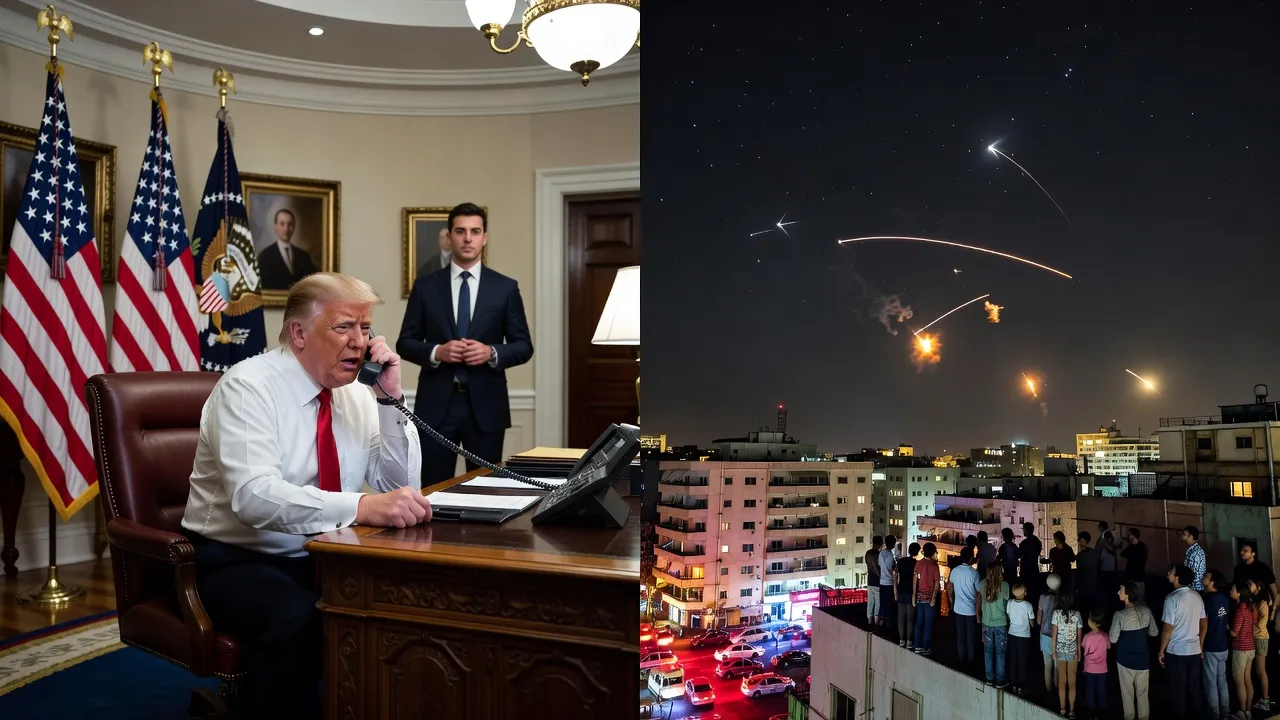
Trump publicly demanded both parties stop shooting immediately — a degree of direct presidential engagement observers across the spectrum described as unusual even for a Middle East crisis.
Israeli and American conservative press presents Israel as responding to prior Iranian provocations ; Al Jazeera and Nigerian press point to Israeli strikes on Beirut as trigger ; French and Italian press adopts a documentary position without designating a primary responsible party.
Coverage aligned with this reading
Indian and Canadian press reads Netanyahu's defiance as a strategic turning point. American press is divided between those seeing it as a Trump weakness and those seeing it as alliance robustness.
Italian press publishes a fact-check cataloguing every time Trump announced an imminent deal over 100 days without result. Israeli right-wing and American conservative press treats the declaration as a credible goal.
This grouping describes the publications analysed, not the position of these countries’ populations or of their governments.
What the coverage of each country leaves aside, while others put it forward.
United States
Israel
France
Preview: 3 of 8 media perspectives. Syntheses of the media analysed — not direct quotations. Method & limitations
Washington oscillates between commander-in-chief and impotence : Trump orders halt to strikes, Netanyahu continues
10 sources · View sources
Paris reads a two-level war : missiles on the ground and a narrative battle between Washington and Tel Aviv
5 sources · View sources
Ottawa watches the Trump-Netanyahu standoff : an ally who disobeys and a peace deal receding with every promise
4 sources · View sources
DOMINANT ANGLE
Washington oscillates between commander-in-chief and impotence : Trump orders halt to strikes, Netanyahu continues
ANALYSIS
Washington experienced June 7-8, 2026 with a mixture of disbelief and editorial candor.
DOMINANT ANGLE
Paris reads a two-level war : missiles on the ground and a narrative battle between Washington and Tel Aviv
ANALYSIS
Paris followed the night of June 7-8 live.
DOMINANT ANGLE
Ottawa watches the Trump-Netanyahu standoff : an ally who disobeys and a peace deal receding with every promise
ANALYSIS
Ottawa followed June 7-8 with the common line characterizing Canadian coverage of Middle Eastern crises : document the facts, signal the economic risks, and avoid sharp judgments on political responsibilities.
DOMINANT ANGLE
Jerusalem chooses its Eshkol moment : Netanyahu stands up to Trump and claims the right to self-defense
ANALYSIS
Jerusalem experienced June 7-8, 2026 with the awareness of a turning point.
DOMINANT ANGLE
Lagos watches a war that exhausts the world : Trump calls for restraint, the missiles keep falling
ANALYSIS
Lagos and Abuja followed June 7-8 with the attention Nigeria reserves for global oil crises.
DOMINANT ANGLE
New Delhi measures the damage : 100 days of war weighing on Indian markets as the Trump-Netanyahu relationship fractures
ANALYSIS
New Delhi followed June 7-8, 2026 with the attention India reserves for crises affecting its direct strategic interests in the Gulf region.
DOMINANT ANGLE
Doha questions the logic of a war without end : the truce collapses, the Strait of Hormuz waits, civilians pay
ANALYSIS
Doha posed the central question on June 8 morning, through Al Jazeera : Iran and Israel bomb each other — Is the ceasefire over ?
DOMINANT ANGLE
Rome fact-checks Trump : how many times has he announced an imminent Iran deal ? The answer is instructive
ANALYSIS
Rome brought the most analytically incisive angle of the week : Adnkronos published a detailed fact-check on how many times Trump has announced an imminent deal with Iran since the conflict began.
Explore every perspective on this subject across 8 countries.
Compare viewpoints and see where they diverge.
published on
countries
sources
articles
gap
On 7 and 8 June 2026, a fresh exchange of strikes between Iran and Israel broke the ceasefire reached in April, two months after it took effect, reviving fears of a broader resumption of hostilities. Donald Trump then publicly demanded that both sides stop firing immediately and promised a total American victory within two weeks. Despite this direct presidential order, Israel continued its bombardments, exposing an open disagreement between Washington and Tel Aviv.
This sequence comes on the 101st day of a conflict that has already caused thousands of casualties and led to the closure of the Strait of Hormuz for six weeks. The refusal to comply with Trump's demand marks a first under this term: a key ally is conducting its own military operations against the explicit position of the White House. The timing, ahead of the first midterm primaries, is read by many observers as a political signal as much as a diplomatic one.
Several points remain disputed. Actors disagree on the origin of the ceasefire's collapse, some pointing to prior Iranian provocations, others to Israeli strikes in Lebanon. The significance of Israel's defiance is also divisive: some see a strategic turning point, others a weakness or, conversely, proof of the alliance's strength. Finally, the promise of victory within two weeks draws skepticism from those recalling repeated announcements of an imminent deal over the past hundred days, while others treat it as a credible course. The impact on civilian populations, markets and oil remains unevenly covered.
Measured with the previous method (distance between texts), on a different scale.