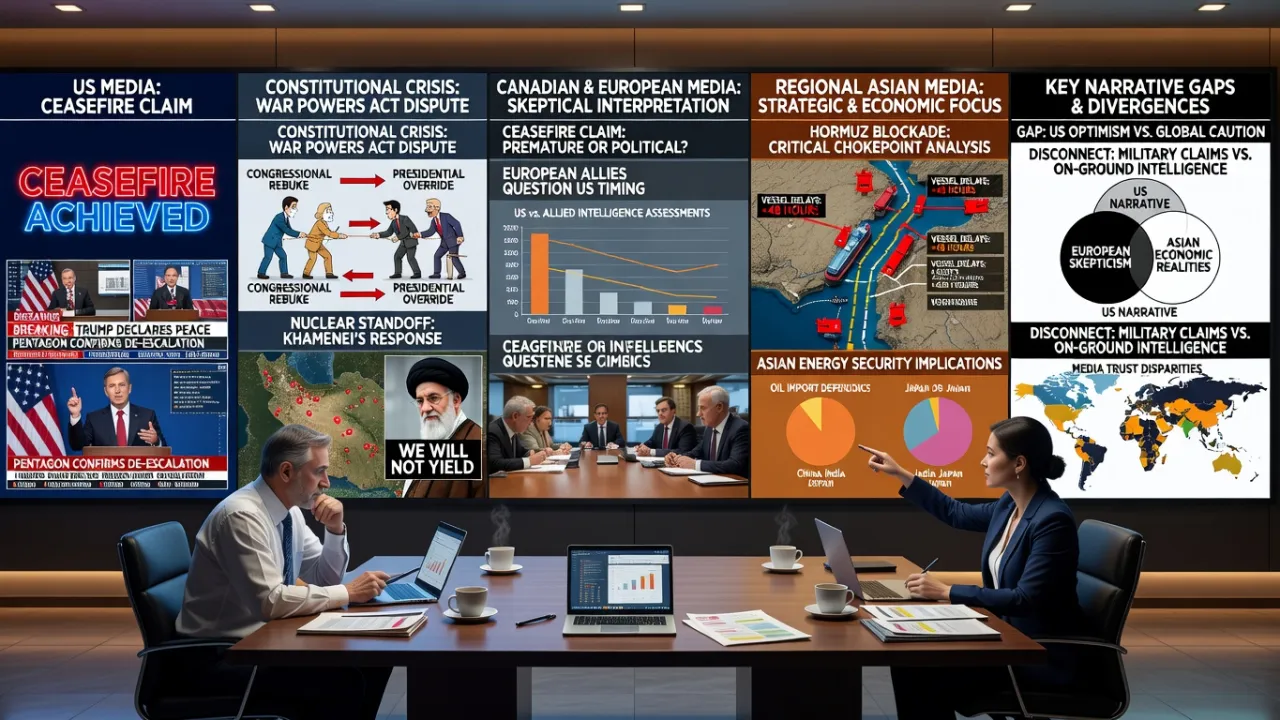
Sixty days after the start of the American strikes against Iran, the conflict crosses a legal threshold as much as a military one. The sixty-day deadline set by the 1973 War Powers Act has been reached: this law, drafted after the Vietnam War to limit a president's use of force, normally requires the White House to obtain a vote from Congress beyond that point. Donald Trump argues that hostilities are "over" and that a truce makes such a vote unnecessary; Congress and many constitutional scholars dispute this reading, seeing it as a way of bypassing the rule.
On the diplomatic front, Ayatollah Mojtaba Khamenei has rejected any dismantling of Iran's nuclear program as a precondition for an agreement. The truce declared in Washington is not recognized by Tehran, which refuses to accept its terms. Both sides thus hold irreconcilable positions, one speaking of the end of the conflict, the other of a continuing confrontation.
The repercussions are global. The Strait of Hormuz remains partially blocked, keeping the price of oil above 125 dollars a barrel, a historically high level that weighs first on energy-importing economies. The actors involved disagree on the very nature of this blockade, described variously as strategic pressure, an economic disaster, or a tool of domination.
Several uncertainties remain. The true cost of the war is the subject of estimates that diverge widely, and the scale of the human consequences as well as the outcome of mediation channels remain disputed. It is this overlap of an internal constitutional crisis, a nuclear standoff, and an energy shock that makes the situation as unstable as it is hard to read.