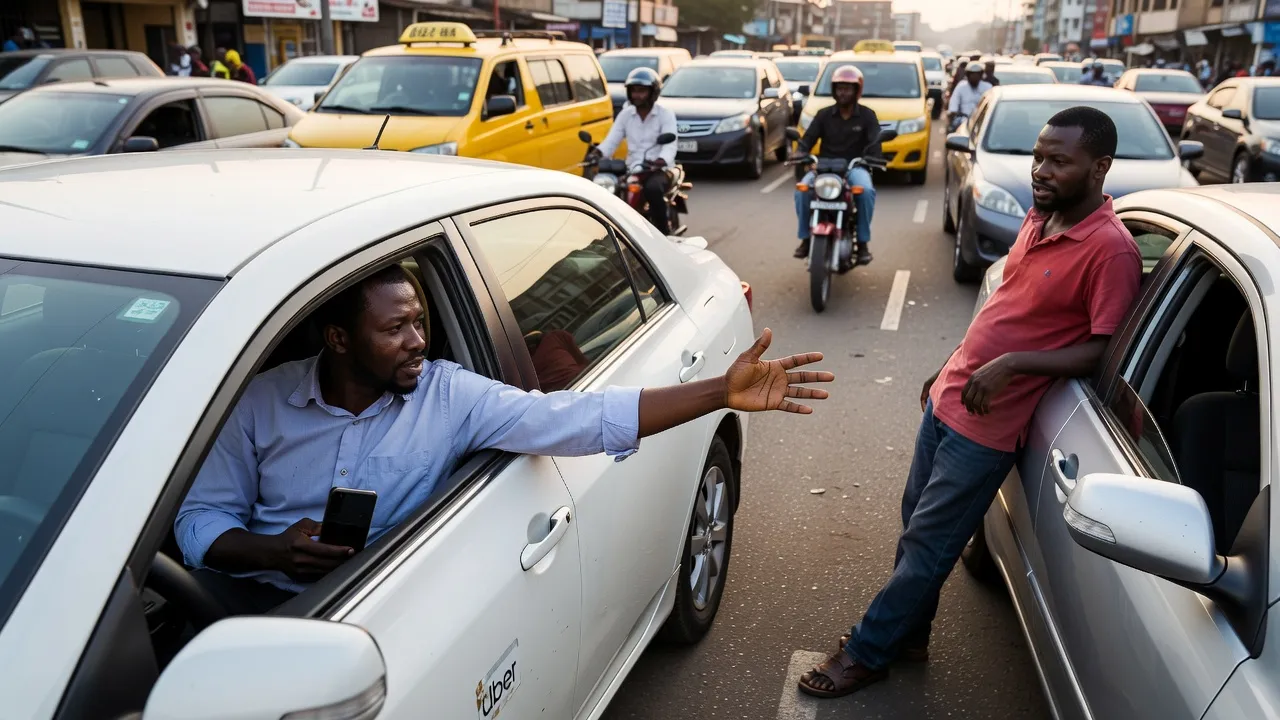
Common ground and differences in coverage across the media analysed.
Uber announced on September 2, 2026, the elimination of around 3,300 positions, approximately 10% of its roughly 34,000 employees worldwide — its largest workforce reduction in several years.
Uber's management, through the voice of its CEO Dara Khosrowshahi, justifies the cuts by citing a desire to simplify management layers and free up resources for the future of autonomous driving.
The announcement of job cuts came on the same day as the recommendation by Delivery Hero's board of directors to accept Uber's acquisition offer.
Nigeria frames its own withdrawal as a sudden abandonment, echoing the union's accusation of AUATON's exploitative model, while France and Colombia, which also report on this closure, treat it as a minor fact within a global financial arbitration, without passing judgment.
France and Colombia present Nigeria's and Uganda's withdrawal as a direct consequence of the same financial streamlining movement that led to 3,300 job cuts, while Nigeria views it as a separate decision, motivated by the sector's economic model rather than Uber's global strategy.
Some Nigerian media outlets link Uber's departure, through an opposition advisor, to a perceived hostile business climate under the Tinubu government, while France and Colombia do not mention any dimension of Nigerian domestic politics, focusing their analysis on the company's global financial strategy.
This grouping describes the publications analysed, not the position of these countries’ populations or of their governments.
What the coverage of each country leaves aside, while others put it forward.
Nigeria
Germany
France
Colombia
Preview: 3 of 7 media perspectives. Syntheses of the media analysed — not direct quotations. Method & limitations
Nigeria is particularly concerned about Uber's silence towards its drivers: twelve years of presence erased in a statement, without a transition plan, while the AUATON union denounces an "exploitative" model and Bolt promises to stay.
3 sources · View sources
Berlin is deciphering Uber's restructuring primarily through the lens of Delivery Hero: its headquarters will remain in the capital until 2029, employment will be stabilized, and up to two billion euros in investment have been promised in Germany.
2 sources · View sources
Paris views Uber's staff cuts as a capital trade-off: sacrificing 3,300 jobs and two African markets to fund, up to $10 billion, its bet on robotaxis.
2 sources · View sources
DOMINANT ANGLE
Nigeria is particularly concerned about Uber's silence towards its drivers: twelve years of presence erased in a statement, without a transition plan, while the AUATON union denounces an "exploitative" model and Bolt promises to stay.
ANALYSIS
Lagos, September 3, 2026.
DOMINANT ANGLE
Berlin is deciphering Uber's restructuring primarily through the lens of Delivery Hero: its headquarters will remain in the capital until 2029, employment will be stabilized, and up to two billion euros in investment have been promised in Germany.
ANALYSIS
Berlin, September 3, 2026.
DOMINANT ANGLE
Paris views Uber's staff cuts as a capital trade-off: sacrificing 3,300 jobs and two African markets to fund, up to $10 billion, its bet on robotaxis.
ANALYSIS
Paris, September 3, 2026.
DOMINANT ANGLE
Bogotá is first looking at the financial mechanics behind the layoffs at Uber: what the local economic press is taking away is the announced $1 billion in savings and the bet on robotaxis, more than the African withdrawal.
ANALYSIS
Bogotá, September 3, 2026.
DOMINANT ANGLE
Pakistan's capital is eyeing Uber's robotaxi pivot in the wake of Wall Street: 3,300 jobs cut, with no mention of the withdrawal from Nigeria and Uganda in available local press.
ANALYSIS
Islamabad, September 3, 2026.
DOMINANT ANGLE
The United States government is gauging Uber's shift towards autonomous vehicles in light of its own domestic efforts: Waymo is expanding its California footprint, Zoox is launching paid rides in Las Vegas, while the local press remains quiet on the African withdrawal.
ANALYSIS
Washington, September 2, 2026.
DOMINANT ANGLE
Pretoria is gauging the impact of Uber's 3,300 job cuts on the stock market, with the company's stock rising 2%, while local economic media remains silent on the withdrawal from neighboring Nigeria and Uganda.
ANALYSIS
Johannesburg, September 3, 2026.
Explore every perspective on this subject across 7 countries.
Compare viewpoints and see where they diverge.
published on
countries
sources
articles
gap
On Wednesday, September 2, 2026, Uber announced it would cut around 3,300 jobs worldwide, approximately 10% of its workforce, its largest reduction since 2020. The same day, the company ended its operations in Nigeria and Uganda after twelve years of presence, citing reduced management layers and funding for autonomous vehicle development. Bolt announced it would stay in Nigeria, while Delivery Hero recommended Uber's buyout offer on the same day.
No official figures on the number of drivers or employees affected in Nigeria and Uganda have been released by Uber to date.
AUATON denounces a departure "without a transition plan", judging the Uber model to be exploitative.
Offer at 41.50 € per share (35% premium), acceptance open until November 5, 2026.
Uber promises more than $10 billion to its partners Avride, Lucid, Nuro, and Rivian.
Uber had already left Tanzania early 2026, before Nigeria and Uganda.
More divergent than 37% of recent comparable stories (reference: 91 recent stories measured with the same method).