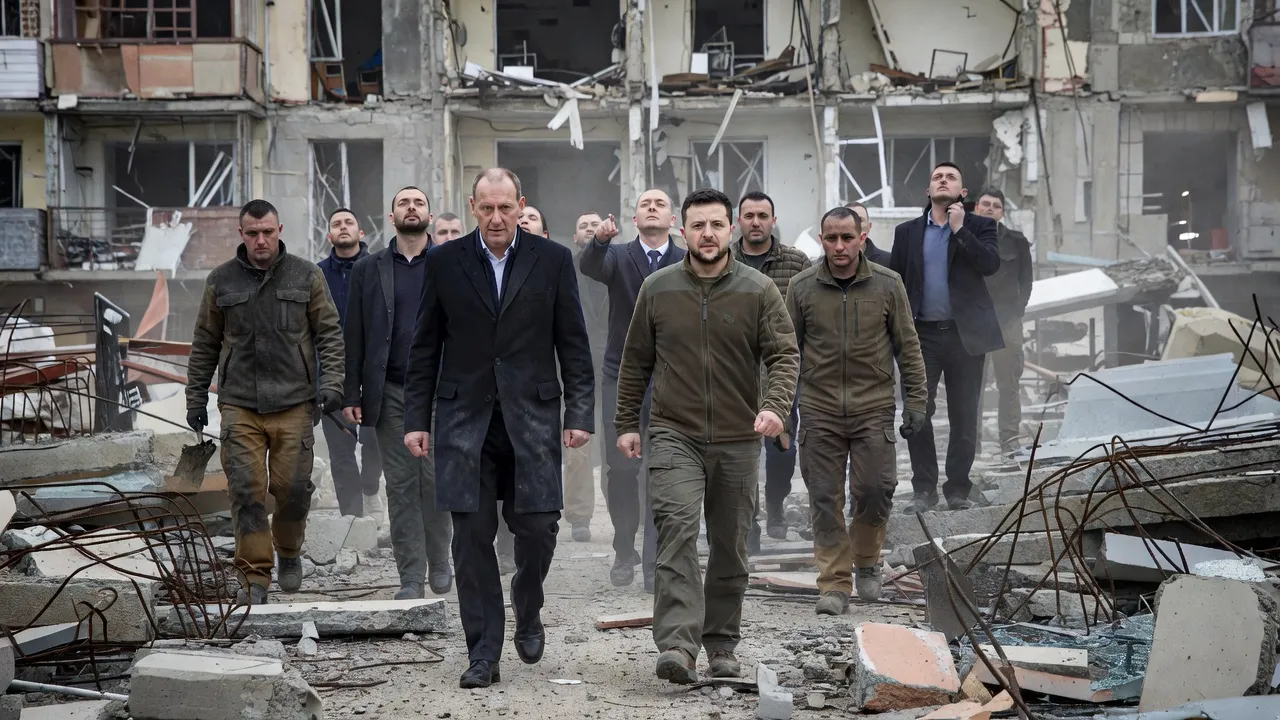

DOMINANT ANGLE
Moscow sees Merz's visit to Kiev as an episode of German domestic politics: a chancellor with historically low ratings, facing an increasingly unfavourable public opinion and opposition to aid.
Dominant angle identified — does not reflect unanimity of this country’s media
KEY POINTS
- 01
Merz announced around 1 billion euros in military aid and 350 million euros for Ukrainian energy (TASS, Vedomosti).
- 02
According to the ZDF poll cited by TASS, support for increased aid dropped from 43% in February to 32% in June.
- 03
According to Vedomosti citing Politico, Merz proposed an associate member status and Zelensky demanded full and equal membership.
ANALYSIS
Moscow, October 5, 2026. The Russian press treats Friedrich Merz's visit to Kiev on Sunday, October 4, first and foremost as an episode of German domestic politics. Kommersant writes that the chancellor "left one problem to find another": while Kiev is suffering from more intense strikes and a budget deficit, Berlin is going through a crisis of confidence, and the trip "looks like an attempt to kill two birds with one stone," supporting Ukraine and halting the decline of a popularity rating that has fallen to a historic low. The newspaper cites an INSA poll from October 1.
The content of the aid is reported factually by TASS, Vedomosti, and RIA: approximately one billion euros in military aid, including long-range weapons, strike drones, and satellite equipment, plus 350 million euros for energy (generators, substations, repairs). RIA, citing Reuters, mentions more than 15,000 interceptor drones and missiles with a range of over 1,000 kilometers. Vedomosti, according to Politico, highlights a disagreement on membership: Merz proposed an "associated member" status, and Volodymyr Zelensky demanded "full and equal" membership. TASS reports that Merz wants to "accelerate" the process.
The coverage gives a large place to critical German voices. TASS reprints the ZDF poll: support for strengthening European aid fell from 43% in February to 32% in June, while the share of supporters of a reduction rose from 24% to 31%. Alice Weidel (AfD) denounces a chancellor who "distributes the money of German taxpayers"; Sevim Dagdelen (BSW) accuses him of being ready to drag Germany into a war with Russia to boost his ratings. Presidential envoy Kirill Dmitriev calls him a "warmonger"; according to RIA, Russian Foreign Ministry spokeswoman Maria Zakharova links the visit to his declining polls.
On the military front, RIA recalls Moscow's position: arms deliveries hinder a settlement, and Sergey Lavrov warned that any arms shipment would be a legitimate target. The Russian Ministry had warned foreigners, including diplomats, on October 3 against staying in Ukraine. Meduza and The Moscow Times describe mainly the arrival to the sound of sirens, the strike on the North Bridge, on the Dnieper, according to Mayor Vitali Klitschko, and Merz's phrase: "If Russia is not stopped, its war machine will sooner or later turn against us."
SOURCES (5)
- VedomostiMEDIUM
- RIA NovostiMEDIUM