
DOMINANT ANGLE
Canberra views Obama's return to the campaign trail as a test of Democratic mobilization just ten days out from the midterms, with a amused look at his most biting phrases.
Dominant angle identified — does not reflect unanimity of this country’s media
KEY POINTS
- 01
On Saturday, October 24 (US time), in Cleveland, Obama held his first midterm campaign meeting and denounced "two years of chaos, cruelty, and corruption" (The Age, SMH).
- 02
In Michigan, Obama supported Senate candidate Abdul El-Sayed, who is running against Republican Mike Rogers, and presented the November 3 election as a "circuit breaker" (PerthNow).
- 03
Obama blamed the Trump administration for rising costs and a war in Iran "that nobody asked for", and ridiculed the gold trim at the White House (The Age, SMH).
ANALYSIS
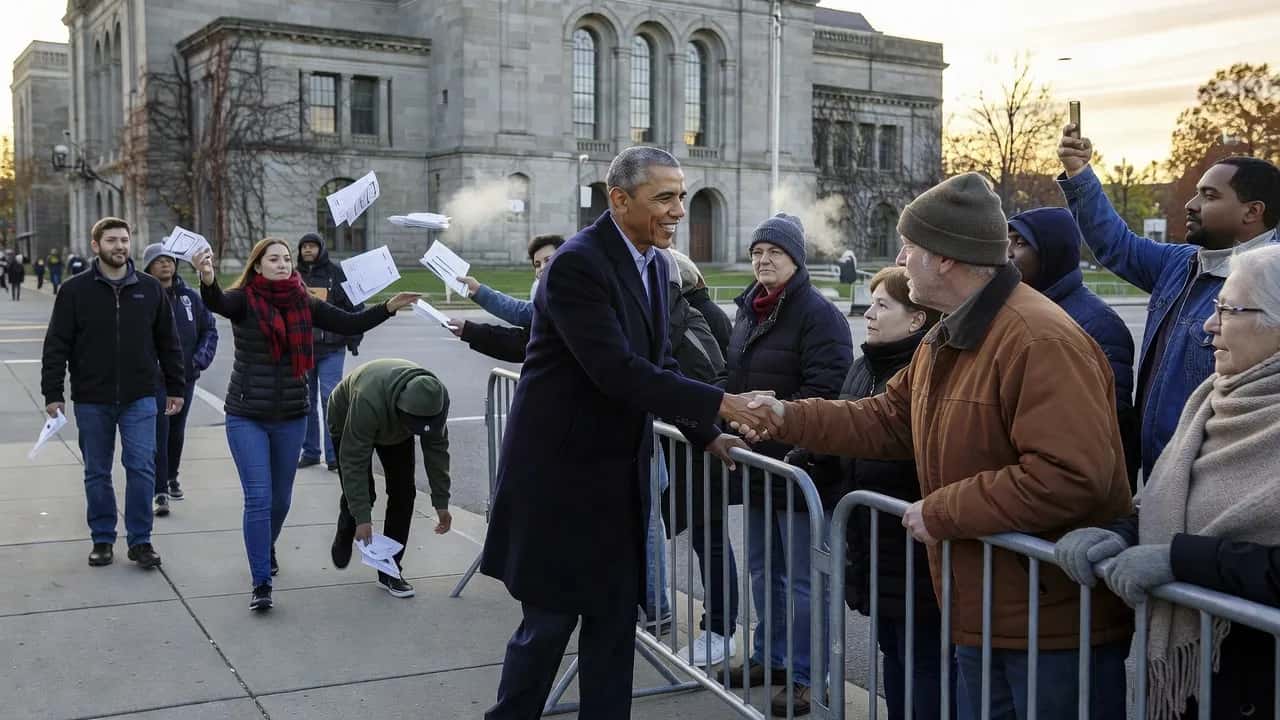
Canberra, 25 October 2026. Australian outlets from the Nine group and PerthNow are covering Barack Obama's return to the midterm election scene as both a campaign event and a verbal spectacle. The Age and the Sydney Morning Herald, which ran the same story, headlined with the phrase "Like Saddam opened a Cheesecake Factory" and presented the Cleveland meeting on Saturday, 24 October (US time), as his first campaign rally for these midterms, and "his most virulent attack on Trump in a long time".
The account emphasizes the contrast: Obama, "selective" in his public criticism, is said to have changed his tone. He evoked "two years of chaos, cruelty, and corruption", judged the administration's top officials as "not serious", and accused Donald Trump of having led the United States into a war in Iran "that nobody asked for", which is economically painful. On prices, he stated that the administration's actions were "directly responsible" for the rise in costs. He also mocked the attention given to the gold decorations in the White House ("He should be on HGTV") and criticized a Vivek Ramaswamy ad, a Republican candidate for Ohio governor, as a symptom of a hardening political life.
PerthNow, which picked up a wire report, broadens the scope to the institutional stakes. Ten days before a vote that will determine control of a highly divided Congress, Obama campaigned in Cleveland and then in Michigan, alongside Abdul El-Sayed, the Democratic candidate for the Senate against Republican Mike Rogers. He presented the 3 November vote as a "circuit breaker" that would "at least put a brake on the nonsense" of the Trump presidency and "bring accountability" to the government. The text notes that Trump is asking voters to see these elections as a vote on his person, and that Obama took up the invitation.
The Australian press remains largely descriptive: little analysis of the 2015 nuclear agreement or the war in Iran, more on the campaign mechanics and Obama's value as a mobilizer of the Democratic electorate in a tight Senate race. Trump's response, his meeting in Georgia, and his nighttime messages are not mentioned in the pool's articles, which only indicate that the White House had not responded at the time of writing.


