
Common ground and differences in coverage across the media analysed.
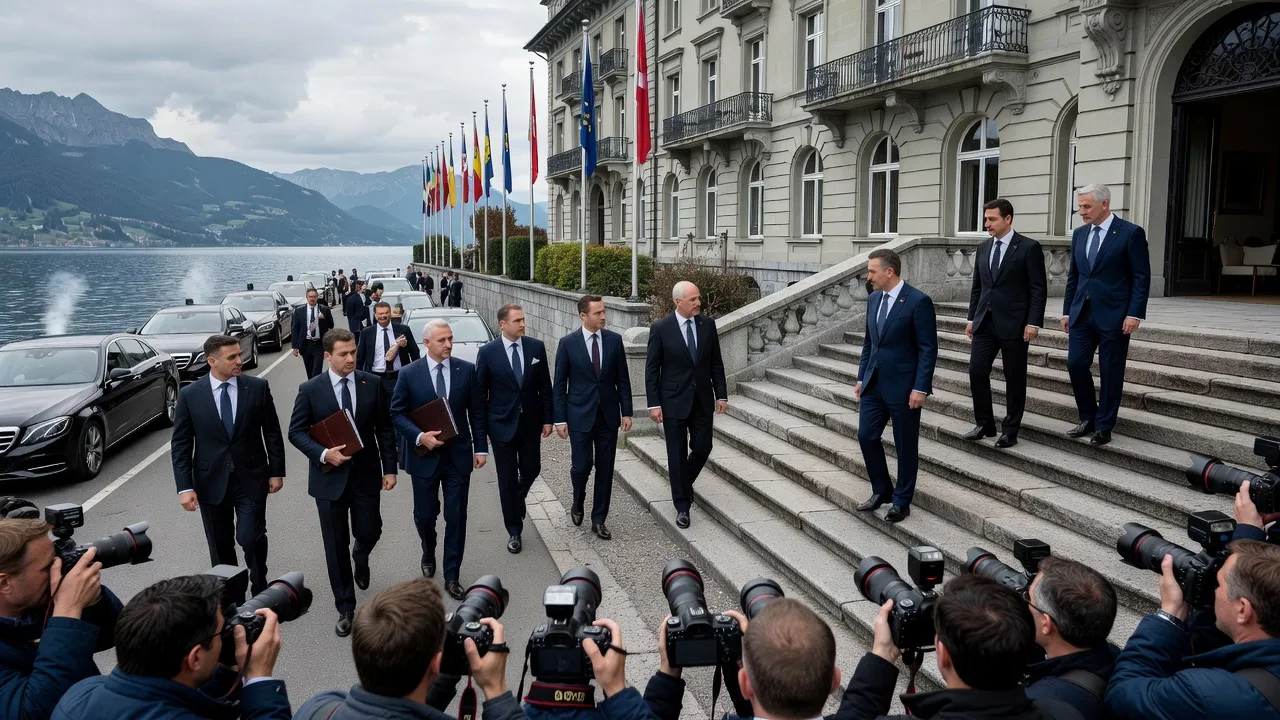
A 14-point memorandum of understanding and a 60-day roadmap to a final agreement were concluded at the Bürgenstock complex near Lake Lucerne, with Qatar and Pakistan serving as official co-mediators.
The Iranian delegation left the negotiation room following a post by Donald Trump on social media deemed threatening, before talks resumed through the mediators.
The status of the Strait of Hormuz emerged as a major friction point: Iran announced its closure while the U.S. Central Command asserted that commercial traffic continued normally.
Washington, Pakistan, and Qatar present the agreement as historic progress, while Israel, Russia, and Iran emphasize structural fragilities and unfulfilled conditions.
Coverage aligned with this reading
Iranian and Russian perspectives attribute the suspension of discussions to Trump's public threats, seen as a violation of the spirit of the memorandum. American and European perspectives present the incident as turbulence overcome within a positive dynamic.
Iran and Egypt contend that the nuclear file cannot progress until a ceasefire in Lebanon takes effect. The United States and Israel reject this conditioning, with Washington refusing to assume responsibility for Israeli compliance.
Coverage that diverges
This grouping describes the publications analysed, not the position of these countries’ populations or of their governments.
What the coverage of each country leaves aside, while others put it forward.
United States
Israel
Pakistan
Preview: 3 of 14 media perspectives. Syntheses of the media analysed — not direct quotations. Method & limitations
Beijing closely monitors the real scope of the fourteen-point US-Iran memorandum, emphasizing both the formal breakthrough achieved in Switzerland and the persistent fragility of a process traversed by Trump threats and Lebanese incidents.
2 sources · View sources
Berlin watches the Burgenstock process with caution, noting a framework agreement won in 14 points amid mutual threats, where Trump's public provocations nearly derailed negotiations before any substantive progress could be measured.
4 sources · View sources
Madrid observes the fragility of the Swiss breakthrough: a 14-point memorandum and a 60-day roadmap that wobbles on its first day of implementation, caught between Iranian withdrawals and Trumpian threats.
3 sources · View sources
DOMINANT ANGLE
Beijing closely monitors the real scope of the fourteen-point US-Iran memorandum, emphasizing both the formal breakthrough achieved in Switzerland and the persistent fragility of a process traversed by Trump threats and Lebanese incidents.
ANALYSIS
Beijing, June 22, 2026.
DOMINANT ANGLE
Berlin watches the Burgenstock process with caution, noting a framework agreement won in 14 points amid mutual threats, where Trump's public provocations nearly derailed negotiations before any substantive progress could be measured.
ANALYSIS
Berlin, June 22, 2026.
DOMINANT ANGLE
Madrid observes the fragility of the Swiss breakthrough: a 14-point memorandum and a 60-day roadmap that wobbles on its first day of implementation, caught between Iranian withdrawals and Trumpian threats.
ANALYSIS
Madrid, June 22, 2026.
DOMINANT ANGLE
Paris reads the Swiss breakthrough with cautious assessment: a 14-point memorandum and a 60-day roadmap are secured, but the Iranian delegation's dramatic exit following a Trump Truth Social message exposes the structural fragility of negotiations under permanent pressure.
ANALYSIS
Paris, June 22, 2026.
DOMINANT ANGLE
New Delhi monitors with careful attention the structural fragilities of the American-Iranian Burgenstock accord: Washington's economic dependence and the volatility of the Strait of Hormuz create a precarious equilibrium for global energy markets.
ANALYSIS
New Delhi, June 22, 2026.
DOMINANT ANGLE
Tehran conditions any nuclear advancement on prior implementation of the 14-point memorandum signed in Islamabad: the Iranian delegation departed talks in Burgenstock after Trump's social media statements were perceived as threatening.
ANALYSIS
Tehran, June 22, 2026.
DOMINANT ANGLE
Rome weighs the fragile gains of Bürgenstock with skepticism: a 14-point memorandum and a 60-day roadmap extracted despite Iran's dramatic walkout, which occurred as a protest against Trump's public threats over the Strait of Hormuz.
ANALYSIS
Rome, June 22, 2026.
DOMINANT ANGLE
Tokyo measures the US-Iranian accord signed in Switzerland through the lens of structural energy dependence: the Strait of Hormuz is not an abstract geopolitical question, but a vital artery whose repeated closure directly affects the supply of oil and naphtha to a resource-poor nation.
ANALYSIS
Tokyo, June 22, 2026.
DOMINANT ANGLE
Seoul evaluates the Burgenstock agreement through the lens of its immediate maritime interests: two South Korean vessels have transited the Strait of Hormuz, while twenty-two others remain trapped, converting the 60-day roadmap into an urgent economic test for Korean commerce.
ANALYSIS
Seoul, June 22, 2026.
DOMINANT ANGLE
Islamabad claims a historic role as the central mediator between Washington and Tehran, signing the Islamabad Memorandum and hosting both delegations in Switzerland, transforming a regional crisis into a showcase for Pakistani diplomacy.
ANALYSIS
Islamabad, June 22, 2026.
DOMINANT ANGLE
Doha frames its own diplomatic footprint within the Burgenstock breakthrough, where Qatar co-mediated negotiations that produced a 14-point memorandum and a 60-day roadmap between Washington and Tehran.
ANALYSIS
Doha, June 22, 2026.
DOMINANT ANGLE
Moscow reads the Burgenstock negotiations as a fragile breakthrough: a 14-point memorandum and a 60-day roadmap were indeed finalized, but the Iranian delegation departed after Trump's public threats, immediately exposing the accord's structural limits.
ANALYSIS
Moscow, June 22, 2026.
DOMINANT ANGLE
Ankara cautiously evaluates the advances at the Lucerne Summit: the 14-point agreement between Washington and Tehran is viewed as a fragile first step, whose implementation remains contingent on Lebanese ceasefire assurances and guarantees from the United States.
ANALYSIS
Ankara, June 22, 2026.
DOMINANT ANGLE
Washington assesses the Lake Lucerne summit as a claimed diplomatic triumph yet exposing deep fractures: a 14-point accord and 60-day roadmap, but the Strait of Hormuz reopening amid threats, and billions in frozen Iranian assets whose fate remains contested.
ANALYSIS
Washington, June 22, 2026.
Explore every perspective on this subject across 14 countries.
Compare viewpoints and see where they diverge.
published on
countries
sources
articles
gap
Meeting at the Bürgenstock complex near Lake Lucerne, the American and Iranian delegations concluded a fourteen-point memorandum of understanding accompanied by a sixty-day roadmap toward a final agreement. Qatar and Pakistan acted as official co-mediators and issued a joint statement describing a "positive and constructive" atmosphere. The process was disrupted when the Iranian delegation walked out after a social-media post by Donald Trump deemed threatening, before talks resumed through the mediators.
This first formal de-escalation framework, known as the Islamabad accord, comes amid a conflict open since 28 February 2026, marked by military strikes and a naval blockade. The Strait of Hormuz, through which 20% of the world's hydrocarbon supplies normally pass, was a central point of friction: Tehran announced its closure while U.S. Central Command stated that commercial traffic was continuing normally. The conclusion of the first round coincided with a fall in crude oil prices.
Several points remain disputed. The nuclear file was not addressed in substance, with Iran conditioning that discussion on the prior implementation of several provisions of the memorandum, notably a ceasefire in Lebanon — a requirement rejected by the United States and Israel. The release of frozen Iranian assets and the oil waivers are presented by some as concrete gains, by others as conditional leverage not yet granted.
The parties also diverge on the overall assessment: some hail a historic breakthrough, others stress structural fragilities and unmet conditions. The sixty-day roadmap remains contingent on the parties' ability to disentangle these intertwined files.
Measured with the previous method (distance between texts), on a different scale.