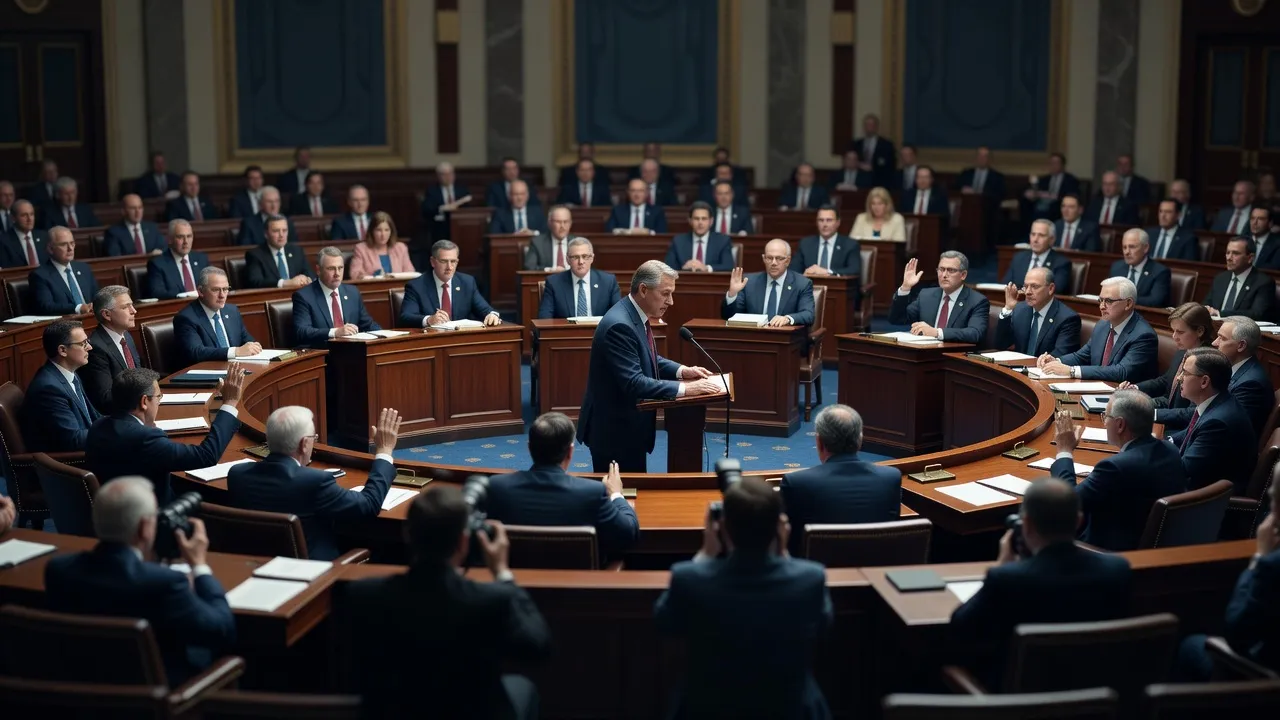
US Senate votes to end Iran involvement: an institutional rebuke for Trump
published on
countries
sources
articles
Measured with the previous method (distance between texts), on a different scale.
On 23 June 2026, the US Senate passed a war powers resolution by 50 votes to 48, ordering Donald Trump to end military operations against Iran. Four Republican senators broke ranks to vote with the opposition. It marked the first time since the War Powers Act was adopted in 1973 that both chambers of Congress jointly approved a measure directing a president to halt an ongoing military action.
The legal reach of the vote is limited. It is a concurrent resolution with no direct binding force: it is not sent to the White House for signature, and the administration immediately declared the War Powers Act unconstitutional. Trump called the vote "badly timed and meaningless," while acknowledging that it complicates his task as negotiations proceed with Tehran.
The vote falls within a conflict opened on 28 February by US-Israeli strikes carried out without prior congressional authorization. After four months of hostilities that disrupted traffic in the Strait of Hormuz and pushed Brent crude to roughly 125 dollars a barrel, a preliminary memorandum was signed on 17 and 18 June, opening 60 days of talks. A request to Congress for 87.6 billion dollars to fund the war adds a budgetary dimension to the institutional crisis.
Several points remain disputed. Some actors frame the resolution as a lasting constitutional precedent; others stress its symbolic character, especially as the Senate reversed course by 25 June. The parties also offer conflicting accounts of the agreement's terms and of nuclear inspections. In the background, polls show only 24 percent of Americans consider the conflict justified, and November's midterm elections weigh on lawmakers' calculations.
What the comparison reveals
Common ground and differences in coverage across the media analysed.
What the media report in common
The U.S. Senate passed a war powers resolution on June 23, 2026 by a vote of 50 to 48, ordering Trump to end military operations against Iran, with the support of four Republican senators (Cassidy, Collins, Murkowski, Paul).
The resolution is a 'concurrent resolution' without direct binding force: it is not transmitted to the White House for signature and the administration immediately declared the 1973 War Powers Act unconstitutional.
This is the first time since the adoption of the 1973 War Powers Act that both chambers of Congress have jointly approved a resolution ordering a president to cease ongoing military action.
Where media coverage diverges
True scope of the vote
Some perspectives emphasize the symbolic and legally limited character of the resolution; others present it as a constitutional precedent with significant medium-term political consequences.
Coverage aligned with this reading
Interpretation of the U.S.-Iran agreement
Washington and its close allies view the June 17-18 memorandum as a diplomatic achievement, while Tehran and critical countries present it as a declaration of American defeat; both sides offer contradictory narratives about nuclear inspections.
Regime change objective
Some perspectives argue that the initial regime change objective was not achieved despite Khamenei's death; others emphasize that succession by Mojtaba Khamenei consolidated rather than weakened the regime.
Coverage that diverges
This grouping describes the publications analysed, not the position of these countries’ populations or of their governments.
Blind spots
What the coverage of each country leaves aside, while others put it forward.
 Germany
- humanitarian consequences of the conflict in Iran
- economic impact on Europe of Strait of Hormuz disruptions
- European Union position on the crisis
 Brazil
- Tehran's reactions to the Congressional vote
- Pakistani mediation in the agreement
- consequences for countries of the Global South
 Israel
- legal analysis of the War Powers Act
- positions of Iranian civilian populations
- role of mediating countries (Oman, Pakistan)
How each country reads it
Preview: 3 of 12 media perspectives. Syntheses of the media analysed — not direct quotations. Method & limitations
 Canada
Ottawa measures the scope of institutional repudiation inflicted on Trump by his own Senate Republicans in an Iranian conflict that has lasted four months without achieving its initial objectives.
4 sources · View sources
 Australia
Sydney evaluates the scale of institutional rebuke that Trump endured in the US Senate—parsing a 50-48 vote that marks the first clear bipartisan breach on Iran policy, while underscoring its limited legal reach and the fragile state of the emerging ceasefire.
3 sources · View sources
 Pakistan
Islamabad reads the US Senate vote as a deep institutional fracture over the Iran conflict, revealing a legitimacy crisis at the heart of Trump's executive authority.
3 sources · View sources
The full text, country by country
Canada
DOMINANT ANGLE
Ottawa measures the scope of institutional repudiation inflicted on Trump by his own Senate Republicans in an Iranian conflict that has lasted four months without achieving its initial objectives.
ANALYSIS
Ottawa, June 25, 2026.
Australia
DOMINANT ANGLE
Sydney evaluates the scale of institutional rebuke that Trump endured in the US Senate—parsing a 50-48 vote that marks the first clear bipartisan breach on Iran policy, while underscoring its limited legal reach and the fragile state of the emerging ceasefire.
ANALYSIS
Sydney, June 24, 2026.
Pakistan
DOMINANT ANGLE
Islamabad reads the US Senate vote as a deep institutional fracture over the Iran conflict, revealing a legitimacy crisis at the heart of Trump's executive authority.
ANALYSIS
Islamabad, June 25, 2026.
 Russia
DOMINANT ANGLE
Moscow decodes in the Senate vote on the Iran war a symptom of deep institutional fracture: a conflict launched without Congressional mandate, contested ten times in succession, and ultimately defended by Trump at the cost of reversing Republican senators under presidential pressure.
ANALYSIS
Moscow, June 24, 2026.
 United States
DOMINANT ANGLE
Washington moves: the Senate's 50-48 vote against military operations in Iran marks an unprecedented institutional split, with Congress asserting its authority over presidential war powers as lawmakers seek to reclaim oversight on military engagement.
ANALYSIS
Washington, June 24, 2026.
Israel
DOMINANT ANGLE
Jerusalem views with concern the fallout from the US Senate vote on Iran: beneath the institutional symbolism lies deeper anxiety about the reliability of American military backing and the shape of emerging negotiations with Tehran.
ANALYSIS
Jerusalem, June 25, 2026.
 Singapore
DOMINANT ANGLE
Singapore carefully weighs the institutional fractures revealed by the U.S. Senate's narrow Iran vote, while assessing regional risks to maritime freedom and the durability of a deal contested by both Washington and Tehran.
ANALYSIS
Singapore, June 25, 2026.
 Iran
Iran
DOMINANT ANGLE
Tehran reads the fracture within America's institutional structures as confirmation that the military campaign against Iran lacks political legitimacy in Washington, even among Republicans.
ANALYSIS
Tehran, June 24, 2026.
Germany
DOMINANT ANGLE
Berlin scrutinizes what German media frames as a constitutional crisis in Washington: the Senate's passage of war powers legislation against Trump on Iran, following the House vote weeks earlier, reveals institutional legitimacy concerns that extend beyond the military conflict itself.
ANALYSIS
Berlin, June 24, 2026.
 United Kingdom
DOMINANT ANGLE
London reads the Senate vote as evidence of a profound institutional fracture between Congress and the White House over the Iran war—a bipartisan rebuke without precedent since 1973.
ANALYSIS
London, June 24, 2026.
 India
India
DOMINANT ANGLE
New Delhi reads the Senate's push to curtail Trump's Iran war powers as a window into American institutional tensions with far-reaching implications for regional stability, energy flows, and strategic alignments in Asia.
ANALYSIS
New Delhi, June 25, 2026.
Brazil
DOMINANT ANGLE
Brasilia watches a rare institutional rebuke of Trump: the Senate's 50-48 vote, with four dissenting Republicans, stands as a historic precedent on presidential war powers, wielding symbolic force but real political significance as midterm elections approach.
ANALYSIS
Brasilia, June 25, 2026.
Explore every perspective on this subject across 12 countries.
Compare viewpoints and see where they diverge.