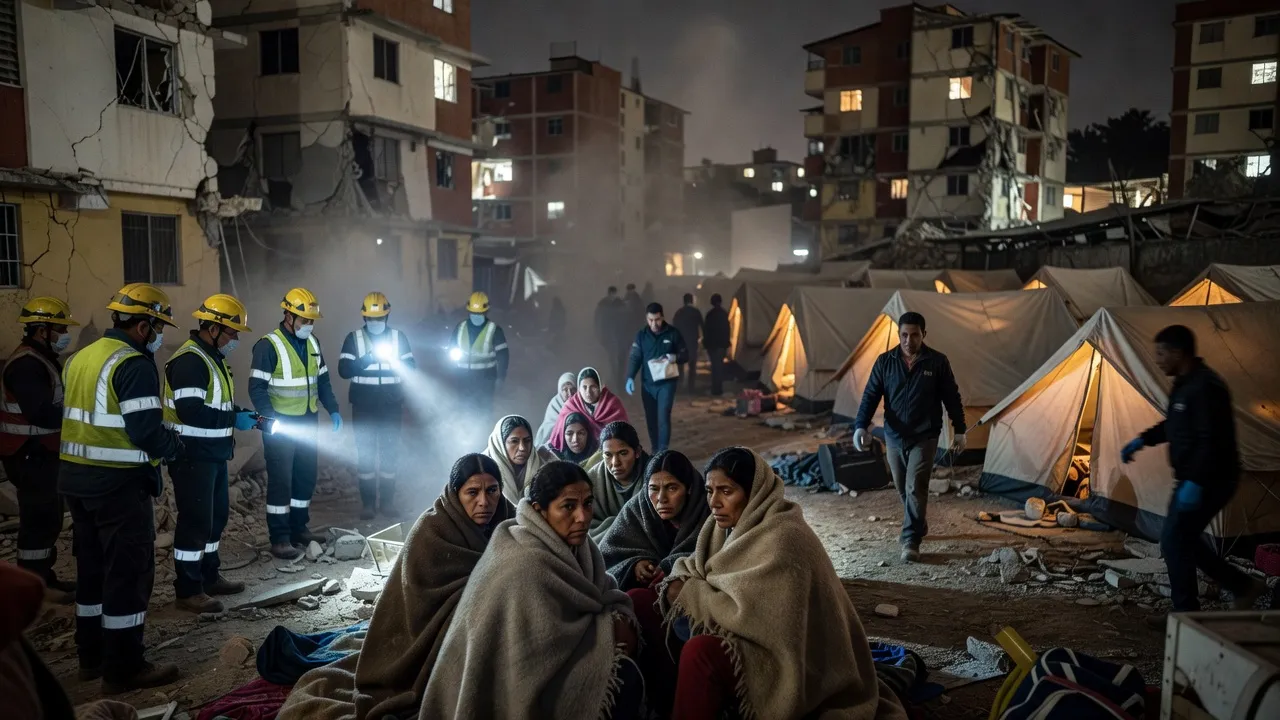
On 24 June 2026, two earthquakes measuring magnitude 7.2 and 7.5, striking 39 seconds apart, hit Venezuela. As of 27 June, the official toll stands at 1,430 dead and 3,238 injured, making it the deadliest seismic disaster in the country in more than a century. The coastal state of La Guaira accounts for most of the destruction, with around a hundred collapsed buildings and an area placed under military control by the authorities.
The human scale remains hard to assess. The UN estimates that roughly 50,000 people are missing, while the International Organization for Migration projects that up to 6.76 million people could be affected. An international response has been deployed, bringing together more than 1,600 foreign rescuers from at least 17 countries, including the United States, Germany, France, Mexico and Brazil. Washington has committed 150 million dollars in aid.
The disaster comes against a distinctive political backdrop: the country is undergoing a transition following the capture of Nicolás Maduro by the United States in January, and an interim government whose legitimacy remains disputed must handle the emergency. The American aid is accompanied by a temporary easing of sanctions and a partial reopening of the Caracas airport, signs of an ongoing diplomatic normalization. A decade of recession had already weakened infrastructure and the health system. Direct damage is estimated at 7 billion dollars, around 6 percent of GDP.
Several points remain contested. Some actors highlight the slowness and shortcomings of the institutional response, as well as contradictions between official tolls and international estimates, while others relay Caracas's figures without reservation. Projections of the final toll differ sharply, with some assessments extrapolating a number of victims far above the updated official count.