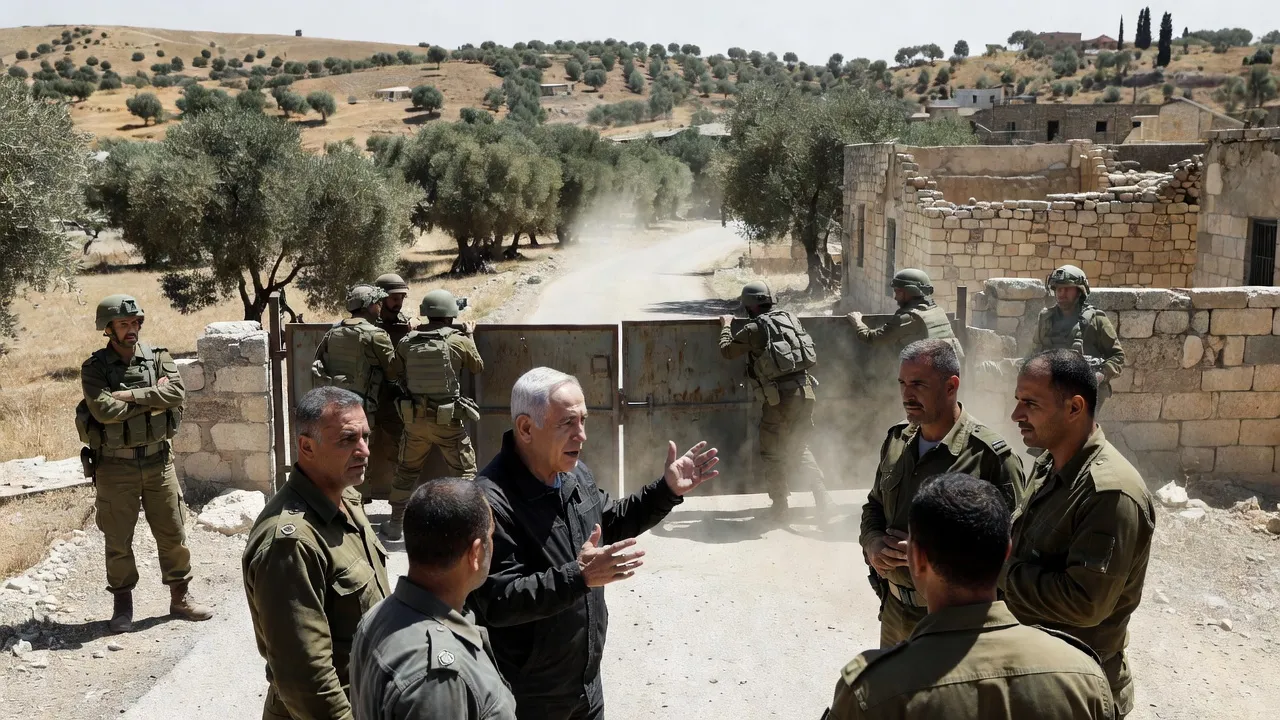
West Bank: after two soldiers are killed in Hebron, Benjamin Netanyahu orders a closure and announces a large-scale operation
published on
countries
sources
articles
More divergent than 62% of recent comparable stories (reference: 98 recent stories measured with the same method).
Accounts of the Hebron attack rely almost entirely on the Israeli army and the office of Benyamin Netanyahu, describing a twenty-minute exchange of gunfire, seized weapons, and a target that the army did not specify, with media differing on the number of injured and the link to Hamas.
The lockdown of Hebron has been ordered and that of the entire West Bank is being prepared; the operation announced by Netanyahu has not yet been detailed.
The sequence of events according to the army
The Jerusalem Post and the Globe and Mail report that the two men arrived by car at the Judea intersection, near Hebron, and opened fire on soldiers. CBC and the Globe and Mail mention an exchange of gunfire of about twenty minutes. The Jerusalem Post talks about an M4 rifle and a pistol; the Tagesschau and CBC cite an M16 rifle and a handgun.
According to the Jerusalem Post, military sources estimate that the attackers wanted to continue on to route 35 for a larger attack. The BBC and CBS News relay the same version: the army says it found a large quantity of weapons and ammunition in their vehicle. ABC News, which cites the Times of Israel, writes that the two men were 27 years old, lived in Hebron, and belonged to the same family.
The number of injured varies depending on the cited source. The army reports three light injuries, according to the Jerusalem Post and the Globe and Mail. Haaretz, CBC, and the BBC cite at least five injured, including two seriously injured according to Haaretz, based on paramedics or initial reports. The BBC specifies that verified images show a violent exchange of gunfire, and that an unverified surveillance video shows the two men getting out of a car armed.
Hamas, between accusation and caution
Netanyahu accuses Hamas of preparing a major attack. According to G1, he stated that "everything indicates" that members of the movement were planning a large-scale attack, given the weapons and ammunition found. The Jerusalem Post writes that without the intervention of soldiers, an attack on civilians would have probably taken place.
Other media outlets point out what these statements do not detail. CBC notes that the Prime Minister did not specify the nature of the project he mentioned. NPR talks about an "alleged" attack and writes that the army did not indicate the target or the identity of the dead. DW writes that it is still unknown whether the two men actually belonged to Hamas.
The vocabulary also differs. The Jerusalem Post refers to Hamas "terrorists". Haaretz writes that the army killed two Palestinians "suspected" of being the perpetrators. HuffPost France specifies that the word "terrorist" is generally used by Israeli authorities to refer to a Palestinian attacker.
Announced measures and political reactions
NBC News reports a cordon around Hebron and Halhul, as well as the idea of "extending this model to other cities". Fox News cites dozens of raids carried out on Friday across the West Bank, with arrests of suspected Hamas and Islamic Jihad members. According to Tagesschau, the army had already set up numerous roadblocks. G1 notes that the Prime Minister's office did not detail what the "total closure" entails.
« We must not wait for an October 7 in Judea and Samaria »
DW writes that Bezalel Smotrich ordered the destruction of "illegal Arab buildings" near the attack site, an order supposed to be carried out on the same day. SBS reports that Itamar Ben Gvir judged that the attack showed the need to restrict the freedom of movement of Palestinians. Estadão notes that Gadi Eisenkot, Netanyahu's main rival, hailed the "courage of the soldiers".
Haaretz adds a military context element: Chief of Staff Eyal Zamir had suspended leave from Thursday, and the troops of the West Bank Command were already reinforced due to fear of violence related to the election.
Press readings and context
In the analyzed corpus, the Brazilian, French, British, German, and Australian coverage first places the lockdown order in the legislative election calendar. This count measures what these presses put forward, not the opinion of their readers. Sud Ouest, with AFP, writes that the attack comes at the end of the campaign, an election in which Netanyahu "is playing for his survival". According to CBS News, he has made national security a central theme of his campaign.
« in which Benyamin Netanyahu is playing for his survival »
The Israeli, Canadian, and American presses rely mainly on the statements from the army and the Prime Minister. The Portuguese press is organized around another question, the reaction from Brussels. RTP reports that the European Commission spokesperson, Anouar El Anouni, stated that the Union "condemns all acts of terrorism and violence against civilians", recognized Israel's security concerns, and denounced the plans for colony expansion. The American press does not mention this reaction in the corpus.
The BBC and NBC situate the attack in a climate of tension linked to settler violence during the olive harvest. NBC recalls that the Prime Minister qualified the settlers as "heroic". HuffPost France mentions the aggression, on October 16 and 17, of American photographer Heidi Levine and French mayor Bernard Baudoux by Israeli settlers.
Sergeants Ron Yonatan Roytman (23 years old) and Yuval Shai Svilem (20 years old), from the Ari battalion, according to the Israeli army.
Itamar Ben Gvir calls to "dismantle" the Palestinian Authority; Bezalel Smotrich demands a campaign "like in Gaza".
Hamas described the attack as a "heroic operation" without claiming responsibility.
The EU condemns the blockade and demands freedom of movement in the West Bank, occupied by Israel since 1967.
Key figures
- 2Israeli soldiers killed at checkpoint near Hebron, according to the army1 source · ABC News Australia
What the comparison reveals
Common ground and differences in coverage across the media analysed.
What the media report in common
Benjamin Netanyahu has ordered the immediate closure of Hebron and asked the army to prepare a closure of the entire West Bank.
The attack in Hebron comes just a few days before the Israeli legislative elections on Tuesday, and the press is putting it into this electoral calendar.
Two Israeli soldiers were killed at a Hebron checkpoint, according to the Israeli army, and the two assailants were shot dead.
Where media coverage diverges
Designation of the attackers
The Jerusalem Post refers to 'terrorists' from Hamas, Haaretz to Palestinians 'suspected' of having carried out the attack, and a French media outlet notes that the word 'terrorist' is used by the Israeli authorities.
Link between the attack and Hamas
Hamas is presented as the probable perpetrator by the Brazilian and Israeli press, which relays the statement by the Prime Minister; the German and Canadian press highlights the uncertainty or lack of details about this link.
This grouping describes the publications analysed, not the position of these countries’ populations or of their governments.
How each country frames the event
- domestic politics
- AustraliaBrazilGermanyFranceUnited Kingdom
- security
- CanadaIsraelUnited States
- diplomatic
- Portugal
3 different framings across 9 countries · 5 of 9 countries share the same framing
Pair by pair: same frame or different frames
Each square pairs two countries. Filled: both countries' coverage uses the same frame. Empty: their frames differ. The map describes framings without evaluating them.
Pairs with the same frame: 13 of 36
- same frame
- different frames
Blind spots
What the coverage of each country leaves aside, while others put it forward.
 Portugal
- names and ages of the two soldiers killed
- sequence of events of the shooting at the checkpoint
 United States
- European Union's request regarding freedom of movement
Geopolitical context
The attack in Hebron occurs in the West Bank, a territory occupied by Israel since 1967, three years after the Hamas attacks of October 7, and four days before the Israeli legislative elections. The lockdown and announced operation are accompanied by calls from Itamar Ben Gvir to dismantle the Palestinian Authority and from Bezalel Smotrich for a military campaign modeled on Gaza. The European Union calls for freedom of movement while acknowledging Israel's security concerns.
How each country reads it
Preview: 3 of 9 media perspectives. Syntheses of the media analysed — not direct quotations. Method & limitations
 Australia
Canberra is reporting on the Hébron attack in the context of Tuesday's election deadline, primarily relaying the announcements of the lockdown from Benyamin Netanyahou's office.
3 sources · View sources
 Brazil
Brasília is dissecting Netanyahu's electoral gamble: the Brazilian press is highlighting the "political survival" of the Prime Minister, four days before the October 27 legislative elections, more than the election itself.
3 sources · View sources
 Canada
Ottawa is first focusing on the security aspect: two soldiers killed in Hebron, a lockdown has been ordered and a large-scale operation announced by Netanyahou, just a few days before the Israeli election.
2 sources · View sources
The full text, country by country
Australia
DOMINANT ANGLE
Canberra is reporting on the Hébron attack in the context of Tuesday's election deadline, primarily relaying the announcements of the lockdown from Benyamin Netanyahou's office.
KEY POINTS
- According to ABC, two Israeli soldiers were killed and three other Israelis injured at a checkpoint near Hebron; the two assailants were shot.
- Netanyahu's office ordered the immediate closure of Hebron and preparation for a complete shutdown of the West Bank as early as Friday.
- Israelis vote Tuesday to decide whether to grant a new term to Netanyahu, three years after the Hamas attacks of October 7.
ANALYSIS
Canberra, October 23, 2026. The Australian press is reporting on the attack in Hebron through the lens of the Israeli election deadline. ABC News reports that two Israeli soldiers were killed and three other Israelis were injured when armed men opened fire at a checkpoint near Hebron, in the occupied West Bank, before being shot down. According to the Times of Israel, cited by ABC, the two attackers were 27-year-old residents of the city and members of the same family.
PerthNow and SBS News, which publish the same text, first describe Israeli soldiers killing two men who the army accuses of having launched an attack; "at least five people" were injured, some seriously. The army speaks of a "terrorist attack against Israeli civilians" foiled, with the men carrying an M16 rifle and a handgun. It did not specify the target or the identity of the injured.
A few hours later, Benjamin Netanyahu's office ordered the immediate closure of Hebron and preparation for a complete closure of the West Bank as of Friday. The Prime Minister praised the courage of the soldiers, who "prevented what could have been a major attack", and blamed Hamas, which he claimed was preparing "a major attack aimed at assassinating innocent civilians". He convened his security cabinet and requested the cancellation of all political meetings.
The articles emphasize the calendar: Israelis vote on Tuesday to decide whether to grant a new mandate to Netanyahu or open a new political era, three years after the Hamas attacks that triggered the war in Gaza. SBS writes that the shooting should increase political tensions and security concerns before the election. The Israeli government had warned of possible attacks by its "enemies" as the vote approaches.
The National Security Minister, Itamar Ben Gvir, presented by SBS as a far-right official, estimated that the attack showed the need to restrict the freedom of movement of Palestinians. The three media outlets largely stick to Israeli statements and the Prime Minister's declarations; the Palestinian reaction and that of the European Union are not mentioned in the available excerpts.
Brazil
DOMINANT ANGLE
Brasília is dissecting Netanyahu's electoral gamble: the Brazilian press is highlighting the "political survival" of the Prime Minister, four days before the October 27 legislative elections, more than the election itself.
KEY POINTS
- Sergeants Ron Yonatan Roytman, 23, and Yuval Shai Svilem, 20, died at a checkpoint in Hebron, according to the army as cited by Folha.
- Netanyahu ordered the immediate closure of Hebron and asked the army to prepare a "total closure" of the West Bank, with an operation announced as "like none since the Six-Day War".
- The attack comes four days before the October 27 legislative elections and Netanyahu has cancelled the Likud's scheduled campaign events for Friday.
ANALYSIS
Brasília, October 23, 2026. Estadão, G1, and Folha initially report an attack, then an electoral deadline. On Friday, October 23, in the morning, two men dressed in black, one armed with a rifle, the other with a pistol, opened fire on Israeli soldiers at a checkpoint near Hebron, in the south of the West Bank, before being killed in an intense exchange of fire. Folha, citing the army, identifies the two dead soldiers: Sergeants Ron Yonatan Roytman, 23 years old, and Yuval Shai Svilem, 20 years old. Three other soldiers were slightly injured; Estadão, quoting AFP, reports a total of five injured, including two seriously, and a shootout lasting nearly twenty minutes according to the Israeli press.
The response of Benyamin Netanyahou occupies most of the texts. The Prime Minister ordered the "immediate closure" of Hebron and asked the army to prepare for a "total closure" of the West Bank. On site, he promised an operation "like none since the Six-Day War", specifying that soldiers would "remove the inhabitants" of the neighborhood where the attackers came from and search houses one by one. G1 notes that his office did not detail what this "total closure" entails. Netanyahou also claims that "everything indicates" that Hamas members were preparing a large-scale attack, given the arms and ammunition found; G1 reproduces this statement without counterpoint.
The electoral prism is constant. Estadão and Folha repeat that the October 27 election is at stake for the "political survival" of the head of government, whom Folha describes as leading the "most right-wing executive in Israeli history". Netanyahou asked the Likud to cancel all campaign events scheduled for Friday. His main rival, former Chief of Staff Gadi Eisenkot, praised the "courage of the soldiers" who "prevented a large-scale attack", which Estadão reports as a sign of security consensus in the midst of the campaign.
The territorial context is recalled in a sober manner: Hebron is divided into two sectors, one under Palestinian authority, the other, where settlers live, under army control, and the West Bank has been occupied by Israel since 1967. The provided articles do not report any detailed Palestinian reaction, Brazilian government position, or international condemnations; attention focuses on Jerusalem's announcements and their possible effect on the elections.
Canada
DOMINANT ANGLE
Ottawa is first focusing on the security aspect: two soldiers killed in Hebron, a lockdown has been ordered and a large-scale operation announced by Netanyahou, just a few days before the Israeli election.
KEY POINTS
- Two Israeli soldiers, Ron Yonatan Roytman (23 years old) and Yuval Shai Svilem (20 years old), were killed near Hebron; two suspected shooters were shot dead after about 20 minutes of gunfire exchange.
- Netanyahu's office ordered the immediate closure of Hebron and the preparation of a complete closure of the West Bank as of Friday.
- Netanyahu announced the evacuation of the attackers' neighborhood residents and a "house by house" operation; Israelis vote next Tuesday.
ANALYSIS
Ottawa, October 23, 2026. The Canadian press opens with the human toll and the announced security crackdown. According to the Israeli army, cited by the Globe and Mail and CBC, two soldiers were killed Friday morning in the occupied West Bank: Staff Sergeant Ron Yonatan Roytman, 23, and Sergeant Yuval Shai Svilem, 20. Two suspected shooters were killed. The army reports three light injuries; CBC, citing rescue workers, mentions five injured, some of them seriously.
The two newspapers retell the military account: the attack occurred near the Yehuda junction, outside Hebron. The two suspects, Palestinians from Hebron, were armed with an M16 rifle and a handgun. They hit an Israeli military position, triggering a twenty-minute exchange of fire. The army claims to have prevented a "terrorist attack against Israeli civilians" and to have blocked their path to areas where civilians could have been affected.
The political aspect of the response occupies the rest of the two texts. Benjamin Netanyahu's office ordered the immediate closure of Hebron and the preparation of a complete closure of the West Bank as of Friday. On the scene, the Prime Minister announced a large-scale anti-terrorist operation in the attackers' neighborhood: "We will evacuate the inhabitants, we will go house by house," he said, promising to destroy "the entire terrorist infrastructure." CBC adds that he convened his security cabinet and accused Hamas of "planning a major attack" against civilians, without specifying the nature of the project.
The Globe and Mail puts the event in the electoral calendar: Israelis vote next Tuesday to decide whether or not to grant Mr. Netanyahu a new mandate, and the violence is expected to heighten political tensions and security concerns before the election. The newspaper therefore presents the episode as a test for the end of the campaign, without attributing any intention to the head of government.
Overall, the Canadian coverage remains factual and relies mainly on the army and the Prime Minister's office. The consequences of the closure for the Palestinian population of Hebron, including the announced evacuation of its inhabitants, are mentioned only through Mr. Netanyahu's quote, without a local voice in the provided excerpts.
 Germany
DOMINANT ANGLE
Berlin is deciphering the lockdown of the West Bank through the prism of the Israeli electoral calendar, sticking to official statements and exercising caution in attributing it to Hamas.
KEY POINTS
- According to the army as cited by DW, two Israeli soldiers were killed and three injured near Hebron; the two suspected perpetrators were shot.
- Netanyahu ordered the lockdown of Hebron and asked security forces to prepare for a lockdown of the entire West Bank, just days before Tuesday's election.
- Smotrich ordered the destruction of "illegal Arab buildings" near the site of the attack, according to DW.
ANALYSIS
Berlin, October 23, 2026. The German press reports on the attack in Hebron in a subdued tone, first citing the statements from the office of Benyamin Netanyahou. According to DW, two Israeli soldiers were killed and three others injured on Friday morning near a checkpoint, according to the army; the two presumed Palestinian perpetrators were shot. Tagesschau, which relies on "Israeli indications," reports that several Israelis were injured, some critically, and specifies that the attackers had an M16 rifle and a handgun. It notes that the army did not provide any details about the target.
The two media outlets place the political decision at the center. The Prime Minister ordered the lockdown of the city of Hebron after a meeting with Defense Minister Israel Katz and Chief of Staff Ejal Zamir, and asked the security forces to prepare for the lockdown of the entire West Bank. DW explains what this would imply: the closure of all crossing points. The army has already set up many roadblocks, Tagesschau reports. Netanyahou claims that the security forces prevented a "serious attack" and announces "large waves of arrests"; he promises to pursue "Hamas terrorists and their sponsors everywhere and at all times."
The articles keep their distance on attribution. DW writes that it is still unknown whether the two men were actually members of Hamas, an organization classified as terrorist by many states. Tagesschau indicates that Hamas welcomed the attack without directly assuming responsibility, while Netanyahou accuses it of preparing a large-scale attack against civilians.
The electoral calendar returns in each text: the Israeli election takes place on Tuesday, four days later, and the announcement of the lockdown comes "kurz vor der Parlamentswahl." DW also relays the reaction of Finance Minister Bezalel Smotrich, described as "far-right," who ordered the destruction of "illegal Arab buildings" near the site of the attack, an order supposed to be executed on the same day. Neither of the two articles reports any official Palestinian reaction or the concrete consequences of the lockdown for the civilian population at this stage.
 France
DOMINANT ANGLE
Paris is deciphering the Hébron attack through the electoral prism: just a few days before the legislative elections, the lockdown and operation announced by Benyamin Netanyahou are being seen as much as a campaign moment as a security one.
KEY POINTS
- Two Israeli soldiers, aged 20 and 23, were killed and three injured in Hebron on Friday, October 23, according to the Israeli army (HuffPost France, Le Monde).
- Benyamin Netanyahu ordered the immediate lockdown of Hebron and prepared the "total lockdown" of the West Bank, and announced an operation "like none since the Six-Day War" (Le Monde).
- The attack comes just days before Tuesday's legislative elections, where the Prime Minister "is fighting for survival"; the Likud party cancelled its Friday events (Sud Ouest, BFMTV).
ANALYSIS
Paris, October 23, 2026. For the French press, the attack on Hebron comes at the worst moment in the Israeli campaign. Le Monde reports that on Friday, October 23, two assailants dressed in black opened fire on soldiers at a checkpoint, before being killed in a heavy shootout, witnessed by an AFP photographer. According to the Israeli army, two soldiers, aged 20 and 23, were killed and three others slightly injured; an initial report mentioned five injured. Hamas hailed an "heroic" action without claiming it.
The response of Benyamin Netanyahou dominates the accounts. He ordered an "immediate lockdown" of Hebron and asked the army to prepare the "total lockdown" of the West Bank. During a visit to the site, he mentioned, according to Le Monde, "an operation of very large scale, like none since the Six-Day War", with evacuation of inhabitants and house-to-house searches. His office claims that a "large-scale attack" was avoided. The army says it is conducting "anti-terrorist operations" in the homes of the assailants and other suspects.
The political calendar structures the reading. Sud Ouest, with AFP, writes that the attack "hits the end of the electoral campaign for the legislative elections on Tuesday, in which Benyamin Netanyahou is playing his survival". The Prime Minister cancelled all Likud events scheduled for Friday. BFMTV also notes the position of Itamar Ben Gvir, a figure of the far right, while Sud Ouest notes that the Prime Minister's allies are calling for large-scale retaliation against the territory and its leaders.
French headlines put the episode back into the context of the West Bank, occupied since 1967, where tension is rising. Sud Ouest recalls that colonization, illegal under international law, has increased significantly under this government. HuffPost France mentions the aggression, on October 16 and 17, of American photographer Heidi Levine and French mayor Bernard Baudoux by Israeli settlers, which gives a national resonance to the case. The same media outlet specifies that the term "terrorist" is generally used by Israeli authorities to refer to any Palestinian assailant.
The humanitarian and diplomatic angle remains secondary: the displacement of Palestinian inhabitants is mentioned as a consequence of the operation, but the dominant reading remains that of a Prime Minister who, four days before the vote, takes on the role of war leader.
 Israel
DOMINANT ANGLE
Israel first notes the foiled attack and the price paid by its soldiers, and justifies by it the lockdown of Hebron and the West Bank just a few days before the election.
KEY POINTS
- Two soldiers from the Ari battalion, Ron Yonatan Roytman (23 years old) and Yuval Shai Svilem (20 years old), were killed at the Judea junction, three others lightly injured.
- Netanyahu ordered the closure of Hebron and the blocking of all movement in the West Bank, and cancelled the Likud events scheduled for Friday.
- Ben Gvir called for the Palestinian Authority to be "dismantled, disarmed" and its terrorist infrastructure "completely eradicated".
ANALYSIS
Jérusalem, October 23, 2026. Friday morning, two armed men with an M4 rifle and a pistol, in a car, opened fire on four soldiers at the Judea intersection, near Hebron. Sergeant Ron Yonatan Roytman, 23, from Ashkelon, a squad commander, and Sergeant Yuval Shai Svilem, 20, from Hod Hasharon, from the Ari battalion (775), were killed; three other soldiers were lightly injured, according to the army cited by the Jerusalem Post. Haaretz mentions at least five injured Israelis, including two seriously.
The Jerusalem Post reiterates the army's account: the attackers wanted to continue towards the heavily trafficked route 35 for a larger attack, before realizing they would not get through. General Avi Bluth, head of the Central Command, praised the "bravery" of the soldiers and announced a "significant anti-terrorist operation" with the closure of areas in Hebron. Benyamin Netanyahu asserts that without the soldiers, a major attack would have probably targeted civilians; he ordered the closure of Hebron and the blocking of movement in the West Bank, promised to track down "Hamas terrorists and those who sent them," and had Likud events scheduled for Friday morning cancelled.
The political class is speaking in unison. President Isaac Herzog prayed for the injured, some of whom are in a very serious condition, and congratulated the soldiers. Itamar Ben Gvir, who came to the scene, demands that the Palestinian Authority be "dismantled, disarmed" and its terrorist infrastructure "completely eradicated": "We must not wait for a October 7th in Judea and Samaria."
Haaretz puts the attack into the context of the election: Chief of Staff Eyal Zamir had suspended leave from Thursday to ensure safe elections, and the troops of the West Bank Command were already reinforced due to fear of election-related violence. The newspaper specifies that the army killed, after a brief chase, two Palestinians suspected of being the perpetrators, and closed off several villages.
The articles from the Israeli pool do not mention European condemnation of the closure or the situation of Palestinian inhabitants: attention remains on the victims, the military response, and the fear of a West Bank front comparable to October 7th.
Portugal
DOMINANT ANGLE
Lisbon relays above all the European condemnation of the total lockdown of the West Bank, recalling the illegality of the colonies and the Israeli electoral context.
KEY POINTS
- The European Union, through Anouar El Anouni, demands freedom of movement in the West Bank while acknowledging Israel's security concerns.
- Netanyahu ordered the immediate lockdown of Hebron and then a "total lockdown" of the West Bank, just days before the October 27 legislative elections.
- Ben Gvir called to "dismantle and demilitarize" the Palestinian Authority after the attack.
ANALYSIS
Lisbon, October 23, 2026. The Portuguese press is covering the event from the angle of the European reaction and the Israeli decision to seal off the West Bank. RTP Notícias leads with the European Union's position, which "reacts, this Friday, to the Israeli decision to 'completely' block the West Bank" and calls for the preservation of freedom of movement in the territory.
The European Commission's spokesperson, Anouar El Anouni, stated in Brussels that the EU "condemns all acts of terrorism and violence against civilians." He criticized the attack in southern West Bank, which killed two Israeli soldiers and injured three others. However, he emphasized "freedom of movement in the West Bank," while acknowledging Israel's concerns "regarding security."
RTP also notes that the spokesperson denounced the plans for colony expansion and the opening of a tender for housing, which would isolate East Jerusalem and make the creation of a Palestinian state impossible. According to him, "Israeli colonies in the West Bank are illegal under international law."
SAPO Notícias focuses on the political chronology: Benyamin Netanyahu ordered on Friday what he called a "total lockdown" of the occupied West Bank, just days before Israel's legislative elections on October 27. A "major attack" was allegedly foiled, he said in a government statement, which ordered the immediate lockdown of Hebron, near where the attack occurred, and then a total lockdown for the entire day.
The text quotes the statement by National Security Minister Itamar Ben Gvir, who advocates for the "dismantling" of the Palestinian Authority: "We must not wait for an October 7 to arrive (in the West Bank). That's where the next war will erupt." The Israeli army claims to have "eliminated the two terrorists" after an automatic weapon attack, which injured five people according to Israeli rescue services. The two articles differ on the toll: two soldiers killed and three injured for RTP, five injured for SAPO.
The army says it is conducting "anti-terrorist operations" in the homes of assailants and other suspects. Both media outlets stick to official Israeli statements and Brussels declarations, without Palestinian voices.
 United Kingdom
DOMINANT ANGLE
London links the Hebron attack to the Israeli electoral calendar: four days before the vote, the lockdown of the West Bank is presented as a test for Netanyahu, who has built his campaign on security.
KEY POINTS
- According to the BBC, two Israeli soldiers were killed and three Israelis wounded by two suspected Palestinian assailants at a checkpoint at the entrance to Hebron, with the shooters being shot down.
- Netanyahu's office ordered Hebron to be immediately encircled and the closure of the West Bank to be prepared, four days before the Israeli elections.
- The Likud cancelled its scheduled campaign events for Friday morning, and Smotrich called for a campaign in the West Bank similar to Gaza, according to the BBC.
ANALYSIS
London, 23 October 2026. For the British press, the attack in Hebron is first and foremost seen in the light of Tuesday's election. The BBC reports that two Israeli soldiers were killed by two presumed Palestinian assailants at a checkpoint at the entrance to the city, that three Israelis were injured, and that the shooters were killed. The Independent mentions at least five injured, some in critical condition, and notes that the army did not specify the target of the presumed attack or the identity of the dead and injured.
The reaction of Benyamin Netanyahou occupies the bulk of the accounts. His office ordered the immediate encirclement of Hebron and the preparation of the closure of the West Bank, starting from Friday. The Prime Minister convened his security cabinet and military officials, then accused Hamas of preparing a major attack, according to The Independent. On the spot, he mentioned an "extended action" in the West Bank, according to the BBC. The army claims to have found a large quantity of ammunition in the assailants' vehicle and estimates that they were targeting a much larger attack on route 35, before coming across the checkpoint.
The BBC emphasizes the electoral effect: the attack "has already begun to influence the campaign", with the Likud cancelling its scheduled events for Friday morning. It recalls that Netanyahou built his campaign on the promise of security. It also quotes his far-right partner Bezalel Smotrich, who calls for a campaign in the West Bank on the model of Gaza. The Independent puts the vote in its context: voters will decide on Tuesday whether to grant Netanyahou a new mandate, three years after the attacks by Hamas that triggered the war in Gaza, and the government had warned of possible attacks by the "enemies" of the country before the election.
The BBC finally situates the event in a climate of high tension, marked by extreme Jewish settlers targeting Palestinians during the annual olive harvest. It specifies that verified images show a violent exchange of fire between soldiers and assailants, while an unverified surveillance video shows the two men getting out of a car armed with a pistol and an assault rifle. The accounts remain focused on the military chronology and the political decision, and give little space to the situation of the Palestinian inhabitants of Hebron.
United States
DOMINANT ANGLE
The United States describes a security escalation in the West Bank, with the Israeli electoral calendar as the backdrop: total lockdown, evacuations and an operation announced four days before the election.
KEY POINTS
- Two soldiers, Ron Yonatan Roytman (23 years old) and Yuval Shai Svilem (20 years old), were killed; the two attackers were shot, according to the Israeli army cited by CBS and Fox.
- Netanyahu ordered a lockdown of Hebron, a cordon around Hebron and Halhul, and requested preparation for a "full lockdown" of the entire West Bank (NBC, NPR).
- Israeli voters go to the polls on Tuesday; CBS writes that Netanyahu has made national security a central theme of his campaign.
ANALYSIS
Washington, October 23, 2026. The American press is treating the Hebron attack as a security event whose shockwave is reaching the Israeli campaign. NBC News reports that Benjamin Netanyahu, filmed in Hebron wearing a bulletproof vest, has ordered a "full lockdown" of the occupied West Bank after the death of two soldiers and three injuries. He announced house-to-house searches, the evacuation of inhabitants, and the destruction of "terrorist infrastructure", with a cordon around Hebron and Halhul and the idea of "extending this model to other cities".
CBS News gives the names of the soldiers, Staff Sergeant Ron Yonatan Roytman and Sergeant Yuval Shai Svilem, and notes that the army claims to have found a large quantity of weapons and ammunition in the attackers' vehicle, who were preparing, according to the army, a major attack against civilians. Fox News repeats the ages (23 and 20 years), the mention of AP on the total closure, and dozens of raids carried out on Friday throughout the West Bank, with arrests of suspected members of Hamas and the Islamic Jihad.
NPR is more reserved: it talks about an "alleged" attack, notes that the army did not specify the target or the identity of the dead, and that Netanyahu, who accuses Hamas of "planning a major attack", did not detail this project. The electoral calendar is everywhere: Israelis vote on Tuesday, three years after the attacks carried out by Hamas, and CBS writes that Netanyahu has made national security a central theme of his campaign.
NBC is the only one to broaden the context: recent surge in violence by settlers and military activity during the olive harvest, with Palestinians, militants, and American journalists attacked or detained. It recalls that the Prime Minister has called the settlers "heroic" and announced that a "settlement infrastructure" would be built.
Overall, the four media outlets stick to the statements of the Prime Minister and the army: Netanyahu assures that "our brave soldiers" foiled the attack, and Fox specifies that the general staff, through the voice of Eyal Zamir, detailed the seizures. Hamas is only mentioned as the target of the government leader's accusations.
Explore every perspective on this subject across 9 countries.
Compare viewpoints and see where they diverge.