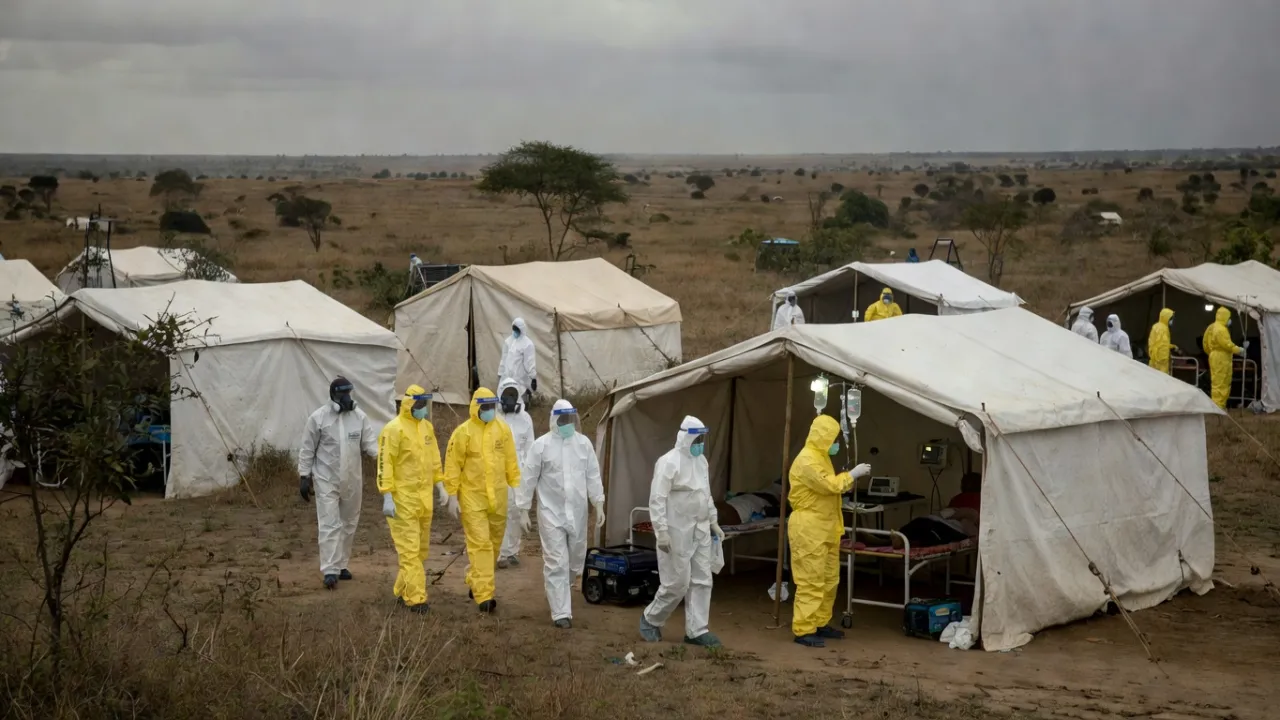
On 17 May 2026, the WHO declared a Public Health Emergency of International Concern (PHEIC) in response to the Ebola outbreak affecting the Democratic Republic of Congo and Uganda. This corresponds to the second-highest alert level under the International Health Regulations. The strain involved, Bundibugyo, currently has no approved vaccine or treatment, unlike the Zaire strain for which vaccines exist.
Cross-border spread has been confirmed: cases have been detected in Kampala and Kinshasa, located several hundred kilometres from the epicentre in Ituri province. The WHO explicitly advises against border closures and travel restrictions, which it considers counterproductive. The affected area remains hard to reach due to armed conflict, mobility linked to mining activity, and weakened health infrastructure, leaving epidemiological surveillance fragmentary.
The crisis unfolds against a tense security backdrop in central and eastern Africa. Ituri has been marked by decades of clashes involving various militias, and a confirmed case in Goma, a city under the control of the M23 militia, illustrates the added logistical obstacles. The declaration also tests, for the first time in an African setting, the health governance mechanisms established after the Covid-19 pandemic, including the pandemic emergency threshold introduced in June 2024.
Several points remain disputed. Some actors question whether WHO emergency declarations can mobilise concrete resources quickly, citing the 2024 mpox precedent; others focus on epidemiological data without challenging the institutional mechanism. The absence of a vaccine against the Bundibugyo strain reopens debate over research inequalities between pathogens, and the WHO's initial mobilisation of 500,000 USD is seen by some observers as insufficient given the crisis's potential scale.