World Cup 2026: dynamic pricing, vandals in Mexico City, FIFA investigated in New York — the most expensive event in history opens in chaos
published on
countries
sources
articles
Measured with the previous method (distance between texts), on a different scale.
Six days before kickoff, the 2026 World Cup opens across its three host nations — the United States, Canada and Mexico — amid unprecedented tensions. FIFA has banned fans from bringing reusable water bottles into the sixteen stadiums, while tickets have resold for up to fifty times their face value under dynamic pricing tied to demand.
The event is now the target of a criminal investigation opened by the attorneys general of New York and New Jersey, who are challenging the organization's pricing practices. An NGO has also filed a class action against FIFA's president ahead of the tournament's start. It is the first time U.S. jurisdictional authorities have questioned the commercial methods of an international sports body in this way.
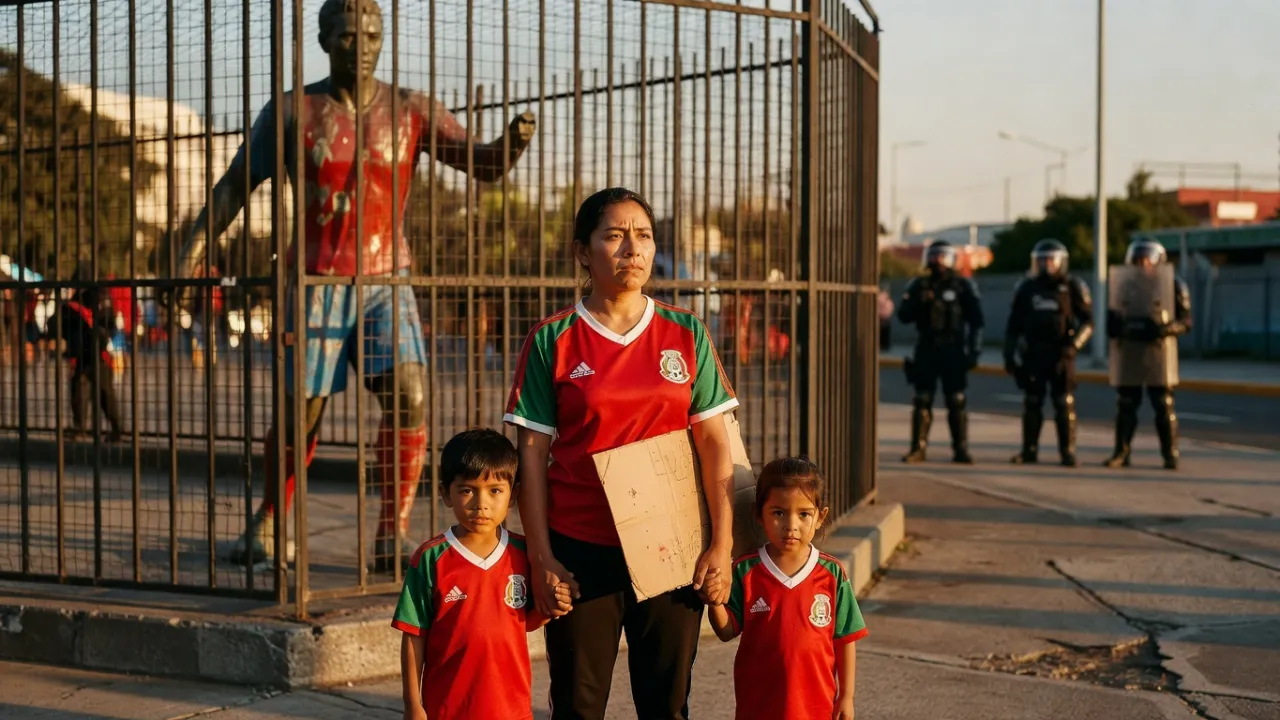
In Mexico City, protests are intensifying: statues of players have been vandalized and barriers were partially removed from the Zócalo after local merchants mobilized. The city has become the focal point of tensions over the competition's economic model, billed as the most heavily covered sporting event in history and, at the same time, the most contested for its commercial design.
The actors diverge on how much criticism is warranted. Some describe FIFA as a predatory institution that captures profits at fans' expense; others view it as a neutral sports operator or a strategic partner to be handled with care. The debate also extends to Mexico City, seen by some as a legitimate actor exercising its right to protest, and by others as a security risk to be managed. The facts themselves are agreed upon; it is their interpretation that sets the perspectives apart.
What the comparison reveals
Common ground and differences in coverage across the media analysed.
What the media report in common
World Cup 2026 opens in six days in the three host countries (United States, Canada, Mexico)
A criminal investigation by the New York and New Jersey attorneys general targets FIFA for inflating ticket prices
FIFA has banned fans from bringing refillable water bottles into the 16 stadiums
Where media coverage diverges
Acceptable level of FIFA criticism
For Western broadsheet media (Bloomberg, LA Times, ZEIT, France 24), FIFA is a predatory institution to denounce. For Nigerian and South African sports media, FIFA remains a neutral sports operator whose rules are accepted. For future-host media (Qatar, Saudi Arabia), FIFA is a strategic partner to spare.
Coverage aligned with this reading
Coverage that diverges
Framing of Mexico City: passion or victim?
For the Mexican and Brazilian press, Mexico City is a passionate actor with the right to protest. For the German and French press, Mexico City is a victim of the imposed FIFA model. For the Anglo-Saxon press, Mexico City is a security risk to manage.
Coverage that diverges
The tournament as cultural event or commercial machine
For Doha and Riyadh, the World Cup remains a cultural global event to celebrate. For Stockholm, Berlin and Paris, it is above all a commercial machine to analyze. For the British popular press, it is both at once.
This grouping describes the publications analysed, not the position of these countries’ populations or of their governments.
Blind spots
What the coverage of each country leaves aside, while others put it forward.
 Nigeria
- Absence of criticism of FIFA and the NY/NJ criminal investigation
- No coverage of Mexico City protests
- No attention to the ICE migrant dimension
 Qatar
Qatar- Systematic avoidance of FIFA criticism
- No coverage of Mexico City protests or organizational dysfunctions
- No mention of the American criminal investigation
 United States
- Weak coverage of Mexico City protests on the co-host side
- Latin American cultural dimension not valued
- Little attention to fans economically expelled from other countries
 United Kingdom
- Weak institutional coverage of the American criminal investigation
- Little attention to Mexico City protests
- Populist approach that does not dig into systemic stakes
How each country reads it
Preview: 3 of 13 media perspectives. Syntheses of the media analysed — not direct quotations. Method & limitations
 Mexico
Mexico documents the paradox of being the most football-loving of the three hosts and the least consenting to the commercial model
2 sources · View sources
 Canada
Ottawa and Toronto navigate between logistical pride and economic critique of the FIFA model
3 sources · View sources
 France
Paris watches the World Cup with the critical distance of a Gaullist press facing the FIFA commercial model
1 source · View sources
The full text, country by country
Mexico
DOMINANT ANGLE
Mexico documents the paradox of being the most football-loving of the three hosts and the least consenting to the commercial model
ANALYSIS
Mexico becomes the theater of the World Cup's central paradox: being the most passionately football-loving host country of the three and the least enthusiastic about the commercial planning.
Canada
DOMINANT ANGLE
Ottawa and Toronto navigate between logistical pride and economic critique of the FIFA model
ANALYSIS
Ottawa and Toronto observe the World Cup's arrival with the contained enthusiasm of a country that has not yet decided whether to be proud as co-host or worried about the bill.
France
DOMINANT ANGLE
Paris watches the World Cup with the critical distance of a Gaullist press facing the FIFA commercial model
ANALYSIS
Paris watches the event with the distance of a country that won the last World Cup (2022 per this universe's calendar) and just lost a friendly against Côte d'Ivoire.
 Germany
DOMINANT ANGLE
Berlin covers the World Cup with institutional lucidity on FIFA's private capture and sporting modesty after 2022
ANALYSIS
Berlin covers the World Cup with a triple reading: economic, political and sporting.
 Sweden
DOMINANT ANGLE
Stockholm documents the economic predation of the FIFA model on the South American working classes
ANALYSIS
Stockholm covers the event with the lucidity of a press that does not have its team at the World Cup but watches the economic situation closely.
 Brazil
DOMINANT ANGLE
Brasilia mixes sporting passion and soft-power calculation in lucid coverage of supporter dispossession
ANALYSIS
Brasilia covers the World Cup with the passion of a five-time-champion country that knows this edition could be Neymar's last chance.
 Argentina
DOMINANT ANGLE
Buenos Aires articulates the football passion and critical lucidity on the economic dispossession of Argentine supporters
ANALYSIS
Buenos Aires approaches the World Cup with the dual consciousness of being both reigning champion (per this universe's calendar) and economically stripped by the tournament.
United States
DOMINANT ANGLE
Washington discovers that the 250th-anniversary World Cup is piloted by a predatory FIFA no one likes
ANALYSIS
Washington discovers that the World Cup it co-financed may turn into its biggest PR nightmare.
United Kingdom
DOMINANT ANGLE
London covers the World Cup through the angle of ordinary fans stripped by FIFA, with a Brexit-compatible contempt
ANALYSIS
London covers the World Cup with the nostalgia of a country that just saw Cole Palmer absent from the English selection and that watches the situation with the usual passion of the British press.
Qatar
DOMINANT ANGLE
Doha covers the World Cup with the strategy of an actor already thinking of 2030 and 2034 while honoring 2026
ANALYSIS
Doha covers the World Cup with the dual identity of former 2022 host and future actor in the 2030 and 2034 World Cup calendar.
 Japan
Japan
DOMINANT ANGLE
Tokyo covers the World Cup through operational logistics rather than frontal criticism
ANALYSIS
Tokyo covers the World Cup with the factual precision typical of the Japanese press.
Nigeria
DOMINANT ANGLE
Lagos covers the World Cup with the technical passion of a distant observer who does not emotionally invest
ANALYSIS
Lagos covers the World Cup with the enthusiasm of a country that is not qualified but passionately follows.
 South Africa
DOMINANT ANGLE
Pretoria observes the World Cup with the detachment of a former host that knows the limits of the FIFA model
ANALYSIS
Pretoria covers the World Cup with the detachment of a country that is not qualified but hosted the 2010 tournament (first African host).
Explore every perspective on this subject across 13 countries.
Compare viewpoints and see where they diverge.