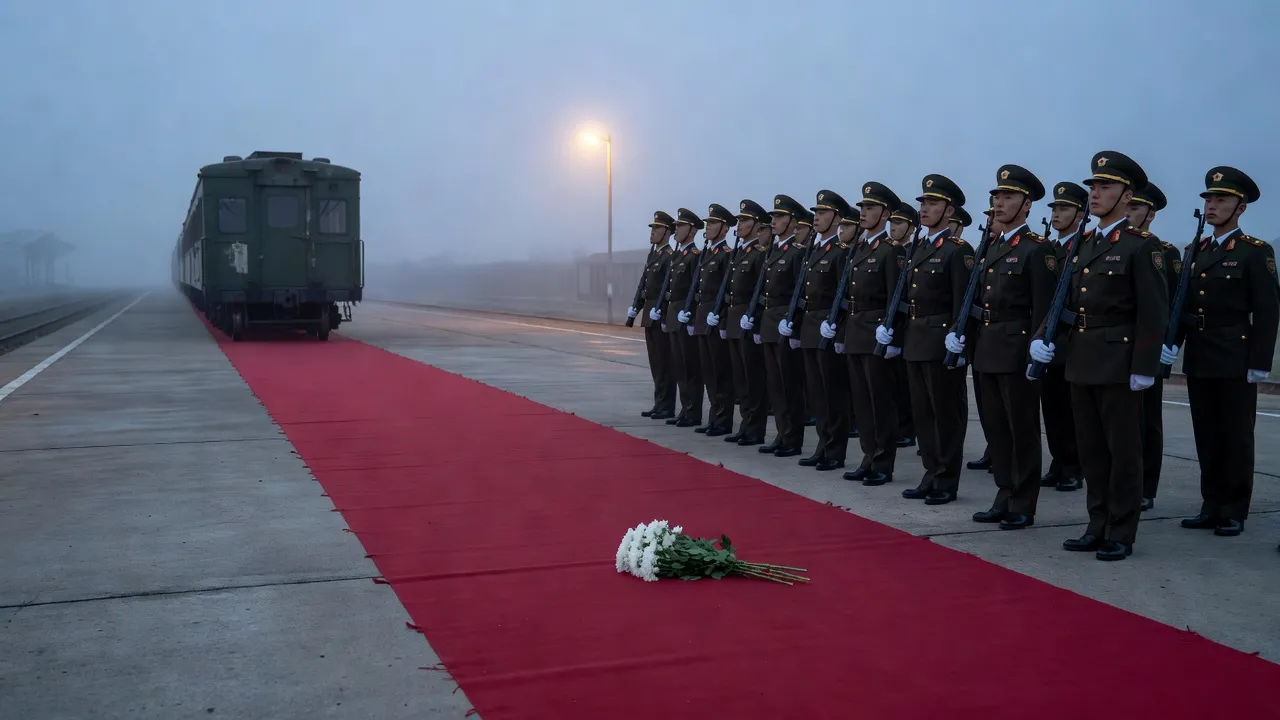
On 5 June 2026, the official Chinese and North Korean agencies announced the same morning a state visit by Xi Jinping to Pyongyang on 8 and 9 June. It is his first trip to the country since June 2019 and his first foreign visit of the year, after he sharply curtailed his travel since the pandemic. The visit caps a dense diplomatic sequence: Xi received Donald Trump in Beijing on 14-15 May, then Vladimir Putin on 19-20 May.
The day before the announcement, on 4 June, Kim Jong-un unveiled a new uranium enrichment facility and called for an "exponential" expansion of the nuclear program. In May, he had already codified a doctrine of automatic launch if the chain of command were targeted. The timing of the two announcements puts Pyongyang in a position of strength on the eve of the talks.
The regional context is tense: North Korea has deployed troops alongside Russia in Ukraine, South Korea is negotiating enrichment rights with Washington, Japan is accelerating its rearmament and Australia is investing in AUKUS. The year 2026 also marks the 65th anniversary of the 1961 treaty of friendship and mutual assistance, China's only formal defense treaty, which now accounts for most of North Korea's foreign trade.
Readings of the event diverge. Some actors see it primarily as a message addressed to Moscow, or as an attempt to reassert Chinese influence over an ally that has grown more autonomous; others describe an openly multipolar bloc. The extent of Xi's real commitment to denuclearization remains disputed: Washington asserts a shared objective with Beijing, while the Chinese side speaks only of "continuity and consistency," and a joint statement signed with Moscow in May opposes sanctions and military pressure on Pyongyang.