N°18
Thirty-six thousand soldiers: the week Washington threatened to leave Europe
36,000troops
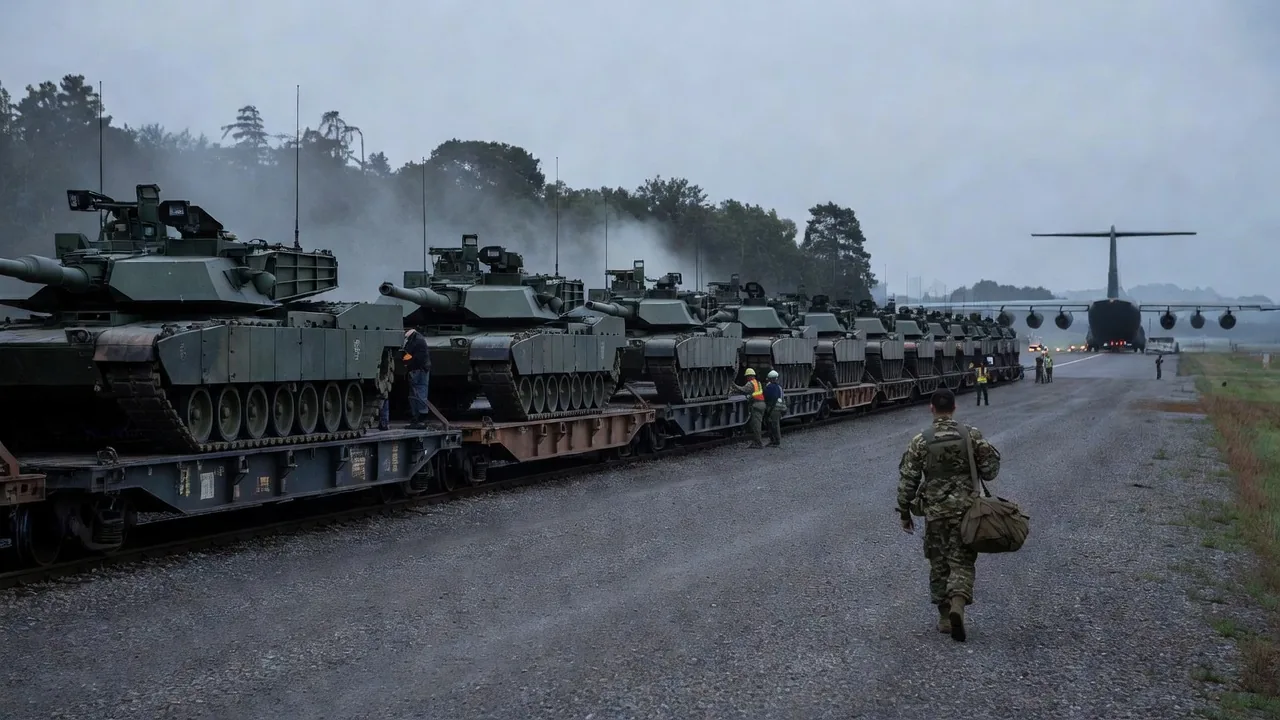
The number of US soldiers stationed in Germany that Trump threatened to withdraw on April 29, 2026. The 2024 National Defense Authorization Act caps US forces in Europe at 85,000 and forbids reductions below 76,000 without joint allied evaluation (source: 20minutes; Johanna Möhring, SWP). A mass pullout is therefore legally constrained. In 2020, Trump had already requested the return of 9,500 troops from Germany (Les Echos) — the current threat covers a force four times larger and now extends to Italy and Spain. On April 30, even as the press documented the threat, a US colonel was appointed to a strategic post within the German army command — evidence that Washington is reorganizing its European posture rather than retreating from it (Nico Lang, SWP, BFMTV).
21
Subjects analysed
27
Countries compared
21%
Owned track-record
The week's three acts
01What divides — free02Under the radar — weak signals03What we bet — predictionsAct 1Free · open access
What divides
The divergence score measures the framing gap between the world’s newsrooms on the same event. The higher the score, the more the narrative fractures along borders.
↑ Most divergent
85/100
Trump threatens to pull US troops from Germany: the transatlantic fracture deepens
84/100
The UAE leaves OPEC: the end of Gulf solidarity
82/100
Antisemitic attack in London: two Jewish men stabbed in Golders Green, the UK raises its terror threat level
↓ Least divergent
Convergences — what every newsroom tells without connecting
36,000 troops, Italy, Spain: how the threat of US withdrawal becomes a multi-front coercion policy
Trump threatens on April 29 to pull US forces from Germany — 36,000 stationed troops (source: Politico-Pravda, Le Monde)The 2024 NDAA caps US troops in Europe at 85,000 and forbids reductions below 76,000 without allied agreement (Johanna Möhring, SWP)The threat extends to Italy (W17) and Spain (W17, NATO suspension floated) — same pattern, lateral escalationOn April 30, a US colonel is appointed to a strategic post within the German army command — reorganization, not withdrawal (Nico Lang, SWP)King Charles III tells the US Congress on April 29 that the transatlantic alliance 'cannot rest on its laurels' — the first British royal address at the Capitol amid a NATO crisis
Confidence 91% · US · DE · UK · FR · IT · ES · KR
OPEC fractured, Hormuz negotiated, Pakistan mediating: oil geopolitics tilts toward South-South hubs
The UAE leave OPEC on May 1 after 59 years — 2.9 mb/d production in 2024 (BBC, Al Jazeera)Iran proposes on April 29 to reopen Hormuz in exchange for the lifting of the US naval blockade — three-step proposalPakistan continues its mediator role despite the collapse of the Islamabad talks on April 26Talks reorganize around a Qatar-Pakistan-UAE axis — bypassing the traditional P5+1 frameworkThe Chinese and Indian silence on the OPEC exit leaves Beijing space to negotiate bilateral deals with Abu Dhabi
Confidence 87% · AE · IR · PK · QA · US · CN · IN · SA
Act 2◆ Signals & shifts locked
Under the radar
Weak signals and narrative shifts are the Prism’s deep analysis: what newsrooms have not yet named. Subscribers only. The blind spots stay free.
Weak signals ◆ Locked
Ukraine orders 50,000 ground robots: the threshold where autonomy becomes a distinct military category
After the UAE, Qatar and Pakistan structure a South-South mediation hub: the end of the Western monopoly on peace talks
The Golders Green attack and Britain's terror level rise: 'Iran-linked terror' enters European criminal law as an operational category
Narrative shifts ◆ Locked
Transatlantic policy
Oil diplomacy
Monetary policy
Blind spots Free · open access
China
The UAE's exit from OPEC after 59 years: a Chinese silence while Beijing imports 50% of its crude from the Gulf
The UAE announced on April 30 their effective withdrawal from OPEC after 59 years of membership — May 1, 2026 marks the end of the longest Arab membership in the cartel. The UAE produced 2.9 million barrels per day in 2024 (BBC, Al Jazeera) and the exit opens the way to bilateral oil deals. Chinese state media (Global Times, Xinhua, CCTV) did not cover the news, despite their habitual detailed analysis of Gulf cartel dynamics. China imports roughly 50% of its crude from the Middle East, with a substantial share from the UAE. The silence is telling: Beijing does not wish to spotlight the fragility of the OPEC system on which it depends for supply stability, nor signal too early that bilateral China-Gulf agreements could replace multilateral coordination. India also ignored the news — an editorial choice driven by approaching national elections and reluctance to revive domestic debates over fuel prices. Brazil, the third major emerging-market customer, covered OPEC only through the lens of prices, not structural fragmentation.
Covered: AE · SA · GB · US · QAIgnored: CN · JP · IN · BR
Japan
The transatlantic fracture and the Powell-Warsh Fed succession: an editorial silence ahead of the G7
Japanese media devoted little coverage to the two most structuring stories of the week for Japanese security and economic interests: Trump's threat to withdraw 36,000 troops from Germany, and the confirmation of Kevin Warsh as Powell's Fed successor (partisan 13-11 vote at the Senate Banking Committee — the first such vote in the committee's history, per Fortune). Japan depends on the US security umbrella in Asia — any erosion of US commitments in Europe reduces the credibility of Indo-Pacific guarantees. Japan is also the world's third-largest economy and a major holder of US Treasuries: the politicization of the Fed directly affects the value of its reserves. The editorial silence is strategic: Tokyo is preparing the G7 summit and avoiding amplifying internal US tensions before a multilateral diplomatic format. Asahi Shimbun and Yomiuri Shimbun preferred to cover domestic topics (post-quake reconstruction, weapons exports to the Philippines) rather than relay the transatlantic crisis.
Covered: DE · FR · UK · US · KRIgnored: JP
India
Pakistan as a permanent US-Iran mediator: India's silence on the emergence of a South-South diplomatic hub
On April 26, Trump cancelled his envoys' trip to Islamabad and the US-Iran talks collapsed — but Pakistan continues positioning itself as a structural mediator. Dawn (Pakistan), Al Jazeera (Qatar), Anadolu (Turkey) and The National (UAE) documented Asim Munir's trajectory: visit to Tehran on April 16, hosting talks in W15, active mediation on Hormuz reopening in late April. Indian outlets (Times of India, The Hindu, Indian Express) almost entirely ignored the Pakistani role, even though a Pakistani diplomatic success would redefine the regional balance to New Delhi's detriment. The Indian silence reflects an editorial preference: cover Pakistan only through the terrorism lens, never as a credible diplomatic actor. This cultural filter creates a strategic blind spot: if Pakistan crystallizes a non-Western mediation framework (with Qatar and the UAE), India will be excluded by default, despite having the diplomatic capacity to participate.
Covered: PK · QA · TR · AE · UKIgnored: US · IN · FR · DE
Act 3◆ Reasoning locked
What we bet
Dated, falsifiable predictions, judged publicly. The statement and deadline are free — the reasoning behind them is for subscribers. We settle them later, won and lost alike.
31
May 2026
By May 31, 2026, NATO convenes an extraordinary summit in Brussels to formalize a collective response to the threat of US withdrawal from Germany — with a joint declaration limiting US unilateral actions
Reasoning: The W18 predigest documents a convergence of signals: escalation of US discourse (36,000 troops), Charles III's address at Congress, designation of a…
🔒 Full reasoning for subscribers
79%
Confidence
30
Jun 2026
By June 30, 2026, at least one other OPEC member — likely Kuwait or Oman — announces a quota revision or partial withdrawal, following the path traced by the UAE
Reasoning: The UAE's exit on May 1 after 59 years sets a fragmentation precedent.
🔒 Full reasoning for subscribers
66%
Confidence
15
May 2026
By May 15, 2026, the Bank of Japan or the Bundesbank publish a formal statement calling for safeguards to protect central bank independence — in reaction to the partisan Senate Banking Committee vote on Warsh
Reasoning: The W18 predigest identifies this convergence with 0.66 confidence.
🔒 Full reasoning for subscribers
63%
Confidence
30
Jun 2026
By June 30, 2026, Ukraine reaches an operational fleet of 30,000 autonomous ground robots — forcing NATO to publish a UGV integration doctrine for its own forces
Reasoning: The 25,000 UGV contract for $250 million announced on April 28 (Euromaidan Press) targets a mid-2026 delivery.
🔒 Full reasoning for subscribers
71%
Confidence
Our track-record — free, owned, verifiable
21%
of predictions confirmed across all settled editions. We publish everything: bets won and bets lost. Transparency is the contract — not infallibility.
04
ConfirmedPredictions that landed
15
DeniedOwned publicly
19
Settled totali.e. 21% success — won and lost
Unlock
edition N°18
The statement is free. Reading the world, less so. Access the weak signals, the narrative shifts and the full reasoning behind every prediction.
- 5 weak signals decrypted in full
- 3 narrative shifts with their evidence
- The reasoning of each of the 4 predictions
- Full access to the 21 subjects of the week
- All archives, from the start to today
Subscribe to the Prism
Secure payment · Cancel anytime
— The newsroom that bets on the future
Complete weak signals, narrative shifts with evidence, and the reasoning behind every prediction.
$4.99/month$39.99 /year · save 33%
The Prism is published every Saturday. The in-depth analysis is for subscribers.
SHARE THIS RECAP
SHARE THIS COMPARISON
Show your friends how the world sees the same news differently.
Subscribe to the newsletter
Get the Weekly every Saturday morning. Free.