N°19
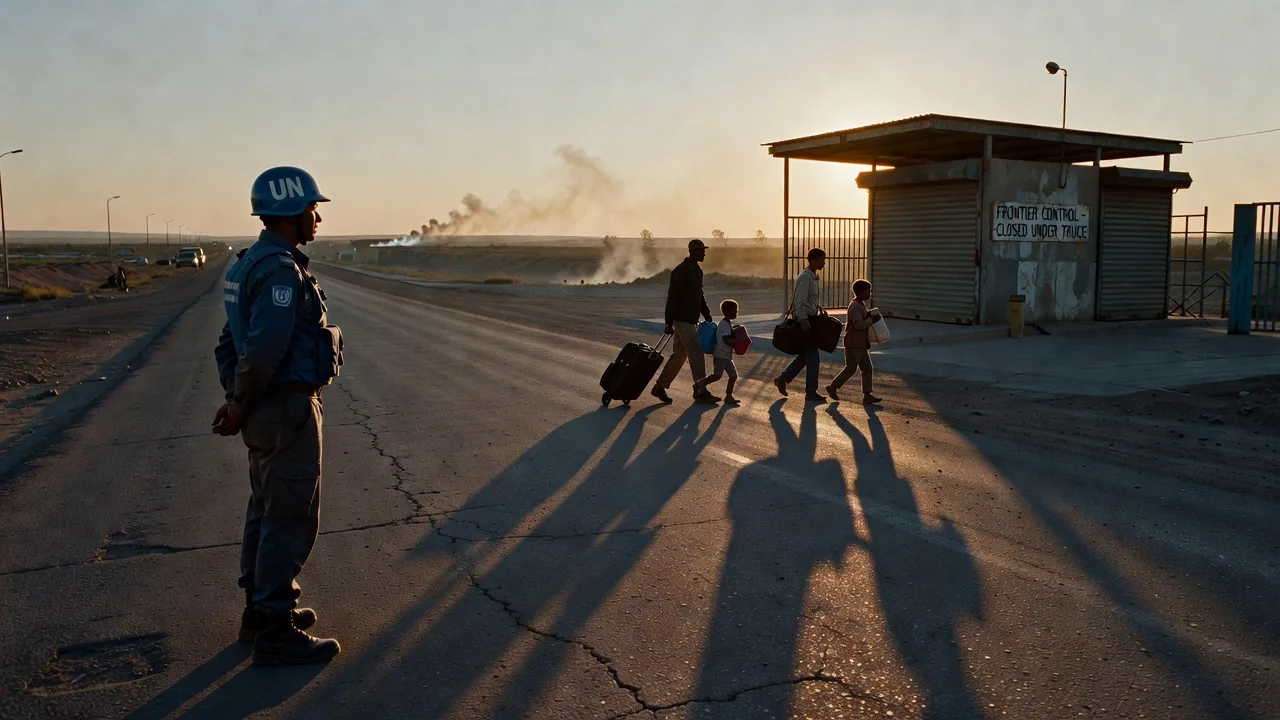
The week three ceasefires cracked at once
1,820violations
The number of Russian violations documented by Kyiv during the unilateral ceasefire declared by Volodymyr Zelensky for Victory Day on 9 May 2026. On 7 May, a strike on a kindergarten in Sumy killed two people (regional prosecutor's report, relayed by Reuters and Le Monde). On 8 May, Moscow notified foreign diplomatic missions in Kyiv to evacuate their personnel ahead of 'massive' retaliatory strikes if Kyiv disrupted the Moscow parade — the first formal warning to foreign embassies on enemy soil since 1962. The figure crystallises a week in which three ceasefires — Iran-United States, Israel-Lebanon, Russia-Ukraine — fractured simultaneously, each through a calibrated symbolic strike designed to signal exit from the framework without formally breaking it.
28
Subjects analysed
32
Countries compared
21%
Owned track-record
The week's three acts
01What divides — free02Under the radar — weak signals03What we bet — predictionsAct 1Free · open access
What divides
The divergence score measures the framing gap between the world’s newsrooms on the same event. The higher the score, the more the narrative fractures along borders.
↑ Most divergent
86/100
Iran strikes Fujairah and ADNOC: the first direct attack on the Emirates since the ceasefire
84/100
The Pentagon signs 7 military AI contracts and excludes Anthropic: the war over ethical standards
82/100
Mexico: Sinaloa governor indicted by Washington, Sheinbaum holds the line
↓ Least divergent
Convergences — what every newsroom tells without connecting
Project Freedom buried, ADNOC struck, Iran's 14-point plan: Tehran sets the agenda for de-escalation through Pakistan
4 May: the US naval escort operation in the Strait of Hormuz, named 'Project Freedom', is launched by Trump as a response to Iranian seizures (Reuters, AFP, The Refract dossier iran-hormuz-deal-blocus-naval-trump-20260429).4 May: Iran transmits via Islamabad a 14-point peace plan — a response to the American 9-point plan — proposing the cessation of hostilities within 30 days and a phased reopening of Hormuz, with no mention of the nuclear file (Tasnim, Press TV, Dawn).5 May: Iranian drones and missiles strike the ADNOC oil facility at Fujairah (UAE) — the first direct attack on Emirati soil since the April ceasefire. Three Indian nationals wounded (Khaleej Times, The National, Reuters).5 May: Trump publicly threatens to 'wipe Iran off the face of the Earth' but keeps the Pakistani channel open (Truth Social, picked up by AP and BBC).6 May: Trump suspends Project Freedom 48 hours after launch and announces 'considerable progress' in negotiations with Tehran. The naval blockade remains in place but the armed escort is halted (Reuters, Wall Street Journal).8 May: no resumption of Iranian seizures or strikes on the Gulf — the first documented de-escalation window since the start of the war.
The 4-6 May sequence reads like a textbook on asymmetric coercion: Tehran struck a US ally (the UAE) precisely as Washington had launched a naval operation designed to protect that same ally. The strike on ADNOC was neither a full act of war nor a diplomatic warning — it was a priced demonstration that the US escort did not cover the full set of allied assets and that Tehran could impose a marginal cost on every day of escalation. The suspension of Project Freedom 48 hours later validates the Iranian reading: the operation could not be politically sustained in the face of a direct attack on Emirati installations. The 14-point plan, transmitted via Islamabad, bypasses two traditional mediators (Russia and the European Union) and installs Pakistan as an operational pivot — Asim Munir had already visited Tehran on 16 April, Trump had cancelled a trip by his envoys to Islamabad on 26 April. The geopolitics of the Iran-United States conflict is now arbitrated from Rawalpindi, not from Geneva or Muscat. The deliberate omission of the nuclear track in the Iranian plan is the detail that structures what comes next: Tehran proposes a tactical de-escalation without conceding on the underlying file — a format that may suit Trump (who can claim 'considerable progress' without showing a nuclear deal to Congress) but places Israel in an adversarial position, as the Beirut strike of 8 May demonstrated. Country-by-country consequences: for the UAE, Abu Dhabi's 6 May statement ('we will study the conditions for a return to a multilateral format') confirms that the OPEC departure of 30 April and the strike of 5 May are linked — the country is exploring bilateral oil deals with China and India while withdrawing from collective frameworks. For Pakistan, the role of permanent mediator now matters as much as the nuclear status Islamabad has cultivated since 1998. For France and the United Kingdom, the joint naval mission launched on 18 April (The Refract /en/topics/ormuz-reouverture-iran-otan-mission-navale-20260418) remains operational, but Paris and London are no longer in the decision room.
Act 2◆ Signals & shifts locked
Under the radar
Weak signals and narrative shifts are the Prism’s deep analysis: what newsrooms have not yet named. Subscribers only. The blind spots stay free.
Weak signals ◆ Locked
The Iranian strike on ADNOC at Fujairah: the threshold where a strike on a US ally becomes a negotiating instrument
The Pentagon labels Anthropic a 'supply-chain risk': the migration of the ethical criterion towards administrative classification
The dismantling of the Voting Rights Act and the redistricting cascade: the 2026 electoral map rewritten in seven days
Narrative shifts ◆ Locked
Foreign policy and coercion
Escalation diplomacy
Pontifical diplomacy and geopolitical alignment
Blind spots Free · open access
China
Trump's Cuba executive order and the threat of military intervention: a Beijing silence at a moment when China is Havana's leading trade partner
On 1 May 2026 Donald Trump signed a presidential decree extending US sanctions to any foreign bank cooperating with Havana. The next day, in Florida, he raised the prospect of taking control of Cuba 'almost immediately', citing the USS Abraham Lincoln 'on its way back from Iran'. Chinese outlets (Global Times, Xinhua, China Daily) covered neither the decree nor the military threat — even though China is Cuba's leading trade partner after Venezuela and Beijing installed an electronic listening station at Bejucal in 2024. The silence is instrumental: the decree explicitly targets the 'foreign banks' financing Cuban energy and defence — Bank of China chief among them. By not covering, Beijing avoids taking a public stance and keeps the option of a quiet withdrawal of exposed banks. Russia, the second strategic silence, also has no interest in publicising a file in which it cannot offer anything: Moscow already lost its Lourdes station in 2002. India and Brazil, the third silence, are in active tariff negotiations with Washington — Brasília is waiting for the BRICS summit, New Delhi is observing the effect of banking extraterritoriality before commenting.
Covered: FR · UK · CA · QA · TR · UA · PK · AR · SGIgnored: CN · RU · IN · BR
Russia
Iran's 14-point plan and Pakistani mediation: a Russian silence as Moscow is shut out of the only functioning diplomatic format
On 4 May 2026, Iran transmitted to the United States a 14-point peace plan via Islamabad — a response to the American 9-point plan delivered the previous week. The document proposes ending hostilities within 30 days, a phased reopening of Hormuz and a regional de-escalation framework. It deliberately omits the nuclear track. RIA Novosti, TASS and Kommersant did not relay the existence of the plan. Sputnik framed the suspension of Project Freedom as an 'American retreat' without mentioning the Iranian sequence or the Pakistani role. The silence is doubly revealing: Moscow loses its historic mediating function between Tehran and Washington (a role played since 2003 in the Geneva format) in favour of a Sunni nuclear state, Pakistan. The Munir-Khamenei channel, opened in April, operates without Russians, without Chinese, without Europeans. For Moscow, publicising the process would amount to formalising its own marginalisation just as Russia is trying to stabilise its own Trump-Putin Ukraine mediation (the call of 30 April).
Covered: IR · US · FR · CA · IL · PK · EG · IN · SG · AU · CNIgnored: RU
India
The indictment of the Sinaloa governor and US extraterritorial criminal jurisdiction: an Indian silence as the precedent exposes the diasporas of the Global South
On 28 April 2026, the US Department of Justice indicted Rubén Rocha Moya, sitting governor of the Mexican state of Sinaloa, for alleged ties to the cartel — the first federal criminal indictment of a sitting foreign governor by the United States. Mexican President Claudia Sheinbaum refused any extradition 'without irrefutable evidence'. Indian outlets (Times of India, The Hindu, Indian Express) did not cover the legal dimension of the precedent — a striking editorial choice for a country negotiating in parallel a bilateral trade agreement with Washington at the Paris G7 (7 May). India has triple exposure: (1) three Indian nationals were wounded in the Iranian strike on ADNOC at Fujairah on 5 May; (2) the Indian diaspora in the United States (4.8 million, the second-largest foreign community) is regularly targeted by financial investigations linked to drug trafficking; (3) the Rocha precedent establishes that a sovereign state can lose a sitting leader because of a US indictment. The silence is defensive: New Delhi does not wish to legitimise the precedent through public criticism before having assessed it legally. Brazil, South Africa and Nigeria adopt the same posture — confirming that the Global South considers extraterritorial criminal jurisdiction a structural threat to be negotiated in silence, not denounced in public.
Covered: US · MX · ES · FR · UK · CA · QA · AUIgnored: IN · BR · ZA · NG
Act 3◆ Reasoning locked
What we bet
Dated, falsifiable predictions, judged publicly. The statement and deadline are free — the reasoning behind them is for subscribers. We settle them later, won and lost alike.
25
May 2026
By 25 May 2026, Iran and the United States announce a limited Hormuz de-escalation framework — phased reopening of the strait in exchange for a freeze of the US naval blockade — with no nuclear deal, transmitted via the Pakistani channel
Reasoning: Three indicators converge.
🔒 Full reasoning for subscribers
71%
Confidence
15
Jun 2026
By 15 June 2026, the EU adopts counter-tariffs on US agricultural exports (at least 10 billion euros) in response to the 25% on cars and the withdrawal of 5,000 troops from Germany — coordinated via the Commission, with no national veto
Reasoning: The failure of the 7 May Paris G7 on tariff coordination and the entry into force of the EU-Mercosur agreement on the…
🔒 Full reasoning for subscribers
66%
Confidence
30
Jun 2026
By 30 June 2026, the US Department of Justice indicts at least one additional sitting Latin American leader or former leader — most likely Venezuelan or Colombian — on the Rocha Moya model
Reasoning: The 28 April precedent (Governor Rocha Moya) establishes that a sitting foreign leader can be indicted without diplomatic coordination.
🔒 Full reasoning for subscribers
63%
Confidence
24
May 2026
By 24 May 2026, Hezbollah conducts at least one retaliatory strike on northern Israel — Galilee or Golan plateau — in response to the death of Malek Ballout, definitively breaking the 17 April Israel-Lebanon ceasefire
Reasoning: Hezbollah doctrine since 2006 requires a response to any targeted elimination of a Radwan commander; the absence of immediate retaliation (8-10 May)…
🔒 Full reasoning for subscribers
64%
Confidence
Our track-record — free, owned, verifiable
21%
of predictions confirmed across all settled editions. We publish everything: bets won and bets lost. Transparency is the contract — not infallibility.
04
ConfirmedPredictions that landed
15
DeniedOwned publicly
19
Settled totali.e. 21% success — won and lost
Unlock
edition N°19
The statement is free. Reading the world, less so. Access the weak signals, the narrative shifts and the full reasoning behind every prediction.
- 5 weak signals decrypted in full
- 3 narrative shifts with their evidence
- The reasoning of each of the 4 predictions
- Full access to the 28 subjects of the week
- All archives, from the start to today
Subscribe to the Prism
Secure payment · Cancel anytime
— The newsroom that bets on the future
Complete weak signals, narrative shifts with evidence, and the reasoning behind every prediction.
$4.99/month$39.99 /year · save 33%
The Prism is published every Saturday. The in-depth analysis is for subscribers.
SHARE THIS RECAP
SHARE THIS COMPARISON
Show your friends how the world sees the same news differently.
Subscribe to the newsletter
Get the Weekly every Saturday morning. Free.