N°20
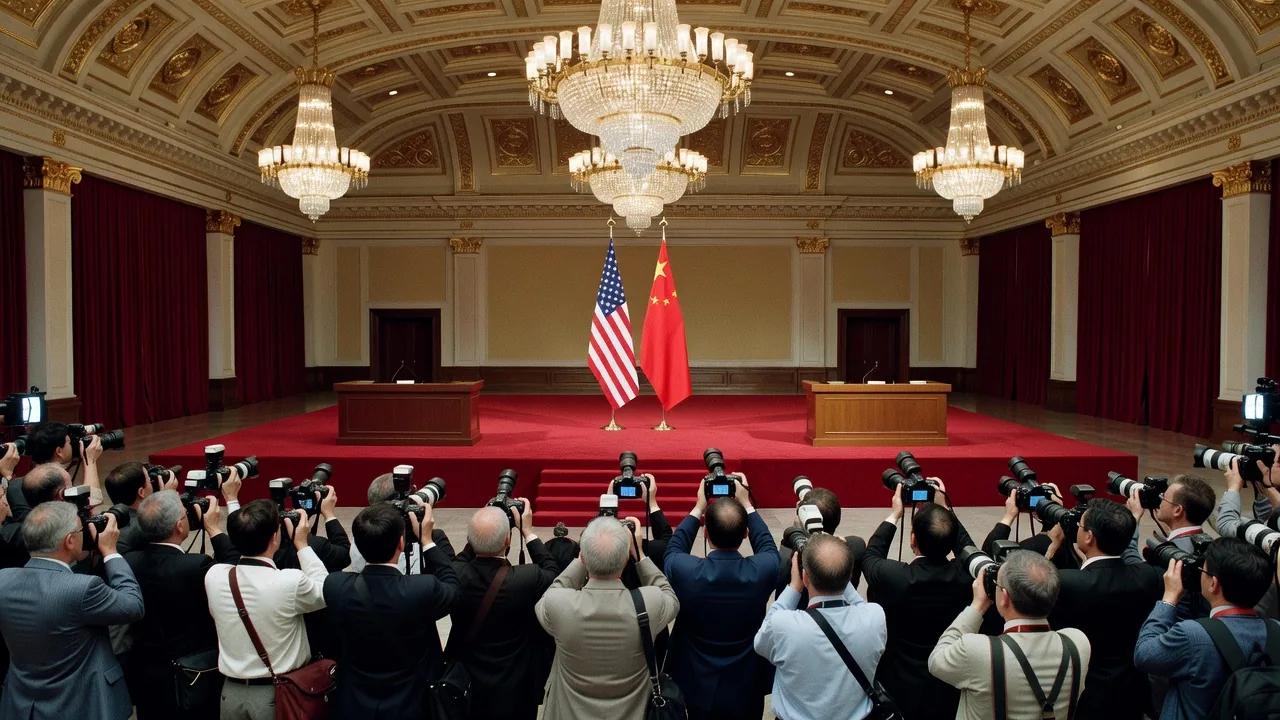
The Week Two Men Posed for History
28days the Strait of Hormuz stayed closed
While Donald Trump and Xi Jinping posed in Beijing for what every capital called "the summit of the century," the Strait of Hormuz entered its twenty-eighth day of closure, pushing US inflation to 3.8% and threatening Asian economies with a second energy shock. The figure captures the week's gap: the diplomatic staging celebrated an orderly recomposition of the world, while the truce that summit was meant to stabilize remained, in Trump's own words, "on life support." Two leaders managing an order that was unravelling 6,000 kilometers from the room where they shook hands.Sources — Reuters · Bloomberg · Al Jazeera
13
Subjects analysed
32
Countries compared
21%
Owned track-record
The week's three acts
01What divides — free02Under the radar — weak signals03What we bet — predictionsAct 1Free · open access
What divides
The divergence score measures the framing gap between the world’s newsrooms on the same event. The higher the score, the more the narrative fractures along borders.
↑ Most divergent
78/100
Trump à Pékin : Xi pose ses lignes rouges, le monde retient son souffle
74/100
Tribunal militaire spécial et peine de mort pour le 7 Octobre, sanctions européennes contre les colons
71/100
Le cessez-le-feu Iran-USA en soins intensifs : Hormuz fermé, choc pétrolier mondial
↓ Least divergent
Convergences — what every newsroom tells without connecting
The summit of the century read by each through its own fear
May 12: on the eve of the visit, middle powers scrutinize the trip as a signal about the coming international order.May 13: Trump arrives in Beijing for his first state visit to China in nine years, accompanied by Elon Musk, Tim Cook and a dozen US CEOs.May 14: Xi lays out four non-negotiable red lines and presses Washington to abandon arms sales to Taipei.May 15: Xi warns that any misstep on Taiwan could trigger conflict; the summit closes without a comprehensive deal.
From Brasília to Tokyo, Trump's trip to Beijing was read not as an event but as a mirror: each capital projected its own anxiety onto it. Washington foregrounded the record CEO delegation and the trade leverage. Beijing framed the meeting from a posture of strategic confidence, four red lines on the table and Taiwan at the top. Tokyo and Taipei scrutinized every word about the strait, reading Xi's warning as a test of the US guarantee. Gulf capitals watched for what the two men would say about Iran. The common thread across more than twenty capitals: a summit sold as the orderly recomposition of the world, watched everywhere as a revealer of who depends on whom.
Confidence 85% · US · CN · QA · RU · SG · UK · CA · JP · KR · TW · IN · BR
Iran's nuclear red line, the only real sticking point
May 11: Iran transmits its answer via Pakistan — it accepts transferring its enriched uranium but refuses to dismantle its sites; Trump calls it "totally unacceptable."May 13: the Strait of Hormuz enters its twenty-eighth day of closure, US inflation reaches 3.8%.
Act 2◆ Signals & shifts locked
Under the radar
Weak signals and narrative shifts are the Prism’s deep analysis: what newsrooms have not yet named. Subscribers only. The blind spots stay free.
Weak signals ◆ Locked
Each country arbitrates alone against a virus science barely knows
Europe finally lifts its internal block on settler sanctions
The "death penalty" precedent set by a democracy
Narrative shifts ◆ Locked
US posture on the Iran ceasefire
Budapest's European anchoring
Keir Starmer's authority over his own party
Blind spots Free · open access
Philippines
The double impeachment of a political heir and the assassination-plot charge
The impeachment of Sara Duterte — the first Philippine official to be charged twice, accused of having commissioned the assassination of President Marcos — is a major constitutional crisis in a democracy of more than a hundred million people. Yet it was followed closely mainly from the Asia-Pacific, with European capitals largely leaving it in the blind spot, absorbed by Beijing and Iran. The simultaneous overturning of the Senate leadership by a Duterte ally, which conditions the entire coming trial, remained almost unexplored outside the region.
Covered: PH · TW · USIgnored: FR · DE · RU
Thailand
Thaksin's return and the recomposition of Thai power
Thaksin Shinawatra's release after eight months in detention reopens the debate on the future of a political dynasty in a Thailand where his Pheu Thai party suffered its worst electoral defeat. It is a test of the patrimonial power model in Southeast Asia, but the subject was treated as an isolated regional item rather than as a signal about the fragility of political inheritances shared by several countries. Most European capitals did not dig into it.
Covered: CN · UK · USIgnored: FR · DE · QA
Netherlands
The absence of an international health framework facing the MV Hondius hantavirus
Beyond the ship's drama — a French woman on ECMO, three deaths, a 42-day quarantine imposed on the Filipino crew — the real blind spot is the total absence of a shared protocol: each state arbitrated alone the quarantine length and repatriation by nationality. The major powers that otherwise steer global health governance did not comment on this fragmentation, even though it foreshadows the response to a more contagious threat. The subject stayed confined to the countries directly hit by the evacuation.
Covered: NL · ES · FRIgnored: US · CN · RU
Act 3◆ Reasoning locked
What we bet
Dated, falsifiable predictions, judged publicly. The statement and deadline are free — the reasoning behind them is for subscribers. We settle them later, won and lost alike.
30
May 2026
The Strait of Hormuz will remain closed or partially blocked as of May 30, 2026, with no full reopening confirmed.
Reasoning: Continuation of the observed state: 28 days of closure, Tehran rejecting the US proposal as illegitimate and Washington calling the answer "totally…
🔒 Full reasoning for subscribers
70%
Confidence
30
May 2026
Keir Starmer will still be Prime Minister of the United Kingdom as of May 30, 2026.
Reasoning: Continuation of the observed state: despite the revolt of more than 70 MPs and ministerial resignations, Starmer explicitly refused to resign and…
🔒 Full reasoning for subscribers
65%
Confidence
30
May 2026
No comprehensive agreement ending Iran-United States hostilities will be signed before May 30, 2026.
Reasoning: The Beijing summit closed without an exit from the Iran crisis, and both camps hold the dismantlement red line.
🔒 Full reasoning for subscribers
75%
Confidence
30
May 2026
The impeachment trial of Sara Duterte before the Philippine Senate will not be concluded by a verdict before May 30, 2026.
Reasoning: The House has just voted the impeachment on May 11; the case moves to the Senate, whose leadership was just overturned by…
🔒 Full reasoning for subscribers
70%
Confidence
Our track-record — free, owned, verifiable
21%
of predictions confirmed across all settled editions. We publish everything: bets won and bets lost. Transparency is the contract — not infallibility.
04
ConfirmedPredictions that landed
15
DeniedOwned publicly
19
Settled totali.e. 21% success — won and lost
Unlock
edition N°20
The statement is free. Reading the world, less so. Access the weak signals, the narrative shifts and the full reasoning behind every prediction.
- 3 weak signals decrypted in full
- 3 narrative shifts with their evidence
- The reasoning of each of the 4 predictions
- Full access to the 13 subjects of the week
- All archives, from the start to today
Subscribe to the Prism
Secure payment · Cancel anytime
— The newsroom that bets on the future
Complete weak signals, narrative shifts with evidence, and the reasoning behind every prediction.
$4.99/month$39.99 /year · save 33%
The Prism is published every Saturday. The in-depth analysis is for subscribers.
SHARE THIS RECAP
SHARE THIS COMPARISON
Show your friends how the world sees the same news differently.
Subscribe to the newsletter
Get the Weekly every Saturday morning. Free.