N°24
The Week of Proclaimed Victories
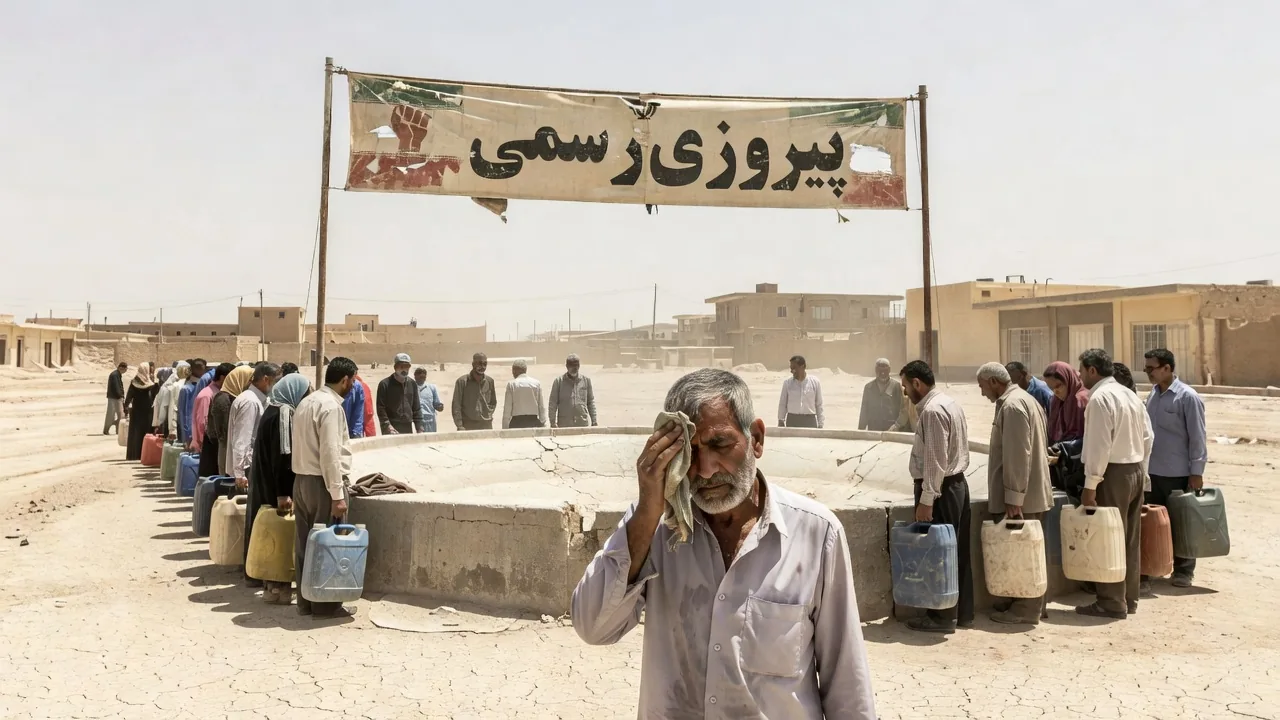
20,000Iranians cut off from drinking water
The US bombing of Tehran's water reservoirs cut off access to drinking water for some 20,000 residents in 50°C heat, according to figures relayed from Tehran and picked up by Gulf chancelleries. The same president who promised a "total victory in two weeks" extended his targeting to bridges and power plants, turning an April truce into open escalation. The figure captures the week's gap: the rhetoric speaks of a deal "100% negotiated," while the ground counts its outages and its dead.Sources — Tasnim · Al Jazeera · Reuters
23
Subjects analysed
46
Countries compared
52%
Owned track-record
The week's three acts
01What divides — free02Under the radar — weak signals03What we bet — predictionsAct 1Free · open access
What divides
The divergence score measures the framing gap between the world’s newsrooms on the same event. The higher the score, the more the narrative fractures along borders.
↑ Most divergent
83/100
Washington frappe les réservoirs d'eau iraniens et menace ponts et centrales : le deal s'effondre
74/100
Trump menace de saisir l'île de Kharg puis annule tout : la guerre du pétrole iranien en montagnes russes
66/100
Ebola déborde le Congo : Washington veut fermer les frontières de l'Europe, Bruxelles refuse
↓ Least divergent
29/100
Xi quitte Pyongyang : ce que son silence sur le nucléaire dit de la reconnaissance de la bombe de Kim
Convergences — what every newsroom tells without connecting
The Iran-US deal announced, denied, re-announced
June 8: first direct Iran-Israel strike since April, eleven missiles on Galilee, a Trump-Netanyahu call hardening into an ultimatum.June 9: Trump promises a "total" US victory over Iran within two weeks while Netanyahu keeps striking despite the order.June 10: a US Apache helicopter downed near Hormuz, CENTCOM retaliates on Qeshm and Jask, Trump insists talks hold.June 11: bombing of Iranian water reservoirs, threats against bridges and power plants, the April deal hanging by a thread.June 12: threat to seize Kharg Island "like in Venezuela," then cancellation of the strikes and announcement of an "almost finalized" deal.
In five days, Washington announced, denied and re-announced a deal with Iran at least three times, against a backdrop of uninterrupted military escalation. The sequence reads identically from Paris to Doha to New Delhi: Paris ties the deal announcement to the G7 calendar and describes a "two-level war," missiles on the ground and the battle of narrative. Rome even kept a tally of imminent-deal announcements. Doha locked down its mediation and published the outlines of a US-Iran-Gaza framework, while Tehran called the oscillation a "miscalculation." The common thread across nine capitals: the gaping gap between the presidential word and the military trajectory, which keeps climbing regardless of announcements.
Act 2◆ Signals & shifts locked
Under the radar
Weak signals and narrative shifts are the Prism’s deep analysis: what newsrooms have not yet named. Subscribers only. The blind spots stay free.
Weak signals ◆ Locked
The "our hemisphere" doctrine spoken aloud
The IAEA reframed as a "farce" by Moscow
The dual pro-European tilt of two micro-states
Narrative shifts ◆ Locked
US posture on Iran
Target of the Iranian oil war
Position in the Ukrainian file
Blind spots Free · open access
Democratic Republic of the Congo
The real health breakdown of the Ebola epidemic
Beyond the diplomatic quarrel over border closures, the effective shortage of tests in Congolese laboratories — as the epidemic crosses 500 cases and around a hundred deaths — was probed only by London, Abuja and Berlin. The capitals that commented on the subject almost all treated it as a foreign-policy file rather than a public-health emergency, even as a World Cup moving hundreds of thousands of people was opening the same week.
Covered: UK · NG · DEIgnored: US · FR · BR
Armenia
The post-Karabakh geopolitical pivot of Armenia and Kosovo
The dual pro-European vote in Armenia and Kosovo, which redraws two regional geopolitical orbits, was closely followed by the directly concerned powers (Berlin, Paris, Beijing, Moscow, Ankara) but ignored by the capitals absorbed by Iran. Yerevan's tilt out of the Russian orbit, in particular, is a first-order strategic signal left in the blind spot by Washington, Tel Aviv and New Delhi.
Covered: DE · FR · CN · RU · TRIgnored: US · IL · IN · BR
North Korea
The implicit recognition of Pyongyang's nuclear status
Xi's first visit to Pyongyang in seven years concluded without a word on the nuclear issue — a silence Tokyo retained as the summit's chief lesson and that Seoul reads as an emboldening of Kim. What that silence says about a de facto recognition of the North Korean bomb, a long-term security issue, was almost entirely ignored by European and Middle Eastern capitals focused elsewhere. It is the week's least divergent subject (score 29) precisely because few capitals dug into it.
Covered: JP · KR · US · AUIgnored: FR · DE · IT · IR
Act 3◆ Reasoning locked
What we bet
Dated, falsifiable predictions, judged publicly. The statement and deadline are free — the reasoning behind them is for subscribers. We settle them later, won and lost alike.
28
Jun 2026
No formal agreement ending Iran-United States hostilities will be signed before June 28, 2026.
Reasoning: Continuation of the observed state: three deal announcements in five days, all followed by escalation (water reservoirs, downed Apache, threat against Kharg).
🔒 Full reasoning for subscribers
75%
Confidence
27
Jun 2026
Brent will remain below 100 dollars per barrel at the close on June 27, 2026.
Reasoning: Despite +3% on the direct strike and the risk premium tied to Hormuz and Kharg, no effective closure of the strait has…
🔒 Full reasoning for subscribers
60%
Confidence
28
Jun 2026
The European Union and Belgium will not impose an entry ban on travelers from the DRC before June 28, 2026.
Reasoning: Continuation of an already-stated position: Brussels and Belgium explicitly refused the US closure request, relying on the WHO line relayed by Abuja.
🔒 Full reasoning for subscribers
70%
Confidence
28
Jun 2026
Donald Trump will attend no 2026 World Cup match involving the United States team before June 28, 2026.
Reasoning: A bold low-confidence bet.
🔒 Full reasoning for subscribers
45%
Confidence
Our track-record — free, owned, verifiable
52%
of predictions confirmed across all settled editions. We publish everything: bets won and bets lost. Transparency is the contract — not infallibility.
22
ConfirmedPredictions that landed
20
DeniedOwned publicly
42
Settled totali.e. 52% success — won and lost
Unlock
edition N°24
The statement is free. Reading the world, less so. Access the weak signals, the narrative shifts and the full reasoning behind every prediction.
- 4 weak signals decrypted in full
- 3 narrative shifts with their evidence
- The reasoning of each of the 4 predictions
- Full access to the 23 subjects of the week
- All archives, from the start to today
Subscribe to the Prism
Secure payment · Cancel anytime
— The newsroom that bets on the future
Complete weak signals, narrative shifts with evidence, and the reasoning behind every prediction.
$4.99/month$39.99 /year · save 33%
The Prism is published every Saturday. The in-depth analysis is for subscribers.
SHARE THIS RECAP
SHARE THIS COMPARISON
Show your friends how the world sees the same news differently.
Subscribe to the newsletter
Get the Weekly every Saturday morning. Free.