N°25
The week the world re-bordered: straits, waters and passages as weapons
20million barrels/day
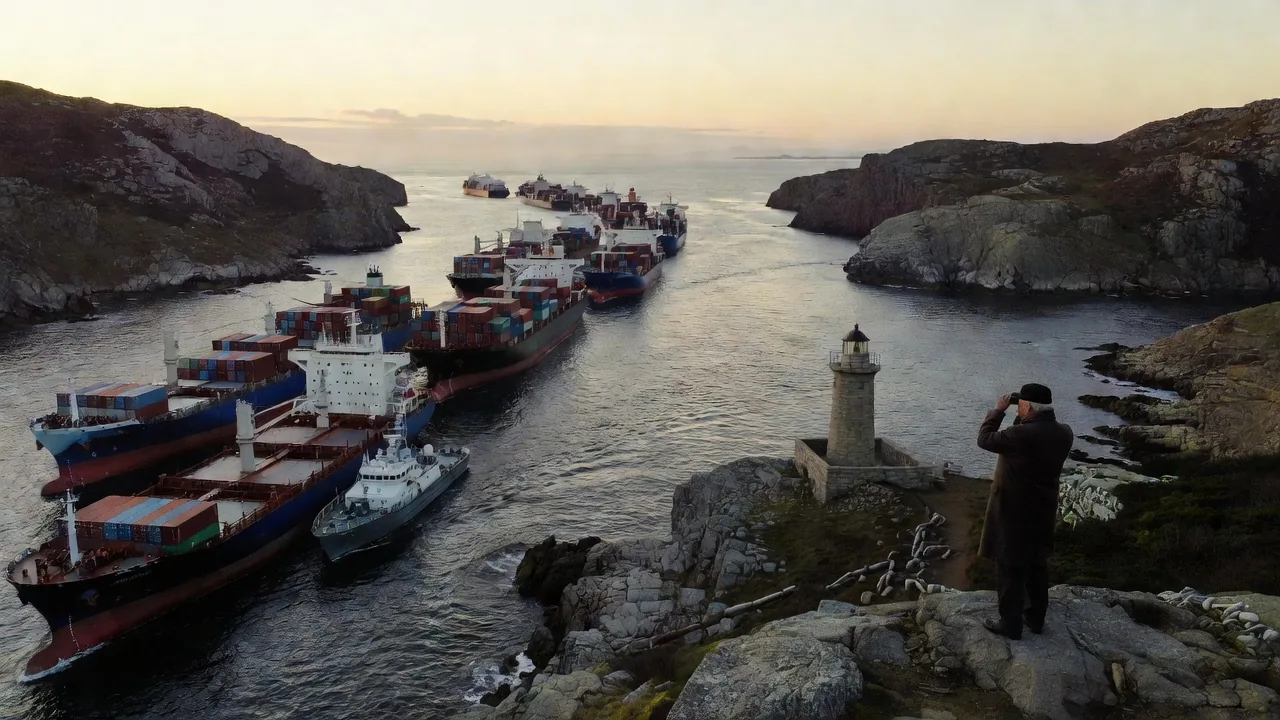
The volume of oil transiting the Strait of Hormuz, which Tehran declared closed on June 21 — roughly a fifth of global supply hanging on a channel a few kilometers wide. The week revealed how power is now measured by physical control of passages, not by communiqués signed five days earlier.Sources — Reuters · Financial Times · Lloyd's List · Bloomberg
24
Subjects analysed
38
Countries compared
52%
Owned track-record
The week's three acts
01What divides — free02Under the radar — weak signals03What we bet — predictionsAct 1Free · open access
What divides
The divergence score measures the framing gap between the world’s newsrooms on the same event. The higher the score, the more the narrative fractures along borders.
↑ Most divergent
26/100
L'Iran ferme le détroit d'Ormuz et déclare l'accord nucléaire « en danger »
18/100
Accord de paix US-Iran finalisé : fin des opérations et réouverture d'Ormuz
15/100
Trump fête ses 80 ans avec un combat UFC à la Maison Blanche
↓ Least divergent
5/100
Trump menace de supprimer les allocations chômage de tous les États
6/100
Rio : collision d'hélicoptères, le chanteur Oliver Tree parmi les victimes
6/100
Groenland : la campagne de Trump pour l'acquérir
Convergences — what every newsroom tells without connecting
Straits return as the central theater
US-Iran peace deal finalized (June 15)Hormuz declared closed and the deal 'in danger' (21)contested European waters: Russian tanker intercepted and warning shots in the Channel
In a single week, two distant maritime chokepoints concentrate the bulk of power politics. At Hormuz, Iran turns a just-finalized accord into leverage: closing the strait instantly hands Tehran back a card diplomacy had only just removed. In the Channel, the United Kingdom intercepts a Russian 'shadow fleet' tanker while a warship fires warning shots — the physical enforcement of sanctions replacing their legal text. The common thread, rarely drawn by newsrooms covering these stories separately: in both cases, control of a passage trumps the international law that governs it. The sea stops being neutral space and becomes, again, a disputed border.
Confidence 82% · IR · US · RU · GB
Territory as acquisition and as memory
Trump's campaign to acquire Greenlandreassessment of US military presence in EuropePoland-Ukraine memory war over Volhynia
Act 2◆ Signals & shifts locked
Under the radar
Weak signals and narrative shifts are the Prism’s deep analysis: what newsrooms have not yet named. Subscribers only. The blind spots stay free.
Weak signals ◆ Locked
The American strategic withdrawal from Europe advances under cover
Maritime enforcement of sanctions turns kinetic
Illiberalism entrenches through party machines, not the ballot box
Narrative shifts ◆ Locked
Relationship with the West
Maritime posture
Commitment in Europe
Blind spots Free · open access
Iran
Human and logistical cost of a Hormuz closure for seafarers and Asian economies
Western coverage treats Hormuz as an oil-price indicator and a geopolitical standoff, obscuring the exposure of crews, marine insurers and Asian importers who bear the real risk.
Covered: QA · IN · SGIgnored: US · FR · GB · DE
South Africa
Violence around a migrant deportation site
While the European deportation vote dominates, the deadly clashes in South Africa — same migration grammar, another continent — remain invisible outside local media, depriving the debate of its global dimension.
Covered: ZA · NGIgnored: FR · DE · US · GB
Ukraine
Destruction of a UNESCO site in Crimea by strikes
The destruction of a listed heritage site, with high mnemonic and legal stakes, is drowned in the flow of daily strikes; few newsrooms outside Eastern Europe make it an event in itself.
Covered: UA · PLIgnored: US · CN · IN · BR
Act 3◆ Reasoning locked
What we bet
Dated, falsifiable predictions, judged publicly. The statement and deadline are free — the reasoning behind them is for subscribers. We settle them later, won and lost alike.
02
Jul 2026
The Strait of Hormuz will have returned to normal commercial traffic (no effective physical blockade of tankers) by July 2, 2026.
Reasoning: Hormuz closures announced by Tehran have historically been political signals rather than sustained blockades, with Iran itself exporting through the strait; the…
🔒 Full reasoning for subscribers
70%
Confidence
04
Jul 2026
No new US-Iran nuclear deal will be officially signed by July 4, 2026.
Reasoning: With a deal already declared 'in danger' and talks postponed on June 20, the dynamic is toward retraction; a two-week window is…
🔒 Full reasoning for subscribers
75%
Confidence
01
Jul 2026
Israeli strikes on South Lebanon will continue despite the ceasefire through July 1, 2026.
Reasoning: Israel has already broken with the EU and struck during the ceasefire; nothing indicates an external constraint capable of halting these operations…
🔒 Full reasoning for subscribers
68%
Confidence
04
Jul 2026
No transfer of sovereignty over Greenland will be enacted by July 4, 2026.
Reasoning: A territorial acquisition requires the agreement of Denmark and Greenland, legally and politically out of reach in this timeframe; the 'campaign' remains…
🔒 Full reasoning for subscribers
92%
Confidence
Our track-record — free, owned, verifiable
52%
of predictions confirmed across all settled editions. We publish everything: bets won and bets lost. Transparency is the contract — not infallibility.
22
ConfirmedPredictions that landed
20
DeniedOwned publicly
42
Settled totali.e. 52% success — won and lost
Unlock
edition N°25
The statement is free. Reading the world, less so. Access the weak signals, the narrative shifts and the full reasoning behind every prediction.
- 3 weak signals decrypted in full
- 3 narrative shifts with their evidence
- The reasoning of each of the 4 predictions
- Full access to the 24 subjects of the week
- All archives, from the start to today
Subscribe to the Prism
Secure payment · Cancel anytime
— The newsroom that bets on the future
Complete weak signals, narrative shifts with evidence, and the reasoning behind every prediction.
$4.99/month$39.99 /year · save 33%
The Prism is published every Saturday. The in-depth analysis is for subscribers.
SHARE THIS RECAP
SHARE THIS COMPARISON
Show your friends how the world sees the same news differently.
Subscribe to the newsletter
Get the Weekly every Saturday morning. Free.