N°26
The week of framework agreements: the Middle East steps back from the brink — on paper
14points negotiated in Switzerland
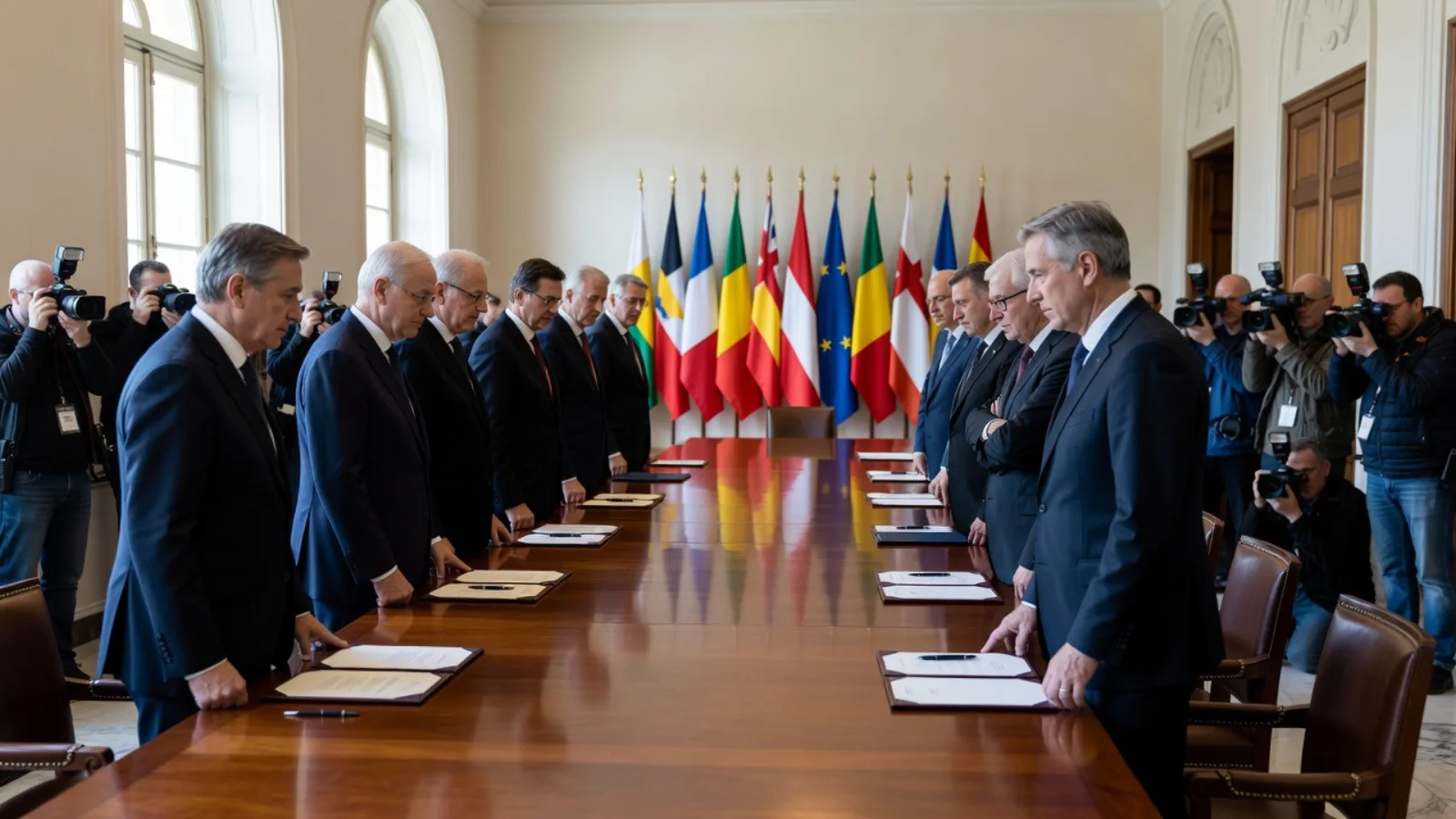
A 14-point US-Iran memorandum, negotiated behind closed doors in Switzerland, framed the week's de-escalation over the Strait of Hormuz. Fourteen paragraphs signed while a cargo ship was attacked in that same strait and the UN suspended its evacuations: the exact measure of the gap between the document and the ground.Sources — Reuters · Le Monde · Al Jazeera · RIA Novosti
25
Subjects analysed
42
Countries compared
52%
Owned track-record
The week's three acts
01What divides — free02Under the radar — weak signals03What we bet — predictionsAct 1Free · open access
What divides
The divergence score measures the framing gap between the world’s newsrooms on the same event. The higher the score, the more the narrative fractures along borders.
↑ Most divergent
68/100
Un cargo attaqué dans le détroit d'Ormuz : l'ONU suspend l'évacuation
66/100
Inspections nucléaires en Iran : Trump dit « oui », Téhéran impose ses conditions
↓ Least divergent
38/100
Double séisme au Venezuela : Caracas s'effondre
42/100
Apple augmente ses prix : la pénurie de puces mémoire
Convergences — what every newsroom tells without connecting
The document before the ground: diplomacy as a management tool, not a resolution
The Strait of Hormuz is closed, then reopened under 'managed' passage rather than a return to normalA 14-point memorandum is negotiated in Switzerland and an Israel-Lebanon-US framework agreement is signed in WashingtonMeanwhile a cargo ship is attacked in the strait and the UN suspends its evacuationsThe signature defuses the risk of open war without restoring the physical security of the passage
Three diplomatic frameworks in one week — the Swiss memorandum, the Washington framework agreement, the resumption of inspections — share a common grammar: they turn an unsolvable crisis into a manageable one. None closes the underlying file; all lower the odds of an immediate flare-up. This is a diplomacy that buys time, and the actors know it: Tehran reopens Hormuz 'under conditions', Washington signs 'a framework', no one declares the crisis over. A framework agreement's effectiveness is measured less by what it resolves than by what it postpones.
Confidence 78% · US · IR · IL · LB
The Senate and Hormuz pull in the same direction, for opposite reasons
The US Senate votes to end military engagement in Iran, rebuking the executiveTehran closes then 'manages' the Strait of HormuzBoth moves simultaneously reduce military pressure in the areaThe de-escalation stems from a convergence of distinct domestic interests, not from an agreement
Act 2◆ Signals & shifts locked
Under the radar
Weak signals and narrative shifts are the Prism’s deep analysis: what newsrooms have not yet named. Subscribers only. The blind spots stay free.
Weak signals ◆ Locked
North Korea launches a nuclear-powered destroyer while everyone watches Hormuz
The European Parliament accelerates deportations as the heatwave overwhelms hospitals
Beijing sanctions US firms: decoupling advances through the door of export controls
Narrative shifts ◆ Locked
Military engagement in Iran
Strait of Hormuz and nuclear inspections
War memory and the figure of Zelensky
Blind spots Free · open access
Democratic Republic of the Congo
Ebola outbreak passing 1,000 cases in Central Africa
A front-rank health emergency in Central Africa is largely absent from the week's Western framings, saturated by the Gulf and NATO. The geography of media attention leaves out a file whose human impact exceeds several more-covered stories.
Covered: CD · NG · ZAIgnored: US · IT · NL · FR
Venezuela
Double earthquake in Caracas and state of emergency
The earthquake striking Caracas and the ensuing state of emergency remain confined to Latin American coverage. The story ranks among the week's least divergent precisely because it is treated as a local disaster rather than a geopolitical stake, which limits its international resonance.
Covered: VE · CO · BRIgnored: US · IT · DE · NL
North Korea
Nuclear-powered destroyer and the North Korean navy
Pyongyang crossing a major naval threshold is treated as a regional Asian story, even though it shifts the Northeast Asian security balance over the long term. The eclipse caused by the Gulf sequence illustrates how heavy programs advance in the blind spots of the global agenda.
Covered: KP · KR · JPIgnored: US · FR · IT · BR
Act 3◆ Reasoning locked
What we bet
Dated, falsifiable predictions, judged publicly. The statement and deadline are free — the reasoning behind them is for subscribers. We settle them later, won and lost alike.
11
Jul 2026
July's NATO summit will be held without a joint communiqué committing to a uniform numerical increase in all members' defense spending.
Reasoning: The displayed tensions between Trump, Rutte and Italy ahead of the summit, and Meloni's silence in the face of public reproach, make…
🔒 Full reasoning for subscribers
68%
Confidence
10
Jul 2026
The Strait of Hormuz will remain open to commercial traffic with no new total closure officially ordered by Tehran.
Reasoning: The Swiss memorandum and the economic cost of a prolonged closure for Iran itself favor maintaining a 'managed' passage rather than reverting…
🔒 Full reasoning for subscribers
70%
Confidence
11
Jul 2026
Nuclear inspections in Iran will effectively resume on the ground, with at least one inspector visit publicly confirmed.
Reasoning: The agreement in principle between Trump and Tehran and the week's framework-agreement momentum make a first concrete step likely, even if Iranian…
🔒 Full reasoning for subscribers
60%
Confidence
09
Jul 2026
No major new US sanctions will be announced against China in direct retaliation for its latest measures against US firms.
Reasoning: The US administration is absorbed by the Iran file and the NATO summit; a further frontal trade escalation with Beijing would be…
🔒 Full reasoning for subscribers
62%
Confidence
Our track-record — free, owned, verifiable
52%
of predictions confirmed across all settled editions. We publish everything: bets won and bets lost. Transparency is the contract — not infallibility.
22
ConfirmedPredictions that landed
20
DeniedOwned publicly
42
Settled totali.e. 52% success — won and lost
Unlock
edition N°26
The statement is free. Reading the world, less so. Access the weak signals, the narrative shifts and the full reasoning behind every prediction.
- 4 weak signals decrypted in full
- 3 narrative shifts with their evidence
- The reasoning of each of the 5 predictions
- Full access to the 25 subjects of the week
- All archives, from the start to today
Subscribe to the Prism
Secure payment · Cancel anytime
— The newsroom that bets on the future
Complete weak signals, narrative shifts with evidence, and the reasoning behind every prediction.
$4.99/month$39.99 /year · save 33%
The Prism is published every Saturday. The in-depth analysis is for subscribers.
SHARE THIS RECAP
SHARE THIS COMPARISON
Show your friends how the world sees the same news differently.
Subscribe to the newsletter
Get the Weekly every Saturday morning. Free.