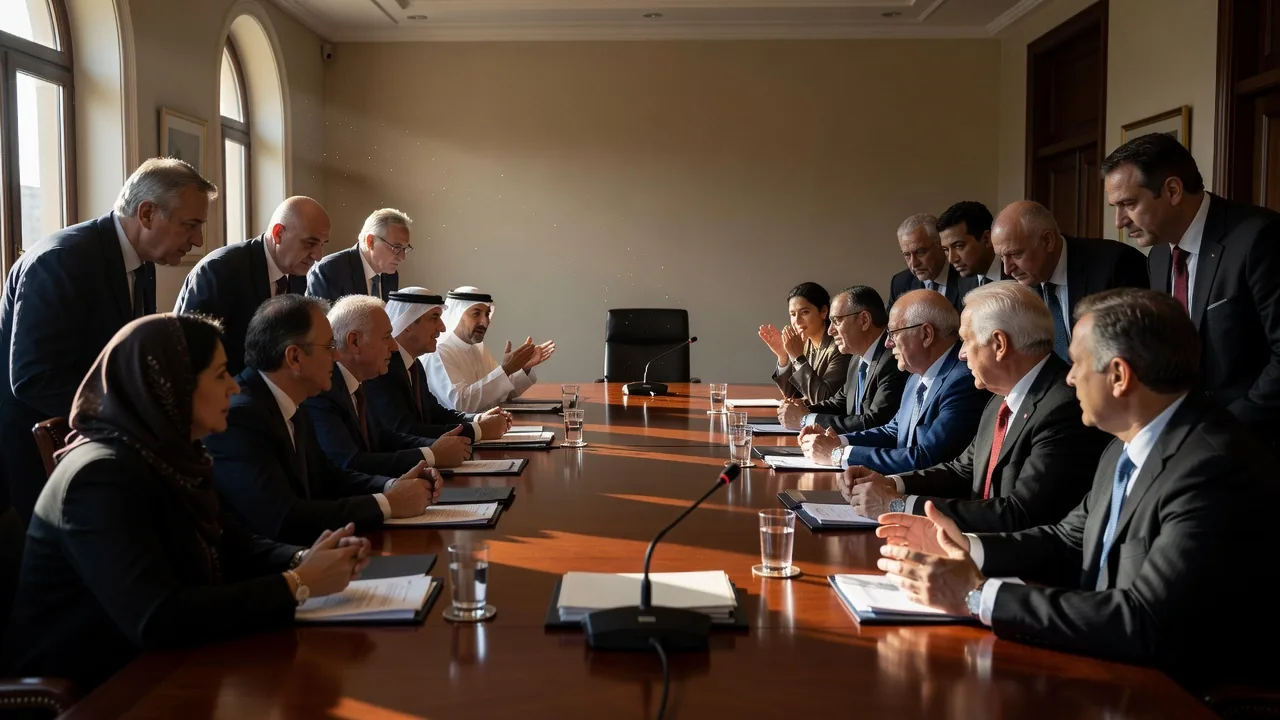
The week everyone stopped waiting for the referee.
What divides
The divergence score measures the framing gap between the world’s newsrooms on the same event. The higher the score, the more the narrative fractures along borders.
Madrid does not turn to Brussels: Madrid closes its own border instead
At no point in this sequence does the body meant to arbitrate Schengen appear as the way out. Two member states trade deadlines — 9 August, 15 August, 7 September — and the collective mechanism becomes the ground of the standoff rather than its judge. Italy, Chile, Bangladesh and Pakistan read the affair as an institutional dispute; Spain, Portugal, Brazil, Qatar and Argentina read it first through the human toll, of between 11 and 141 dead depending on the source and more than a thousand unaccompanied minors. Belgium and Switzerland are the only pools in the corpus to hold all three threads together — diplomacy, deaths, disinformation. And across the 22 perspectives gathered here, the migrants are counted, autopsied, identified by DNA: never quoted.
Riyadh contracts its security guarantee rather than waiting for one
Under the radar
Weak signals and narrative shifts are the Prism’s deep analysis: what newsrooms have not yet named. Subscribers only. The blind spots stay free.
Gulf mediators are cited everywhere, documented nowhere
American debris becomes a showcase for Chinese capability
Attribution has become the call nobody wants to make
Disinformation enters the border file, and is handled through two companies
A hemispheric realignment southern Europe is not watching
Schengen checks and the Ceuta crisis
Regional security architecture
Domestic security doctrine
The object, the company and the agency documenting the crater are all American, and the story is told entirely from the outside. South Korea does not mention that its Danuri orbiter photographed the site before and after the collision, Japan does not recall the part played by its Ispace lander in the January 2025 launch the stage came from, and India does not cover the impact despite its own lunar programme. Four countries directly involved, not one national account.
The densest coverage of the file is from the Gulf — ten on-topic articles for one Qatari outlet, nine for a Saudi one — and neither brings together two distinct mastheads, so neither becomes a perspective. The diplomatic sponsors of the process, the United States and the United Kingdom, are all but absent too, and no Lebanese outlet appears in the corpus even though Lebanon is the country most directly affected by the strikes. The file is read everywhere except where it is playing out.
The duties of 10 to 12.5% that came into force on 24 July target some sixty partners and close to 99% of American imports, yet the dispute is told only from the Americas and Europe. Chile and Brazil are the only ones to consider explicitly an alternative trade rapprochement with China and India — an option absent from North American perspectives, and absent too from New Delhi, Tokyo, Seoul and Pretoria, all directly exposed.
No on-topic Italian coverage of the 6 August orders was identified, even though all of Italy's immediate European neighbours are treating them. Turkey and Russia likewise open no national angle on “birth tourism”, although their nationals have historically been among those most concerned, and India produces no plural coverage despite genuine follow-up. The debate over the threshold of more than 250,000 annual births covered by the broader order thus stays confined to a handful of capitals.
What we bet
Dated, falsifiable predictions, judged publicly. The statement and deadline are free — the reasoning behind them is for subscribers. We settle them later, won and lost alike.
Unlock
edition N°32
The statement is free. Reading the world, less so. Access the weak signals, the narrative shifts and the full reasoning behind every prediction.
- 5 weak signals decrypted in full
- 3 narrative shifts with their evidence
- The reasoning of each of the 5 predictions
- Full access to the 19 subjects of the week
- All archives, from the start to today
An in-depth feature, international insights and developments to follow in upcoming editions.
$4.99/month$39.99 /year · save 33%
SHARE THIS RECAP
SHARE THIS COMPARISON
Show your friends how the world sees the same news differently.
Subscribe to the newsletter
Get the free Prism summary every Saturday.