Common ground and differences in coverage across the media analysed.
What the media report in common
1
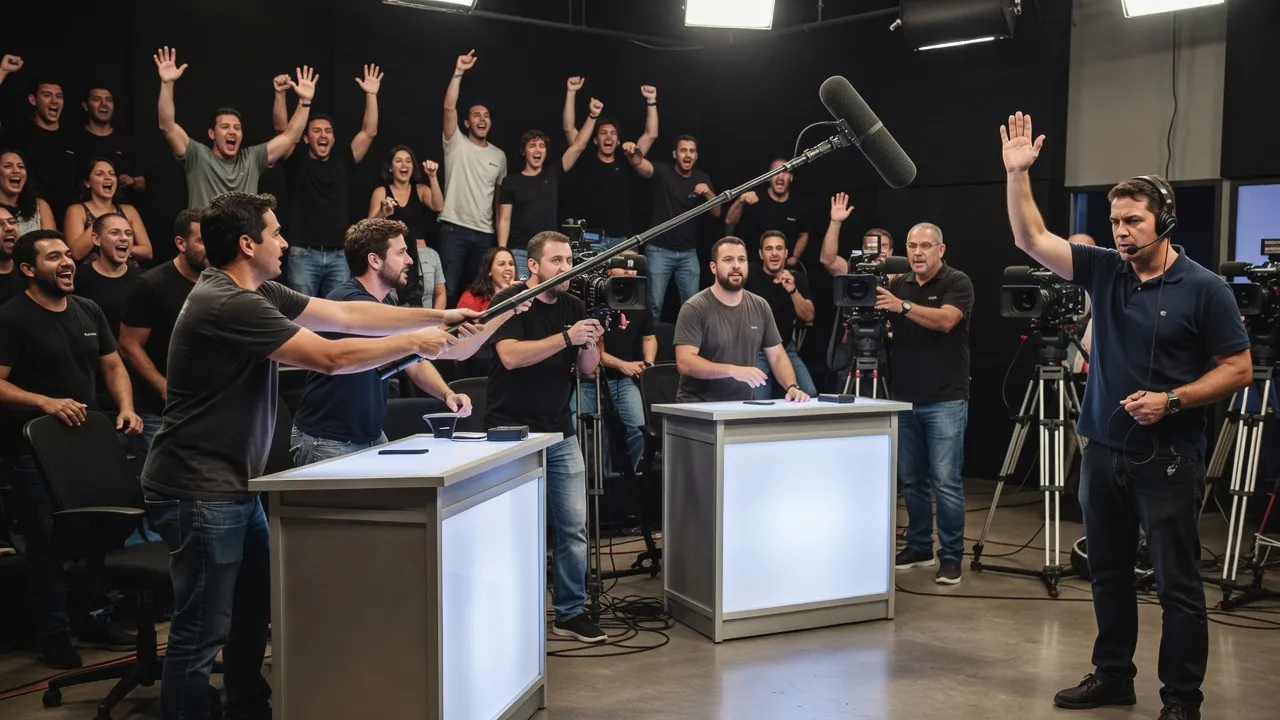
The Band debate, the first face-to-face between Lula and Flávio Bolsonaro, is described as dominated by corruption accusations and personal attacks, with little room for programs.
2
In the first round on October 4, Flávio Bolsonaro led Lula 47% to 45%.
3
The second round takes place on October 25, a week after the debate, with a race described as tight or a technical tie.
Where media coverage diverges
What the debate narrative retains
The Chilean, Mexican, and Venezuelan presses highlight the Master bank affair and the candidates' families; the Brazilian press adds the promise to classify criminal factions as narcoterrorist organizations and the measure of opinion on WhatsApp.
The Argentine press makes Milei's 'chainsaw' a highlight of the debate; the Venezuelan press notes the comparisons with Milei, Trump, Ortega, and Maduro; the French and Italian press rather retain 'corrupt' written on the hand and the 'militant' phrase.
Lisbon is taking note of the chaos from the first face-off between Lula and Flávio Bolsonaro, rich in accusations and poor in proposals, following a series of cancelled debates.
Rome is first and foremost focused on the spectacle of a duel without proposals: just one week away from the runoff, the Italian press describes two candidates who are complete opposites, from their style to their family affairs.
Mexico City takes away from the first Lula-Bolsonaro debate a duel of invectives where corruption eclipses the programs, a week before a second round that polls show is undecided.
Lisbon is taking note of the chaos from the first face-off between Lula and Flávio Bolsonaro, rich in accusations and poor in proposals, following a series of cancelled debates.
KEY POINTS
The Band's debate on Sunday night had three blocks with two moderators, Eduardo Oinegue and Adriana Araújo (SAPO).
Record canceled the debate on October 11 and the one scheduled by the media consortium on October 15 did not take place (SAPO).
The Observador describes the debate as "marked by an exchange of accusations and few proposals".
ANALYSIS
Lisbon, October 19, 2026. The Portuguese press first notes the chaotic nature of the first face-to-face between Luiz Inácio Lula da Silva and Flávio Bolsonaro, held Sunday evening on the Band, one week before the second round set for October 25. The 24 Notícias site from SAPO headlines that it finally took place and was, "as expected, chaotic". The Observador, in its 3 a.m. radio bulletin, summarizes the evening in one phrase: a debate "marked by an exchange of accusations and few proposals". RTP Notícias speaks of a "heated debate" that lasted until Monday night.
A large part of SAPO's account focuses on the path that led to this meeting. In the first round, several debates were cancelled: those of Record and the Momento da Decisão consortium due to lack of confirmation from both camps, that of Globo after Flávio Bolsonaro's withdrawal and judicial decisions on the rules. For the second round, four debates were planned. Record cancelled the one on October 11, citing incompatible schedules; that of the media consortium (CNN, SBT, Metrópoles, and others), scheduled for October 15, did not take place. SAPO writes that Sunday's debate was "the first and perhaps the only one".
The media also details the mechanics of the broadcast: three blocks, two questions from moderators Eduardo Oinegue and Adriana Araújo to each candidate, then a 15-minute direct confrontation that each manages freely. The second block alternates questions from the moderators and cross-questions between candidates, with one minute thirty to ask and four minutes shared between response and reply. Flávio Bolsonaro had confirmed his presence on Wednesday, after Lula assured he would come, whereas the latter had said the day before that he would not be there.
SAPO notes that the Globo debate, scheduled for October 23, has not been cancelled yet: Lula's team has signed the conditions, Flávio Bolsonaro's campaign has not yet formalized its adherence, and the channel set October 19 as the deadline for confirmation, specifying that it would hold the debate even in the absence of a candidate.
The perspective is therefore that of a campaign seen from Lisbon as a battle of image and calendar between two neck-and-neck camps, rather than as a clash of programs. The provided articles do not report on the details of the exchanges on the economy or security, nor the bomb alert targeting Flávio Bolsonaro's vehicle.
Italy
DOMINANT ANGLE
Rome is first and foremost focused on the spectacle of a duel without proposals: just one week away from the runoff, the Italian press describes two candidates who are complete opposites, from their style to their family affairs.
KEY POINTS
Flávio Bolsonaro, 45, won the first round on October 4 with 47% against 45% for Lula, 80 years old (Adnkronos).
Lula wanted to "distance himself from a miliciano"; Flávio Bolsonaro showed the word "corrompu" written on his palm (Adnkronos).
Flávio Bolsonaro attacked Lulinha, Lula's son, who is the target of three investigations; Lula mentioned banker Vorcaro, imprisoned for bankruptcy (ANSA).
ANALYSIS
Rome, October 19, 2026. For the ANSA agency as for Adnkronos, the first debate between Luiz Inácio Lula da Silva and Flávio Bolsonaro, held last Sunday, October 18, in the studios of the Band channel in São Paulo, was more of a personal duel than a confrontation of programs. Adnkronos summarizes: "insults took precedence over proposals." The two candidates exchanged "a barrage of insults and accusations" just a week before the runoff.
Adnkronos recalls the context: against the polls, Senator Bolsonaro, 45, won the first round on October 4 with 47% of the vote, against 45% for Lula, who at 80 is seeking a fourth non-consecutive term. The agency notes several notable scenes: Lula, wearing a tie in the colors of Brazil, ostentatiously distanced himself from his opponent to "take his distance from a miliciano," alluding to Flávio Bolsonaro's supposed links with paramilitary groups in Rio. The latter retorted by showing the word "corrupt" written on his palm, a reference to Lula's conviction, which was later annulled, and which had landed him in prison in 2018-2019.
ANSA emphasizes the contrast between the personalities. Lula, who will soon be 81, appears "more presidential" in a dark gray suit; his rival, 35 years his junior, is more relaxed, without a tie, and walks behind him while he addresses the camera, which Lula's team contested live. The agency describes Lula as "detached, direct, assertive to the point of arrogance" and Flávio as "more ardent, passionate, often less precise, but perhaps more empathetic."
Mexico
DOMINANT ANGLE
Mexico City takes away from the first Lula-Bolsonaro debate a duel of invectives where corruption eclipses the programs, a week before a second round that polls show is undecided.
KEY POINTS
Flávio Bolsonaro won the first round with 47% of the vote against 45% for Lula, and more than 20% of voters abstained (El Siglo de Torreón).
The debate was dominated by the Master bank scandal, "the largest fraud in Brazil's history", and by an embezzlement in Social Security pensions (El Siglo de Torreón).
Lula challenged Bolsonaro to release the bank and phone records of both families to "show who is corrupt"; Bolsonaro responded that Lula's money is "elsewhere".
ANALYSIS
Mexico, October 19, 2026. The Mexican press is treating the first televised debate of the Brazilian runoff as a more personal than programmatic confrontation. Reforma and El Norte, which picked up the AFP dispatch dated October 18, summarized the evening in one sentence: "Con más agravios personales que propuestas," President Luiz Inácio Lula da Silva and Senator Flávio Bolsonaro debated for the first time on television, a week before the runoff, "mientras empatan en encuestas." La Jornada used the same formula and described Flávio Bolsonaro as an "ultraderechista" senator, with the title "Más ataques que propuestas."
El Siglo de Torreón, which relied on a more detailed dispatch, put corruption at the center. According to this text, the exchange lasted half an hour "without respite" around the suspicions targeting the opposing camp. Two cases dominated: the Master bank scandal, presented as "the largest fraud in Brazil's history," and the embezzlement of several million in social security pension funds. The accusations also involved investigations into close associates of the two men, including Flávio Bolsonaro himself.
The newspaper reported two specific moments. Lula challenged his rival to hand over the bank and phone records of the two families to the authorities to "demonstrate who is corrupt" and "who is honest." Bolsonaro responded that Lula has the money "elsewhere." Lula also sought to sow doubt about his opponent's intentions in the event of a victory, wondering if he planned to "privatize" public health or the state oil company.
Argentina
DOMINANT ANGLE
Buenos Aires is first reeling from the shock of the people and the "motosierra" of Milei wielded by Lula, in a debate where, according to Perfil, ideas were notably absent.
KEY POINTS
According to Ámbito and MercoPress, Lula asked Flávio Bolsonaro if he planned to use Javier Milei's "chainsaw" to cut 250 billion reais in public spending.
Flávio Bolsonaro claimed that 73% of inmates voted for Lula; Ámbito clarifies that the figure corresponded to polling stations located near prisons, not just inmates.
First round on October 4: Flávio Bolsonaro 47% to Lula's 45%; Datafolha on October 15: 51% to 49% in valid votes, according to Perfil.
ANALYSIS
Buenos Aires, October 19, 2026. The Argentine press is devoting extensive coverage to the first debate between Luiz Inácio Lula da Silva and Flávio Bolsonaro, held Sunday in São Paulo on the Band channel, one week before the second round on October 25. The Buenos Aires Times describes an "acrimonious" exchange where the two men repeatedly called each other liars. Lula labeled his rival a "habitual liar" and a thug, and said he did not want to approach a "militiaman"; Flávio retorted that it was better to keep his distance "because my wallet could be stolen".
The element that most directly affects the Argentine audience is the mention of Javier Milei. Ámbito and MercoPress report that Lula asked his opponent if he planned to use the "chainsaw" of the Argentine president to cut 250 billion reais in public spending. Ámbito headlines the "bickering" about Milei and prisoners: Flávio claimed that 73% of prisoners had voted for Lula, and Lula responded that he wanted everyone's vote, "even your father's". The newspaper clarifies that the figure was misleading: it corresponded to polling stations located near prisons.
Perfil, under the pen of its correspondent in São Paulo, is the most severe. It judges that if the debate was supposed to pit ideas and projects against each other, "nothing of the sort occurred": most of the time was spent on corruption allegations, Lula questioning Flávio about former banker Daniel Vorcaro, and Flávio mentioning the suspicions surrounding the president's son, "Lulinha". The newspaper notes the physical pressure exerted by Flávio, an attitude that "we Argentines call patotera", and notes that the moderators only intervened in the final block. It also highlights that Flávio devoted most of his speaking time to drug trafficking gangs, promising to declare them narcoterrorists.
Brazil
DOMINANT ANGLE
Brasília notes: the first debate of the second round delivered more attacks than proposals, between two neck-and-neck camps one week from the vote.
KEY POINTS
Datafolha (October 15): Flávio Bolsonaro 47%, Lula 45%; Quaest: 46% to 44%, a technical tie.
Flávio Bolsonaro promises to "declare war on narcoterrorism" and to classify PCC, Comando Vermelho, and militias as narcoterrorist organizations.
According to Palver, as cited by Folha, 62% of opinions on WhatsApp give Lula the win in the debate, versus 31% for Flávio.
ANALYSIS
Brasília, October 19, 2026. The Brazilian press is reporting on the first face-off between Lula (PT) and Flávio Bolsonaro (PL), held last Sunday, October 18, on the Band, just one week before the second round on October 25. G1 notes that the two men, who were absent from the debates in the first round, discussed security, economy, health, relations with the United States, and the age of majority, while exchanging "accusations and provocations" about corruption.
Veja is the most severe: the candidates left their proposals in the background in favor of the Master case, INSS fraud, and links to militiamen. Mediators Adriana Araújo and Eduardo Oinegue had to stop the clock due to the tumult of an audience composed of guests from both camps. Estadão describes Flávio Bolsonaro walking behind Lula during his final considerations; Folha sees this as a tactic similar to Donald Trump's against Hillary Clinton in 2016. Lula's advisor, Sidônio Palmeira, protested, while elected deputy Lucas Pavanato demanded his expulsion.
On the substance, Flávio Bolsonaro promised to "declare war on narcoterrorism" and classify factions as terrorist organizations; Lula defended the PEC of Public Security and a dedicated ministry, then asked his rival if he would borrow "a chainsaw" from Milei. Checks by Folha and G1 reveal errors on both sides: the "7 billion reais" spent on Janja and Lula's trips are false, Lula is mistaken in saying that the GDP only exceeded 3% upon his return, while the gross debt of 11,100 billion reais, or 82.9% of GDP, is confirmed.
Chile
DOMINANT ANGLE
Santiago is deciphering a first face-to-face encounter dominated by cross-accusations of corruption, where the family affairs of the two candidates take precedence over the programs a week before the second round.
KEY POINTS
In the first round on October 4, Flávio Bolsonaro obtained 47% against 45% for Lula; Datafolha and Quaest give 51% against 49% for the second round on October 25 (La Tercera).
Lula accuses Flávio Bolsonaro of having negotiated 134 million reais with banker Daniel Vorcaro for the film "Dark Horse" (BioBioChile).
Lula challenged his opponent to lift the bank and phone secrecy of their families before the vote (BioBioChile).
ANALYSIS
Santiago, October 19, 2026. The Chilean press presents the debate of Sunday, October 18, broadcast by TV Band from São Paulo, as a highly anticipated "cara a cara" after Lula and Flávio Bolsonaro had renounced the pre-first round debates. La Tercera recalls that on October 4, the senator had obtained 47% of the votes against 45% for the outgoing president, a result contrary to the polls, and that Datafolha and Quaest now credit him with 51% against 49%, a "empate técnico".
The narrative emphasizes the role of family affairs. According to La Tercera, the candidates "intercambiaron acusaciones de corrupción, plantearon preguntas que dejaron al otro sin respuesta, se provocaron e involucraron a familiares". Flávio Bolsonaro questioned Lula about lobbyist Roberta Luchsinger, targeted by three investigations with Fábio Luís Lula da Silva, "Lulinha", the president's eldest son. Lula responded that the Federal Police would handle it and that everyone, including his son, would be investigated under his government.
The president counterattacked with the Master affair. BioBioChile details the 134 million reais (approximately 26 million dollars) that Flávio Bolsonaro would have negotiated with banker Daniel Vorcaro, now incarcerated, to finance the film "Dark Horse" about his father. "La mentira es el fuerte de la familia Bolsonaro", Lula launched; the senator retorted: "Tu nariz está creciendo, Lula".
France
DOMINANT ANGLE
Paris regrets a first Brazilian debate reduced to an exchange of insults, where two neck-and-neck candidates leave undecided voters without a clear program before the second round.
KEY POINTS
Flavio Bolsonaro won the first round on October 4 with 47% of the vote against 45% for Lula (Sud Ouest, BFMTV).
Lula wanted to "distance himself from a militia member"; Flavio Bolsonaro showed the word "corrupt" on his hand (HuffPost France).
The electoral court gave Meta 24 hours under penalty of a fine of one million reals per day (Le Monde).
ANALYSIS
Paris, October 19, 2026. The French press reports on a debate where invective took precedence over the program. On Sunday, October 18, in the studio of the Band channel in São Paulo, outgoing President Lula and conservative Senator Flavio Bolsonaro clashed for the first time, one week before the second round scheduled for October 25. Sud Ouest, BFMTV, and HuffPost France, which picked up the AFP dispatch, speak of a "festival of insults and accusations".
The exchanges are reported in detail. Lula distanced himself from his rival to "take distance from a militiaman", alluding to Flavio Bolsonaro's supposed links with paramilitary groups in Rio de Janeiro. The senator retorted by showing the word "corrupt" written on his palm, referencing Lula's 2018-2019 conviction, which has since been annulled. "Inveterate liar, thug", the president launched after comments on the expenses of First Lady Janja; "Brazil will put you into retirement", his opponent responded. Lula also demanded explanations about an investigation targeting Flavio Bolsonaro, related to the financing of a film about his father.
The dominant tone is that of a sterile confrontation. RFI, through the voice of its correspondent Sarah Cozzolino, judges the debate "sterile and violent": Flavio Bolsonaro, calm and insolent, gesticulated behind Lula, an attitude reminiscent of Donald Trump's towards Hillary Clinton in 2016, while Lula often remained on the defensive. The moderators had to interrupt the debate. Le Monde cites political scientist Thomas Traumann, who believes that the two candidates "have not won over any voters" among the 10% of undecided voters, and titles that Lula "struggles to defend his record" while Flavio Bolsonaro "dodges questions".
Uruguay
DOMINANT ANGLE
Montevideo is particularly struck by the spectacle of insults: the first Lula–Flávio Bolsonaro debate is presented as an exchange of insults rather than proposals, just a week before a tight runoff.
KEY POINTS
Flávio Bolsonaro, 45, outran Lula, 80, in the first round by 47% to 45% (Subrayado, El Observador).
The TV debate on TV Band in São Paulo is the first, Lula having refused to participate before the first round.
La Diaria judges that the format produced "a dialogue of the deaf", with interruptions coming from the stands.
ANALYSIS
Montevideo, October 19, 2026. The Uruguayan press first notes the tone of the first televised debate of the Brazilian runoff, held Sunday evening in the studios of TV Band in São Paulo. Subrayado and El Observador, which pick up the same dispatch, open with "more personal grievances than proposals" a week before the October 25 ballot, while the two candidates are tied in the polls.
The headlines list the insults: "payaso", "corrupto", "mentiroso", "miliciano". Lula, who is seeking a fourth non-consecutive term, distanced himself from his rival to mark his "distance from the miliciano", alluding to supposed links between the senator and parapolice groups that control popular neighborhoods in Rio. Flávio Bolsonaro responded that it was better to keep him at a distance because the "wallet can be stolen", then showed his palm where he had written "Corrupto". Lula called him a "contumacious liar, malandro" after a remark about the first lady Janja da Silva, presented as an unnecessary public expense; "Brazil will put you in retirement," Bolsonaro said.
The dispatches recall the context: Flávio Bolsonaro, 45, son of former President Jair Bolsonaro (2019-2022), led in the first round with 47% against Lula's 45%, who is 80 years old. This debate is the first, Lula having refused to participate before the first round. Lula repeatedly demanded explanations about a corruption investigation targeting his opponent, who did not respond; the latter mentioned in return an affair targeting "Lulinha", Lula's son. The articles also recall that Lula was imprisoned for corruption before his conviction was annulled for a procedural flaw.
Venezuela
DOMINANT ANGLE
Caracas is deciphering a Brazilian showdown dominated by corruption suspicions, where Maduro's name is being mentioned by Flávio Bolsonaro, and proposals are taking a back seat.
KEY POINTS
In the first round, Flávio Bolsonaro got 47% of the vote and Lula 45%, according to El Nacional; the second round takes place on October 25.
The debate on Band in São Paulo was dominated by the Master bank and the embezzlement of pension funds, with an exchange of over half an hour.
According to Analitica, Bolsonaro linked Lula to Daniel Ortega and Nicolás Maduro, while Lula associated him with Milei and Trump.
ANALYSIS
Caracas, October 19, 2026. The Venezuelan press is treating the first televised debate of the Brazilian runoff as a clash of suspicions rather than programs. El Nacional speaks of a "duro primer debate" held on Sunday, focused on corruption. Flávio Bolsonaro, who came out on top in the first round with 47% of the vote against 45% for Lula, and the outgoing president sought to crack the opponent's image and win over the undecided, as well as the more than 20% of voters who abstained.
According to El Nacional, the clash began with an exchange of over half an hour, "without respite", around the Master bank case, presented as the largest fraud in Brazilian history, and the embezzlement of Social Security pension funds. Lula challenged his rival to hand over the bank and phone records of the two families to the authorities to "demonstrate who is corrupt"; Bolsonaro responded that Lula kept the money "elsewhere". Lula also asked if his opponent planned to "privatize" public health or Petrobras.
Analitica, which describes a "tenso" debate in the studios of Band in São Paulo, notes that Lula accused Bolsonaro of supposed links with parapolice groups and called him a liar, while the senator recalled Lula's old conviction, which was annulled due to procedural errors. The international aspect directly concerns Caracas: Lula linked his rival to Javier Milei and Donald Trump, and Bolsonaro associated the Brazilian president with Daniel Ortega and Nicolás Maduro, described as an "expresident vénézuélien". On the economy, Bolsonaro reproaches the government for having inflated public spending to favor its re-election; Lula warns against social cuts and attributes part of the inflation to international conflicts.
South Africa
DOMINANT ANGLE
Pretoria is witnessing a neck-and-neck duel where the debate has been reduced to personal attacks, and is gauging what this means for the 33 million abstentionists from the first round.
KEY POINTS
Flávio Bolsonaro had finished nearly two points ahead of Lula in the first round on October 4, according to Business Day and TimesLIVE.
The two candidates want to mobilize the 33 million voters who stayed home in the first round, about one in five.
A second debate is scheduled for October 23, just before the second round on October 25 (Daily Maverick).
ANALYSIS
Pretoria, October 19, 2026. The South African press is reporting on the first televised debate between Luiz Inácio Lula da Silva and Senator Flávio Bolsonaro, through international dispatches reproduced by Daily Maverick, Business Day, and TimesLIVE. The face-to-face took place Sunday evening in São Paulo, on the Band channel, starting at 8 pm (11 pm GMT), one week before the second round on October 25.
The articles emphasize the tension of the election. Flávio Bolsonaro is slightly favored after coming out on top in the first round on October 4, with nearly two points ahead of Lula. However, the polls show a tightening, and Lula says he is confident of becoming the first candidate, since the return of democracy in the 1980s, to win in the second round after finishing second in the first. The two men are seeking to mobilize the 33 million voters who stayed home in the first round, or about one in five.
Daily Maverick describes a debate that "quickly turned into a heated exchange of corruption accusations and personal attacks." Lula questioned his opponent about his alleged ties to imprisoned banker Daniel Vorcaro; Bolsonaro questioned the president about accusations targeting his son and a pension fraud scandal. "Lying is the strong point of the Bolsonaro family," Lula said, while his rival spoke of a "very clear problem in your DNA" and a president "always tainted by corruption."
Explore every perspective on this subject across 10 countries.
Brazil: a week before the runoff, Lula and Flávio Bolsonaro trade insults in their first debate
published on
October 19, 2026
10
countries
34
sources
38
articles
0/100
gap
The ten presses in the corpus recount the Band's evening through its exchanges more than its proposals, this article details the reported accusations, the underlying themes addressed, the gestures that marked the set, and the opinion measures published afterwards.
The second round takes place on October 25; a second debate is scheduled for October 23, according to Daily Maverick, and polls show the two candidates in a technical tie.
The issues at the heart of the discussion
According to La Tercera, the two candidates exchanged accusations of corruption and implicated their relatives. Flávio Bolsonaro questioned Lula about lobbyist Roberta Luchsinger, who is the subject of three investigations with Fábio Luís Lula da Silva, known as "Lulinha", the president's eldest son. Lula responded that the Federal Police would handle the matter and that everyone, including his son, would be investigated under his government.
« The lie is the strong suit of the Bolsonaro family »
Lula da Silva, during the Band debate on October 18, as reported by BioBioChile
The president turned the argument around with the Master case. BioBioChile details the 134 million reais that Flávio Bolsonaro allegedly negotiated with banker Daniel Vorcaro, who is now incarcerated, to finance the film "Dark Horse" about his father. The AFP dispatch, picked up by the Mexican press, adds Social Security pension fraud to the case, and El Nacional presents the Master case as "the largest fraud in Brazil's history".
Lula also asked if his opponent planned to "privatize" public health or Petrobras, according to El Siglo de Torreón and El Nacional. Flávio Bolsonaro retorted that Lula had the money "elsewhere", the same sources report. ANSA notes that Lula recalled the Bolsonaro family's ties to Vorcaro and mentioned the senator's brother, Eduardo, who "fled to America".
Security, economy and foreign references
On security, La Tercera reports that Flávio Bolsonaro promised to "recover each city, each territory" and up to 30 years in prison for gang leaders. G1 and Veja also cite the PEC of Public Security that Lula defended, with a dedicated ministry. Perfil notes that the senator devoted most of his speaking time to narcotics trafficking gangs.
Foreign references vary according to the press. Ámbito and MercoPress report that Lula asked his rival if he planned to use Javier Milei's "chainsaw" to cut 250 billion reais in public spending. Analitica writes that Lula linked his opponent to Milei and Donald Trump, and that Flávio Bolsonaro associated the president with Daniel Ortega and Nicolás Maduro.
Several figures mentioned during the debate have been verified. Ámbito indicates that the "73%" of inmates who voted for Lula, cited by Flávio Bolsonaro, corresponded to polling stations located near prisons. Folha and G1 point out errors on both sides: the "7 billion reais" spent on Janja and Lula's trips are false, while the gross debt of 11,100 billion reais, or 82.9% of GDP, is confirmed.
Gestures, posture and format
Lula distanced himself from his rival to "take a distance from a militiaman," according to HuffPost France, Adnkronos, and Subrayado. Flávio Bolsonaro responded that it was better to keep him at a distance because his "wallet could be stolen," then showed the word "corrupt" written on his palm, referencing Lula's conviction, which has since been annulled.
« Insults have taken precedence over proposals »
Adnkronos, October 19, 2026
Estadão describes Flávio Bolsonaro walking behind Lula during his final considerations. According to Daily Maverick, the moderators deemed this to be in line with the rules, and Lula's team contested it. RFI compares this attitude to that of Donald Trump towards Hillary Clinton in 2016, and Folha sees the same tactic. Perfil talks about physical pressure that "we, Argentines, call patotera."
ANSA contrasts the styles: a more "presidential" Lula, in a dark suit, and a Flávio Bolsonaro without a tie, "more ardent" and "often less precise." According to Veja, the mediators had to stop the clock due to the tumult of an audience composed of guests from both camps. Perfil notes that they only intervened in the last block, and La Diaria describes a "dialogue of the deaf."
After the debate: opinion measures and follow-up
Folha cites the tracking tool Palver: 62% of opinions expressed on WhatsApp consider Lula the best during the debate, versus 31% for Flávio Bolsonaro, of which 69% of mentions are negative. The newspaper specifies that this measure does not reflect voting intentions. It also reports that Lula's lead over the Bolsonaros has decreased in 98% of municipalities in the Northeast.
The polling figures cited vary from one newspaper to another. Folha gives Datafolha at 47% for Flávio Bolsonaro and 45% for Lula, and Quaest at 46% versus 44%. La Tercera credits the senator with 51% versus 49% for these two institutes. Ámbito mentions a Vox Brasil poll that gives the advantage to Lula, 51% versus 49%.
Le Monde cites politician Thomas Traumann, who believes the two candidates "have not won any voters" among the 10% of undecided voters. Regarding the next step, SAPO writes that the Globo debate, scheduled for October 23, had not been cancelled: Lula's team had signed the conditions, Flávio Bolsonaro's team had not formalized their commitment, and the channel had set October 19 as the deadline for confirmation.
The Portuguese-language articles in the corpus do not report the bomb alert, which the Brazilian press describes as having been lifted around 11:40 PM by the Gate of the military police. This finding measures the content of the articles gathered, not the importance given to the event in each country.
The debate framework
Moderators Eduardo Oinegue and Adriana Araújo; Record cancelled its debate on October 11.
The challenge of Lula
Lula requested the lifting of bank and phone secrecy for the families of the two candidates.
The measure of Electoral Justice
Electoral Justice has given Meta 24 hours, under penalty of a fine of one million reais per day.
Key figures
47% versus 45%
Result of the first round on October 4: Flávio Bolsonaro ahead of Lula
The first confrontation focused on family scandals. Flávio Bolsonaro attacked Lula's son, nicknamed Lulinha, who is the subject of three investigations; the outgoing president responded that the justice system was handling it, before recalling the Bolsonaro family's links to banker Vorcaro, who was imprisoned for bankruptcy, and mentioning his brother Eduardo, "fled to America." ANSA also notes that corruption, security, and economy structured the evening, which ended in a climate of near-brawl between the two teams, after more than an hour and a half of continuous interruptions.
The two agencies leave little room for the substance of the programs: the Italian press retains above all the open hostility between the two neck-and-neck camps, and the spectacular dimension of an election set for October 25.
The newspaper recalled the balance of power: Flávio Bolsonaro won the first round with 47% of the vote against 45% for Lula. The two candidates are courting undecided voters and more than 20% of voters who abstained. The text specified that the flexible format of the debate facilitated this "duro" exchange.
The Mexican headlines did not retain any economic program or regional reading: the debate is presented as a test of combativeness between two camps at a stalemate, whose outcome remains open until the October 25 election. The four available articles limited themselves to the agency dispatch and a report of the key moments, without editorial or in-depth analysis.
On the electoral front, Argentine newspapers insist on the tie. Flávio won the first round on October 4 with 47% against 45%. Perfil cites a Datafolha poll from October 15 with 51% against 49% in valid votes, while Ámbito reports a Vox Brasil survey giving Lula the advantage, 51% against 49%, within the margin of error. Clarín mentioned a resurgence of Lula before the debate. MercoPress adds that an incident in the audience forced the moderator to intervene when Lula began his conclusion, and that a new face-to-face is scheduled for Friday, October 23.
Folha cites Palver: 62% of opinions on WhatsApp give Lula the better rating, against 31% for Flávio, of which 69% of mentions are negative, specifying that this does not measure voting intention. The polls remain tight: Datafolha shows 47% for Flávio and 45% for Lula, Quaest shows 46% against 44%. A Folha survey notes that Lula's lead over the Bolsonaros has decreased in 98% of the municipalities in the Northeast. Upon leaving, a bomb alert targeting Flávio's car led to the evacuation of his team; around 11:40 PM, the Gate of the military police indicated that the alarm was false. A final debate is scheduled on TV Globo on October 23.
The Chilean media also reports the most biting jabs: Lula calling Jair Bolsonaro, sentenced to 27 years and three months in prison for attempting a coup, to vote for him, then challenging his opponent to lift the bank and telephone secrecy of their two families "para que el pueblo brasileño sepa quién es ladrón". A moderator cut off Lula's speaking time before Flávio could respond.
On substance, security opens the debate: Flávio Bolsonaro promises a war against narcoterrorism, "voy a recuperar cada ciudad, cada territorio", and up to 30 years in prison for gang leaders, while Lula asserts that his government is already fighting organized crime. La Tercera also mentions exchanges on the economy, health, and national sovereignty, but the detail of the programs remains scarce compared to the judicial aspect.
The electoral context is recalled with precision: Flavio Bolsonaro, 45, led Lula in the first round on October 4, with 47% of the vote against 45%, contradicting the polls. The two men are now neck and neck, and RFI notes that 33 million Brazilians did not vote in the first round.
Le Monde adds a digital aspect: the electoral justice gave Meta 24 hours to prove equal treatment of the two campaigns, under penalty of a fine of one million reals per day, after Lula's accusations of "interference". Meta cites "technical incidents".
La Diaria, more brief, emphasizes the format: it produced "a dialogue of the deaf", with interruptions from the companions in the stands. The newspaper opposes Lula, from the Workers' Party, to Flávio Bolsonaro, from the Liberal Party.
The Uruguayan treatment remains that of a Brazilian domestic policy campaign, read through the spectacle of confrontation rather than the program. The articles in the corpus leave little room for economic or security proposals and do not mention Argentina or the rest of the region. The outcome remains open, with surveys describing a "technical tie".
Contrapunto, for its part, looks back at the previous day: in front of thousands of supporters on Avenida Paulista, Bolsonaro promised to "refregarle" to Lula "the crimes committed against our nation" without detailing them, and launched "Brasil está sin presidente, pero por poco tiempo". He repeated his criticisms of the Supreme Court and promised to appoint at least four judges "opposed to abortion and drugs". "Acts for democracy" took place in favor of Lula, who was absent as he was preparing for the debate. The candidate's father, Jair Bolsonaro, is cited as convicted of attempting a coup and under house arrest.
The format, which allowed the candidates to move around on stage with limited moderation, fueled tense exchanges and vocal frustration from the public. Flávio Bolsonaro walked behind Lula while he was speaking, which the moderators deemed in line with the rules but Lula's team contested. An opinion cited by Daily Maverick gives a slight advantage to the senator, more on posture than content.
Business Day and TimesLIVE put the meeting into perspective with the decline of debates: the two candidates had withdrawn at the last minute from the first round debate, and these meetings, symbols of democracy since the end of the 21-year military dictatorship in 1985, have lost importance. They also signal a dispute around Meta: Lula's coalition claims that his Instagram account was restricted, and Folha de S. Paulo reported internal Meta messages. A second debate is scheduled for October 23, just before the vote.
No story in the recent reference set has a lower score (reference: 90 recent stories measured with the same method).