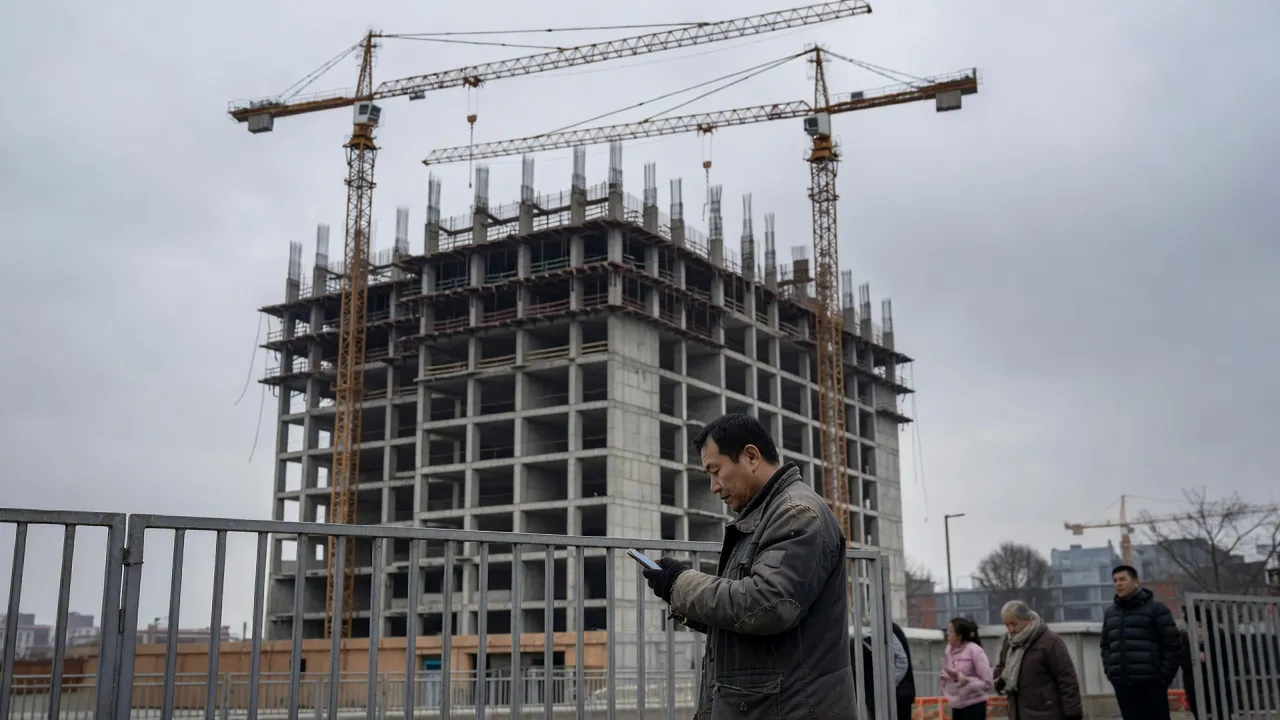
Evergrande founder Xu Jiayin sentenced to life in prison for fraud
published on
countries
sources
articles
Measured with the previous method (distance between texts), on a different scale.
A Chinese court sentenced Xu Jiayin (Hui Ka Yan), founder of real estate developer Evergrande, to life in prison for financial fraud on August 20. The Shenzhen Intermediate People's Court also ordered the confiscation of all his personal assets and the lifelong removal of his political rights. Evergrande Group and its subsidiary Evergrande Real Estate (Hengda) were fined a combined total of 15.82 billion yuan. Fifty-six other individuals linked to the group, including Xu Jiayin's two sons, received prison sentences of up to 18 years on the same day. The group had defaulted on its debt in 2021 with liabilities exceeding $300 billion.
Key figures
- 15,82 Md yuansCombined fines imposed on Evergrande Group and its subsidiary Hengda Real Estate1 source · TimesLIVE
- 45,3 md$Xu Jiayin's personal fortune in 2017, when he was named Asia's richest man by Forbes1 source · Clarín
- 255 M$Assets recovered since the liquidation of Evergrande (2024), compared to $45 billion in claimed creditors' claims1 source · RFI
What the comparison reveals
Common ground and differences in coverage across the media analysed.
What the media report in common
Xu Jiayin (Hui Ka Yan), founder of Evergrande, was sentenced to life in prison by the Shenzhen Intermediate People's Court, with total confiscation of his personal assets and revocation of his political rights.
Evergrande Group and its real estate subsidiary Evergrande Real Estate (Hengda) were fined a combined 15.82 billion yuan for financial fraud, based on inflated assets and hidden liabilities between 2016 and 2021.
56 individuals linked to the group, including Xu Jiayin's two sons and five former top executives, were sentenced on the same day to prison terms ranging from one year and ten months to eighteen years.
Where media coverage diverges
Outcome for foreign creditors
Some coverage presents the verdict as the final settlement of the Evergrande crisis, while others emphasize that repayment of international creditors remains largely unresolved, with most assets remaining out of reach in mainland China.
Biographical vs judicial framing
Some perspectives focus the narrative on Xu Jiayin's personal rise and fall, from a rural village to Asia's largest fortune, while others prioritize the judicial proceedings and economic amounts involved in the case.
Local financial exposure to Chinese risk
A few media outlets explicitly link the Evergrande default to a risk for their own economy or financial readers, while the majority treats the case as a strictly internal Chinese affair.
This grouping describes the publications analysed, not the position of these countries’ populations or of their governments.
Blind spots
What the coverage of each country leaves aside, while others put it forward.
 Italy
- Consequences for foreign creditors and offshore debt
- Impact on Chinese buyers of unfinished homes
 Mexico
- Fate of foreign creditors and international investors
- Situation of Chinese buyers of undelivered homes
 United Kingdom
- Identification of British creditors or funds exposed to Evergrande debt
 South Africa
- Structural reform of China's real estate sector
- Direct exposure of South African investors to default
How each country reads it
Preview: 3 of 11 media perspectives. Syntheses of the media analysed — not direct quotations. Method & limitations
 Argentina
Buenos Aires views the downfall of Xu Jiayin as the judicial culmination of a saga that has reshaped China's real estate credit landscape, without erasing the sector's lingering crisis.
2 sources · View sources
 Australia
Canberra views the condemnation of Xu Jiayin as less of an individual verdict than a reflection of China's unsustainable real estate growth system.
3 sources · View sources
 Brazil
Brasília is taking note of the Shenzhen verdict, less for the judicial sanction than for the trajectory of a man who rose from a rural village to become Asia's greatest fortune, and then to life in prison.
4 sources · View sources
The full text, country by country
Argentina
DOMINANT ANGLE
Buenos Aires views the downfall of Xu Jiayin as the judicial culmination of a saga that has reshaped China's real estate credit landscape, without erasing the sector's lingering crisis.
ANALYSIS
Buenos Aires, August 21, 2026.
Australia
DOMINANT ANGLE
Canberra views the condemnation of Xu Jiayin as less of an individual verdict than a reflection of China's unsustainable real estate growth system.
ANALYSIS
Canberra, August 21, 2026.
Brazil
DOMINANT ANGLE
Brasília is taking note of the Shenzhen verdict, less for the judicial sanction than for the trajectory of a man who rose from a rural village to become Asia's greatest fortune, and then to life in prison.
ANALYSIS
Brasília, August 21, 2026.
 Chile
DOMINANT ANGLE
Santiago views the sentencing of Xu Jiayin as the judicial endpoint of a Chinese real estate crisis whose financial aftershocks continue to unsettle Beijing's trade partners, including Chile.
ANALYSIS
Santiago, August 21, 2026.
 Germany
DOMINANT ANGLE
Berlin views the Shenzhen verdict as the judicial outcome of a Chinese real estate debacle, without a direct link to the German economy, but rich in lessons on the excesses of credit and large-scale accounting fraud.
ANALYSIS
Berlin, August 21, 2026.
 Spain
DOMINANT ANGLE
Madrid views the downfall of Xu Jiayin as the judicial epilogue to a Chinese real estate crisis with eerily familiar echoes for an economy marked by its own housing bubble.
ANALYSIS
Madrid, August 21, 2026.
 France
DOMINANT ANGLE
Paris is primarily concerned with what this verdict does not address: the repayment of creditors, who are left empty-handed despite the severity of the sentence imposed on Xu Jiayin.
ANALYSIS
Paris, August 21, 2026.
Italy
DOMINANT ANGLE
Rome sees in the Shenzhen ruling the judicial closure of one of the largest real estate collapses in recent economic history.
ANALYSIS
Rome, August 21, 2026.
Mexico
DOMINANT ANGLE
Mexico City takes note of Xu Jiayin's condemnation, which highlights the meteoric rise and fall of a former magnate, symbolizing a Chinese real estate system plagued by over-indebtedness and now being held accountable by the justice system.
ANALYSIS
Mexico's government is closely following the developments in the case of Xu Jiayin, the founder of the Chinese real estate group Evergrande, who was sentenced to life in prison and had all his assets confiscated by a court in Shenzhen on August 21, 2026.
United Kingdom
DOMINANT ANGLE
London draws a sobering lesson from Xu Jiayin's lifetime sentence about the solvency of Chinese debt held by international markets.
ANALYSIS
London, August 21, 2026.
South Africa
DOMINANT ANGLE
Pretoria is putting the sentence into local financial perspective, the only press to convert billions of yuan into rand to gauge the extent of the Evergrande disaster.
ANALYSIS
Pretoria, August 21, 2026.
Explore every perspective on this subject across 11 countries.
Compare viewpoints and see where they diverge.