Common ground and differences in coverage across the media analysed.
A glacial avalanche on the Nepal-Tibet border triggered catastrophic flash floods on August 26; the USGS reclassified the signal, initially measured as a 4.4-magnitude earthquake, as a 5.2-magnitude glacier collapse.
Hundreds of people, including many foreign tourists and pilgrims en route to Mount Kailash, remain missing, alongside a death toll confirmed to be in the triple digits.
Several governments have mobilized emergency aid for Nepal (India, United States, South Korea, Bangladesh, IFRC) while tracking the fate of their own missing nationals.
Countries with citizens among the missing focus their coverage on the fate of their nationals, while countries without reported casualties prioritize the regional humanitarian toll or the scientific explanation of the disaster.
Coverage aligned with this reading
Coverage that diverges
The number of confirmed deaths in Nepal varies significantly across media outlets on the same day: from 157 to 165 according to international media, versus 359 in the district-by-district tally reported by Nepalese media.
Coverage aligned with this reading
Coverage that diverges
Pakistani media presents India as the primary provider of material assistance to Nepal, while Qatari media describes a multilateral mobilization (including the United States, South Korea, and the IFRC) without prioritizing contributions.
This grouping describes the publications analysed, not the position of these countries’ populations or of their governments.
What the coverage of each country leaves aside, while others put it forward.
Australia
United States
Preview: 3 of 13 media perspectives. Syntheses of the media analysed — not direct quotations. Method & limitations
Dhaka is extending a hand to Kathmandu and weighing regional hydrological risks rather than focusing on the death toll.
2 sources · View sources
Seoul is focusing its narrative on the fate of its nine nationals who have gone missing at the Nepalese hydroelectric construction site, putting the international toll on the back burner.
4 sources · View sources
Canberra is gauging the Himalayan disaster by the 34 nationals who have gone missing, placing Minister Penny Wong and the DFAT at the center of the national narrative rather than the regional humanitarian toll.
5 sources · View sources
DOMINANT ANGLE
Dhaka is extending a hand to Kathmandu and weighing regional hydrological risks rather than focusing on the death toll.
ANALYSIS
Dhaka, August 27, 2026.
DOMINANT ANGLE
Seoul is focusing its narrative on the fate of its nine nationals who have gone missing at the Nepalese hydroelectric construction site, putting the international toll on the back burner.
ANALYSIS
Seoul, August 27, 2026.
DOMINANT ANGLE
Canberra is gauging the Himalayan disaster by the 34 nationals who have gone missing, placing Minister Penny Wong and the DFAT at the center of the national narrative rather than the regional humanitarian toll.
ANALYSIS
Canberra, August 27, 2026.
DOMINANT ANGLE
France is closely monitoring the situation of its 80 nationals registered in Nepal, with no French casualties confirmed so far by the French Ministry of Foreign Affairs.
ANALYSIS
Paris, August 27, 2026.
DOMINANT ANGLE
New Delhi is mobilizing its diplomacy regarding the fate of its missing citizens in Nepal, particularly the Kailash pilgrims, while putting Bihar and Uttar Pradesh on alert due to the floodwaters rising towards its own borders.
ANALYSIS
New Delhi, August 27, 2026.
DOMINANT ANGLE
The United States government first assesses the danger to its citizens: 47 Americans are reported missing among tourists in Nepal, ahead of emergency aid and a consular warning.
ANALYSIS
The United States government is closely monitoring the situation in Nepal, where dozens have been killed after a glacier collapsed on the Nepal-Tibet border.
DOMINANT ANGLE
Pretoria is first focusing on the fate of its own citizens: four South Africans who have gone missing after the floods in Nepal, and the humanitarian organization Gift of the Givers is ready to deploy as soon as an international call is made.
ANALYSIS
Pretoria, August 27, 2026.
DOMINANT ANGLE
Kuala Lumpur is focusing its concern on the fate of its own nationals who are unaccounted for at the Nepal-Tibet border, rather than the overall toll of the disaster.
ANALYSIS
Kuala Lumpur, August 27, 2026.
DOMINANT ANGLE
Ottawa is mobilizing its consular diplomacy for the 24 Canadians reported missing in the Himalayan floods, as Mark Carney describes the disaster as "absolutely devastating".
ANALYSIS
Ottawa, August 27, 2026.
DOMINANT ANGLE
Tokyo views the Nepal disaster as scientific evidence of a warming Himalaya, rather than a consular crisis involving Japanese nationals.
ANALYSIS
Tokyo, August 27, 2026.
DOMINANT ANGLE
Doha details the international humanitarian mobilization and the toll of the Himalayan floods, with no Qatari nationals reported among the missing.
ANALYSIS
Doha, August 27, 2026.
DOMINANT ANGLE
Islamabad is grappling with a disaster that spare its own citizens but puts neighboring India at the center of the humanitarian response, from Kailash pilgrims to relief efforts sent to Nepal.
ANALYSIS
Islamabad, August 27, 2026.
DOMINANT ANGLE
Kathmandu is tracking the Bhotekoshi flood hour by hour and structuring its response around a single donation portal, prioritizing the national toll district by district over the fate of foreign tourists alone.
ANALYSIS
Katmandou, August 27, 2026.
Explore every perspective on this subject across 13 countries.
Compare viewpoints and see where they diverge.
published on
countries
sources
articles
gap
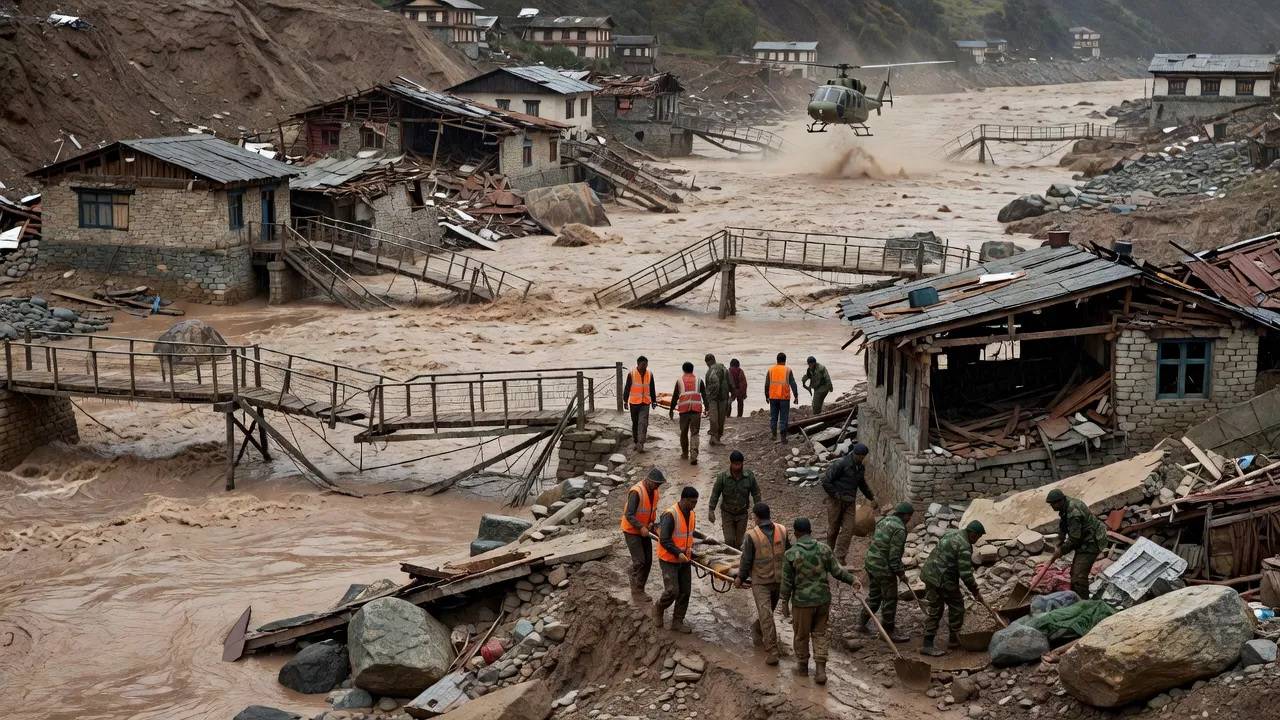
On Wednesday, August 26, 2026, the collapse of a glacier triggered flash floods along the Nepal-Tibet border, near the Lhende River, with Nepalese authorities reporting at least 160 deaths and up to 823 missing, while China reports an additional 558 missing in Tibet's Gyirong county.
The human toll remains unstable, with varying reports from Nepal and China from one update to the next, and no single consolidated total.
Nine South Korean employees at the 216 MW Nepalese hydroelectric dam remain missing.
The USGS ruled out a classic earthquake: the 5.2-magnitude seismic wave originated from the collapse of the glacier.
Bihar and Uttar Pradesh are monitoring the Gandak and Narayani rivers amid a risk of three-meter flooding.
From 95 (United States) to 359 (Nepal). 5 countries give none. · see the detail
More divergent than 47% of recent comparable stories (reference: 91 recent stories measured with the same method).