Common ground and differences in coverage across the media analysed.
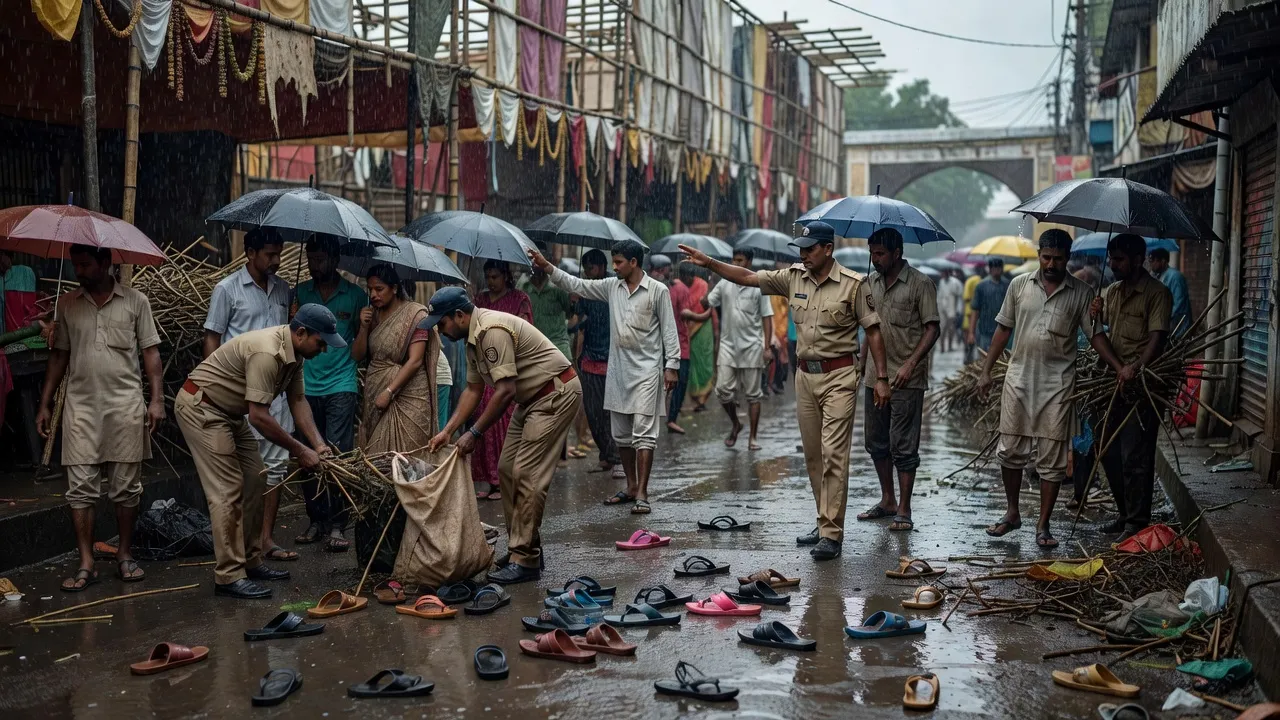
A stampede in front of a Durga Puja pavilion in Calcutta has killed at least 17 to 19 people and injured 25 according to reports.
Narendra Modi's office announces 200,000 rupees for the relatives of each deceased and 50,000 for each injured person.
The head of the West Bengal government, Suvendu Adhikari, is the source of the death toll and the announced measures.
What is the number of deaths? Indian and Bangladeshi media report 19 deaths, while Australian, Nepalese, and Pakistani media report 17 deaths, and Chilean media report 18 deaths.
What explanation of the tragedy is given? Chilean, Nepalese, and Pakistani media emphasize the rain and crowd size; Indian media highlights the compensation, investigation team, and arrests; Australian media places the incident in the series of Indian crowd accidents.
This grouping describes the publications analysed, not the position of these countries’ populations or of their governments.
What the coverage of each country leaves aside, while others put it forward.
Australia
Pakistan
Nepal
Bangladesh
Preview: 3 of 6 media perspectives. Syntheses of the media analysed — not direct quotations. Method & limitations
Santiago sees the Calcutta stampede as a crowd control issue: the Chilean press cites the sudden rain, narrow exits and the announced investigation into attendance control.
2 sources · View sources
Sydney is replacing the Kolkata stampede in the series of Indian crowd accidents, where the ABC notes "recurring management and security failures".
2 sources · View sources
Dhaka recalls from the Calcutta stampede a lack of crowd control: rain, narrow exit, lack of lighting, and a series of similar accidents in India that The Daily Star recalls.
2 sources · View sources
DOMINANT ANGLE
Santiago sees the Calcutta stampede as a crowd control issue: the Chilean press cites the sudden rain, narrow exits and the announced investigation into attendance control.
KEY POINTS
ANALYSIS
Santiago, October 18, 2026. Chilean media are covering the Calcutta tragedy in a factual manner, focusing on the sequence of events and the response of the authorities. BioBioChile published a first report on Saturday, October 17: at least 35 people were injured in a stampede that occurred during the Durga Puja celebrations, "one of the main Hindu festivals in India," according to the police. The incident reportedly took place around 7:40 pm local time (2:10 pm GMT), as a crowd was pushing in front of one of the temporary pavilions set up for the festival, dedicated to the goddess Durga.
The media outlet specifies that, according to the Calcutta police, the rain caused a sudden movement among the people waiting to enter, with several visitors falling to the ground. About 35 people were taken to the Calcutta Medical College and Hospital, rescue teams evacuated the area, and access was suspended. BioBioChile also reports that Indian media are mentioning at least 17 possible deaths, a toll that the authorities had not yet officially confirmed.
La Tercera, in its Sunday, October 18 edition, reports at least 18 deaths, including 13 women and one minor, and eight injured in critical condition. The newspaper cites the local police, who located the stampede at the exit of the Sarada Park Puja Pandal, under the Girish Park police station, and relays the NDTV channel on the mobilization of the police, firefighters, and ambulances. A seven-year-old girl is among the victims, and 25 people were being treated. The head of the state government, Suvendu Adhikari, indicates that the security camera images are being examined. He promises: "We will investigate to see if the crowd was controlled adequately. We will establish responsibilities." La Tercera adds that Prime Minister Narendra Modi has announced financial compensation for the families of the deceased. Witnesses report that many people lost consciousness, and the entrance and exit were very narrow.
Chilean coverage does not dwell on the controversies surrounding the origin of the crowd movement or the arrests of organizers, and remains on a sober register: figures, schedules, official statements. The subject is approached as a crowd management accident in a mass religious gathering, rather than as an Indian political issue.
DOMINANT ANGLE
Sydney is replacing the Kolkata stampede in the series of Indian crowd accidents, where the ABC notes "recurring management and security failures".
KEY POINTS
ANALYSIS
Sydney, 18 October 2026. The ABC and PerthNow, relying on a DPA dispatch, cover the Kolkata (Calcutta) stampede as just another crowd accident in a country that experiences many. According to the ABC, at least 17 people have died and 25 have been injured in front of a pavilion for the Hindu festival of Durga Puja, in eastern India. The head of the West Bengal government, Suvendu Adhikari, indicated that the dead include a seven-year-old girl and that "six bodies have been identified" at this stage.
The causes remain unclear in both articles. The ABC cites State Minister Umesh Rai, who speaks of a "sudden influx of people" into the pavilion, and a senior police official: an announcement triggered "agitation" when the rain started falling at night, the crowd massed in front of the pandal pushing, pulling, and rushing forward before falling. PerthNow, citing local television, locates the incident at the exit gate, in the Girish Park neighborhood, after heavy rains. It also quotes the daily The Hindu, according to which Mr. Adhikari mentions a panic born of a "misleading" announcement. A witness quoted by India Today describes visitors fainting, being taken away by motorcycle.
Regarding the official response, Australian media stick to the office of Prime Minister Narendra Modi. In a message on X, he announces 200,000 rupees (approximately 3,000 Australian dollars) for the relatives of each deceased and 50,000 rupees for each injured person.
The ABC then broadens the discussion, as a reader of a country that views India from afar: "deadly crowd incidents are frequent during major Indian events due to management and security failures". It lists the precedents: 30 deaths at the Kumbh Mela last year, 11 supporters crushed in Bengaluru during celebrations of the local cricket team's title, 36 deaths at a political meeting in Tamil Nadu, 121 deaths in 2024 in Uttar Pradesh during a Hindu gathering. This reminder makes Kolkata just one episode in a series, rather than a drama specific to a festival.
DOMINANT ANGLE
Dhaka recalls from the Calcutta stampede a lack of crowd control: rain, narrow exit, lack of lighting, and a series of similar accidents in India that The Daily Star recalls.
KEY POINTS
ANALYSIS
Dhaka, October 18, 2026. The Daily Star and The Business Standard (TBS) are covering the stampede that occurred on Saturday, October 17, in the evening near the Chorbagan pandal, in northern Calcutta, on the first day of Maha Saptami. Their initial report mentions 17 deaths and 25 injuries; the toll is later raised to 19 deaths, including 17 on the spot, according to the Chief Minister of West Bengal, Suvendu Adhikari, quoted on Sunday, October 18.
The causes are reported with their discrepancies. According to the Calcutta police, the stampede occurred at the exit gate of the Sarada Park pandal (Chor Bagan), under heavy attendance and rain. A senior police official told AFP that an announcement had caused a "commotion" and that the crowd massed outside was pushing and falling to the ground. A witness quoted by The Daily Star denounces narrow entrances and exits and "no lighting in the area". A version published on Sunday by The Daily Star also mentions the collapse of part of the exit gate structure.
The human toll is specified: 13 women and a seven-year-old child are among the dead, and 24 of the 25 injured are out of danger, one remaining in critical condition.
The official response occupies a large place. Narendra Modi announced 200,000 rupees for the families of the deceased and 50,000 for each injured person. Suvendu Adhikari announced a public job per family, 5 lakh rupees per injured person, and the coverage of medical expenses; TBS indicates 25 lakh per deceased family, while The Daily Star reports "2.5 lakh rupees", an unexplained discrepancy in the texts. Organizers, private security guards, and service personnel have been detained for questioning, and the police have collected CCTV footage. The government is to ask the President of the Calcutta High Court to set up a fact-finding committee.
DOMINANT ANGLE
New Delhi is taking note of the West Bengal government's response to the Calcutta stampede: compensation, a judge-led inquiry, and a review of pandal security, against a backdrop of partisan exchanges.
KEY POINTS
ANALYSIS
New Delhi, October 18, 2026. In the Indian press, the Chorbagan stampede is first seen through the response of the authorities. On Saturday, October 17, in the evening, on the day of Maha Saptami, at least 19 people died and 25 were injured in front of the Chorbagan Sarbojanin pandal, in northern Calcutta, during a rush under sudden rain. The head of the West Bengal government, Suvendu Adhikari, visited the Calcutta university hospital. He announced 25 lakh rupees and a group D job for the family of each deceased, 5 lakh for each injured, medical care, as well as a special investigation team (SIT) led by a sitting High Court judge. "Nobody will be spared," he promised, the police having collected CCTV footage.
The causes remain disputed. Adhikari cites an announcement over the loudspeaker by the organizers; relatives of two victims mention whistles from private security guards; Minister Umesh Rai highlights the downpour while speaking of "mismanagement". A senior police officer, quoted by PTI, says he has gathered "sufficient evidence pointing to gross mismanagement": insufficient staff, oral instructions, narrow grid and access road, and an announcement asking to evacuate because the structure was going to collapse, whose author is being searched for.
On the judicial front, 12 people were arrested overnight. Free Press Journal reports seven arrests on Sunday, including the secretary and vice-president of the committee, under several articles of the BNS; Deccan Chronicle reports, citing Adhikari, six arrests. Article 163 of the BNSS prohibits gatherings of five or more people around the Bowbazar police station for three days, from October 18 to 20.
DOMINANT ANGLE
Kathmandu has taken note of the response of the authorities to the Calcutta stampede: a confirmed toll from the Chief Minister of West Bengal, an announced investigation and compensation decided by Delhi.
KEY POINTS
ANALYSIS
Katmandou, 18 October 2026. Nepalese media are treating the stampede that occurred in Calcutta during the Durga Puja festival as a news item from neighboring India, mainly relayed through a Reuters dispatch and a report from the West Bengal authorities.
The Kathmandu Post, which reprints Reuters, reports on a stampede that killed "at least 17" people. The daily specifies that the festival, celebrated over several days each year in the state of West Bengal, attracts considerable crowds to temporary structures, the pandals, which house the idols of the goddess Durga. According to local television cited in the dispatch, the accident occurred at the exit gate, in the Girish Park neighborhood, after heavy rain caused congestion: many devotees were trying to leave the premises at the same time. Dozens of people were injured, according to the text.
The official dimension occupies a large place. The Kathmandu Post indicates that the office of Indian Prime Minister Narendra Modi announced, in a message posted on the X network, a compensation of 200,000 rupees (approximately $2,106) for the relatives of each victim and 50,000 rupees for each injured person.
Khabarhub, an online English-language media outlet, adopts a more institutional tone. It reports that West Bengal Chief Minister Suvendu Adhikari confirmed on Saturday that 17 people had died and 25 others were injured in the stampede that occurred at the Chorbagan Sarbojanin Durga Puja pandal in Calcutta. He promised that all necessary support would be provided to the affected families and that an investigation into the incident would be conducted.
DOMINANT ANGLE
Islamabad describes a crowd stampede in the rain in Calcutta, citing the toll, crowd management at the exit gate of the pandal, and New Delhi's compensation.
KEY POINTS
ANALYSIS
Islamabad, October 18, 2026. The Pakistani press, through Geo News and Business Recorder, reported the stampede that occurred on Saturday, October 17, in Calcutta as a crowd tragedy during the Hindu festival of Durga Puja, based on Indian sources and agency dispatches.
According to Geo News, 17 people died and 25 were injured, according to the Chief Minister of West Bengal, Suvendu Adhikari. The tragedy occurred around 7:40 pm local time, at the exit gate of the Sarada Park pandal, also known as Chorbagan, in the Girish Park neighborhood. Geo News specified that 17 people were taken to the hospital dead, the injured were taken to the Medical College and Hospital, where Mr. Adhikari went, and the authorities fear an increase in the toll.
The Calcutta police, cited by Geo, attributed the incident to the influx of visitors in the rain. Business Recorder, which picked up a dispatch, mentioned a heavy downpour that caused overcrowding as many devotees tried to leave the site, according to local television; it specified that the toll came from local media. Police reinforcements, firefighters, disaster management teams, ambulances, and medical teams were deployed, and the pandal was closed to visitors.
The official aspect occupies a notable place. Prime Minister Narendra Modi expressed his condolences, and his office announced 200,000 rupees (2,106 dollars) from the National Relief Fund for the families of each person killed, and 50,000 rupees for each injured person. Geo added that the West Bengal administration is providing assistance to the affected families.
Explore every perspective on this subject across 6 countries.
Compare viewpoints and see where they diverge.
published on
countries
sources
articles
gap
Once the toll is established, the question of the origin of the stampede remains, with versions reported by the press in six countries varying according to the source cited and the time of the dispatch.
An investigation is underway: a special team has been formed and the causes of the stampede (announcement, rain, whistle) remain to be determined.
The Indian press is the most detailed on this point. A high-ranking police officer, quoted by PTI, says they have gathered evidence of seriously flawed management: insufficient staff, verbal instructions, narrow grid and access road.
« sufficient evidence pointing to gross mismanagement »
He also mentions an announcement calling for evacuation because the structure was about to collapse. The author of this announcement is being sought, according to the same source.
Suvendu Adhikari, for his part, cites an announcement over the organizers' loudspeaker. Relatives of two victims speak of whistle blows by private security guards. Minister Umesh Rai highlights the downpour, while using the word "mismanagement".
According to Calcutta police, the stampede occurred at the exit gate of the Sarada Park (Chor Bagan) pandal, in the Girish Park neighborhood. A senior police official spoke to AFP of a "commotion" caused by an announcement, with the crowd massed outside pushing and then falling to the ground.
A witness cited by The Daily Star denounces narrow entrances and exits and the lack of lighting. A version published on Sunday, October 18, by this daily also mentions the collapse of part of the exit gate structure. A witness cited by India Today, as reported by the ABC, describes visitors fainting, being taken away by motorcycle.
Regarding the victims, The Daily Star and La Tercera cite 13 women and one minor; The Daily Star specifies that it is a seven-year-old child and that 24 of the 25 injured are out of danger.
The tolls differ from one article to another. The Indian and Bangladeshi presses report 19 dead, the Australian, Nepalese, and Pakistani presses 17, La Tercera 18. This discrepancy measures the time of the dispatch taken up by each media outlet, not a disagreement on the facts.
The same time gap explains the injury figures for the first day. BioBioChile, on Saturday, October 17, mentions at least 35 injured; La Tercera, the next day, mentions 25 people treated.
Other discrepancies remain unexplained in the texts. TBS reports 25 lakh rupees per deceased family, The Daily Star "2.5 lakh rupees", the Indian press 25 lakh. For the arrests on Sunday, Free Press Journal counts seven people, Deccan Chronicle six, citing Adhikari.
ABC and The Daily Star place the episode in a series: 30 deaths at the Kumbh Mela last year, 11 in Bengaluru after the cricket team's title, 36 at Vijay's meeting in Tamil Nadu, 121 in 2024 in Uttar Pradesh. This framing appears in the two cited texts; the Indian press in the corpus does not repeat it.
« Deadly crowd incidents are frequent occurrences at Indian mass events due to management and safety lapses. »
The latter focuses on the local follow-up. The West Bengal government has formed a high-level committee on the security of large pandals, while nearly 3,500 pujas are held in the city. Adhikari has called on the 58,000 pujas in the state to respect the guidelines on lighting, entrances and exits, and crowd control.
The partisan debate appears in only one article in the pool. The president of the Bengali BJP, Samik Bhattacharya, calls to avoid any "political mudslinging". The Trinamool points out the links between the pandal committee and BJP elected officials, including a nephew of the head of government; Free Press Journal notes that these links do not establish responsibility in themselves.
The Chilean, Nepalese, and Pakistani articles in the corpus do not mention the arrests or these exchanges. This describes their content, not what happened in Calcutta.
West Bengal announces 25 lakh rupees and a Group D job per deceased, according to Indian press.
Narendra Modi's office announces 200,000 rupees per deceased and 50,000 per injured.
An SIT headed by a judge of the Calcutta High Court; Article 163 of the BNSS is imposed from October 18 to 20.
PerthNow adds a contextual reference point: the Durga Puja takes place in West Bengal from 16 to 21 October and attracts huge crowds to temporary structures housing the goddess's idols. Both articles attribute little to individual responsibilities; they describe crowd mechanisms and a provisional toll still numbered at 17.
The Daily Star places the event in a series: the Kumbh Mela stampede last year (30 deaths), the 11 deaths in Bengaluru after the cricket team's title, the 36 deaths at Vijay's meeting in Tamil Nadu, and the 121 deaths in Uttar Pradesh in 2024. The agency recalls that such tragedies are frequent during religious gatherings. Adhikari himself called on the 58,000 pujas in the state to respect the fire and police instructions on lighting, entrances and exits, and crowd control.
The regional government has also formed a high-level committee to examine the security of large pandals: crowd management, exits, solidity of structures. Several very crowded pandals have been temporarily closed, while nearly 3,500 pujas are being held in the city. At the national level, Narendra Modi announced 2 lakh rupees from the PMNRF fund per deceased and 50,000 per injured; Rajnath Singh and Ashwini Vaishnaw offered their condolences, and Amit Shah postponed his trips to Bengal.
Politics is emerging: the president of the Bengal BJP, Samik Bhattacharya, calls to avoid any "political mudslinging", while the Trinamool highlights the links between the committee and BJP elected officials, including a nephew of the head of government.
The two texts converge on the location, city, and scope of the tragedy, but they are not entirely identical: one highlights the rain and the exit from the site, the other the toll of 17 dead and 25 injured and the commitments of the regional government. The provided articles say nothing about the organizers' arrests or alternative explanations for the origin of the crowd movement, and the Nepalese press does not question here the security of large religious gatherings. It sticks to what the Indian authorities and local press say: a toll, a reported meteorological cause, compensation, and an announced investigation.
The two media outlets situated the event: Durga Puja is one of the largest annual religious and cultural festivals in West Bengal, which attracts crowds to temporary structures, the pandals. Business Recorder also referred to another stampede, six deaths during a gathering for a free pass in a Hindu temple. Neither of the two texts mentioned any arrests or responsibility of the organizers: the coverage remained descriptive, focused on the toll, the immediate causes, and the compensation.
More divergent than 41% of recent comparable stories (reference: 90 recent stories measured with the same method).