EXPLORE THIS STORY
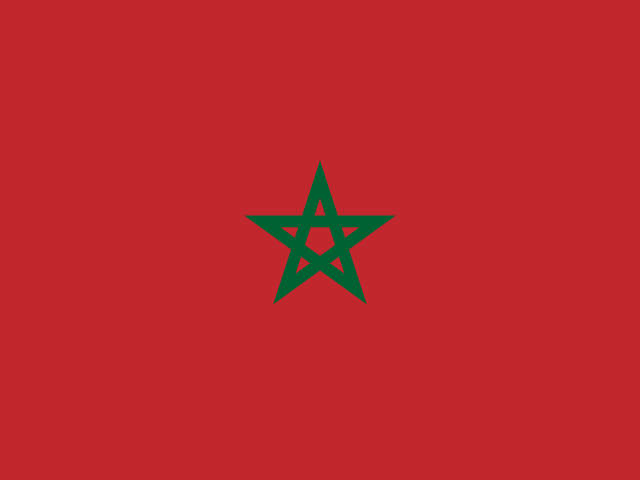
MOROCCO PERSPECTIVE
IRAN-US WAR: MILITARY ESCALATION AND KHAMENEI'S SUCCESSION IN QUESTION
Single source
DOMINANT ANGLE
Legalist approach favoring international law against unilateral actions
Dominant angle identified — does not reflect unanimity of this country’s media
ANALYSIS
Moroccan media coverage reveals a remarkably balanced and legalistic approach to the Iran-United States conflict, systematically privileging international law as the primary interpretive framework. This perspective reflects Morocco's traditional diplomatic position as a country navigating between its Western alliances and regional solidarity. The constant emphasis on the illegality of American-Israeli strikes, repeated in every article, reflects a desire to position itself as a defender of multilateralism against the unilateral actions of great powers.
The tone adopted remains deliberately factual and detached, avoiding sensationalism despite the severity of the reported events, notably the assassination of Iran's Supreme Leader. This editorial restraint, however, masks revealing silences: the complete absence of contextualization regarding regional implications for North Africa, potential economic repercussions on Morocco, or the impact on Mediterranean geopolitical balances. The coverage also ignores the sectarian dimensions of the conflict and the crucial energy issues for Morocco's economy.
The narrative framing systematically presents the United States and Israel as destabilizing actors, with Iran depicted more as a victim than as an aggressive regional power. This binary reading obscures the complexity of Middle Eastern rivalries and suggests a certain sympathy for the Iranian cause, despite criticisms leveled against Tehran's nuclear program. The recurring use of the term 'martyrdom' to describe Khamenei's death reveals a cultural and religious proximity that subtly influences news treatment.
The structural biases reflect Morocco's geopolitical constraints: a historical ally of the United States while seeking to preserve its relations with the entire Muslim world. This dual loyalty transpires in coverage that firmly condemns American actions while carefully avoiding direct criticism of Washington or explicit support for Tehran. This balancing act reveals the limits of Morocco's diplomatic margin for maneuver in a context of growing polarization between rival geopolitical blocs.
KEY POINTS
- Systematic emphasis on the illegality of strikes under international law
- Factual and detached tone avoiding sensationalism despite the severity of events
- Complete silence on regional and economic implications for Morocco
- Framing presenting United States/Israel as destabilizers, Iran as victim
- Use of the term 'martyrdom' revealing cultural proximity to Iran
COGNITIVE BIASES IDENTIFIED
Tightrope position between Western alliances and Muslim solidarity
Avoidance of any direct criticism of the United States despite condemnation of actions
Concealment of energy and economic issues crucial for Morocco
SOURCES (1)
Does this analysis seem accurate?