
Common ground and differences in coverage across the media analysed.
All countries confirm that three Lebanese journalists were killed by an Israeli airstrike
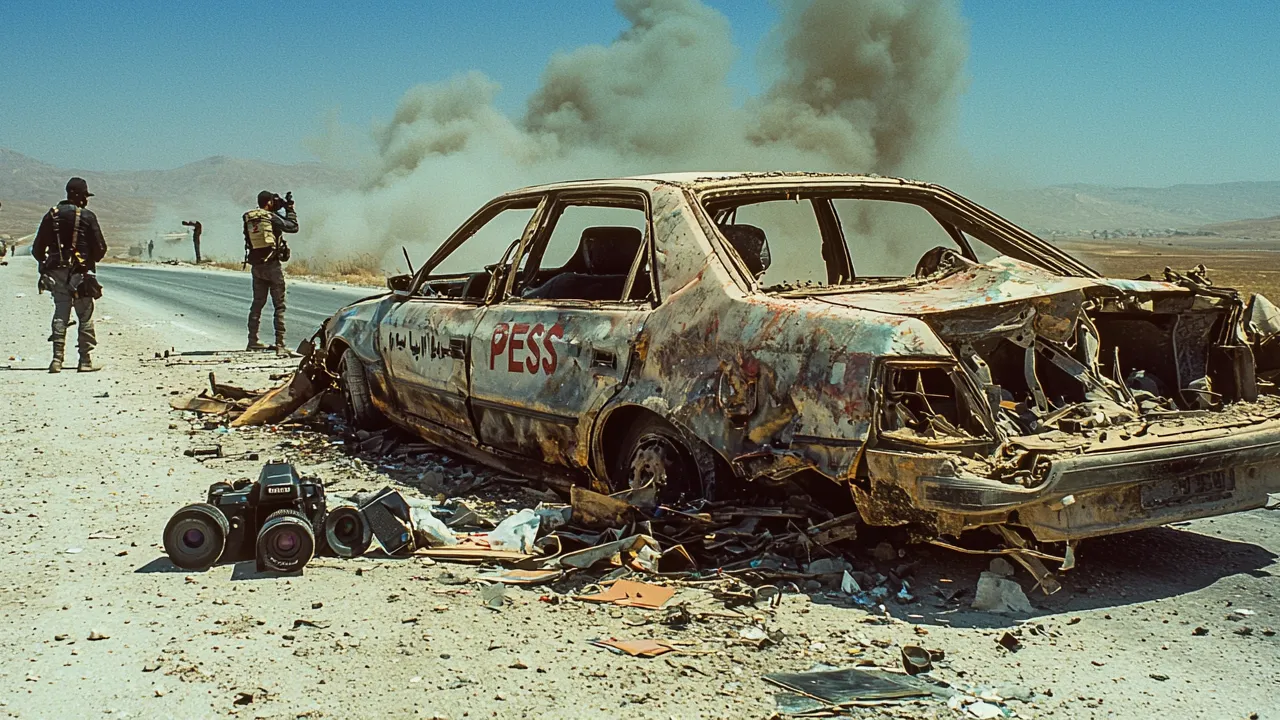
The fact that the target was a civilian vehicle (a car) is reported across all outlets
The escalation of attacks against media in the Middle East is shared context
Turkey and Pakistan say 'crime.' Al Jazeera says 'bloodshed.' The US says 'Officials Say.' Israel says 'Hezbollah operative.'
Israel asserts one journalist was Hezbollah. India reports the claim with 'Claims.' The NYT uses 'Officials Say.' Turkey and Pakistan ignore it entirely.
What the coverage of each country leaves aside, while others put it forward.
Israel
United States
Preview: 3 of 8 media perspectives. Syntheses of the media analysed — not direct quotations. Method & limitations
Three journalists in a car — the vehicle detail as moral judgment
1 source · View sources
'Officials Say' — American caution that avoids naming the act a crime
1 source · View sources
Attacking the Lebanese press means attacking the Francophone world — personal historical bond
1 source · View sources
DOMINANT ANGLE
Three journalists in a car — the vehicle detail as moral judgment
ANALYSIS
Sky News identifies the three victims: Fatima Ftouni, reporter for Al Mayadeen; her brother Mohammed Ftouni, cameraman; and Ali Shoaib, correspondent for Al-Manar TV.
DOMINANT ANGLE
'Officials Say' — American caution that avoids naming the act a crime
ANALYSIS
The New York Times reports a crucial fact that the Jerusalem Post omits: the IDF accused Ali Shoaib of being a Hezbollah operative but the Times notes this accusation was made "without providing any evidence.
DOMINANT ANGLE
Attacking the Lebanese press means attacking the Francophone world — personal historical bond
ANALYSIS
France Info contextualizes within a day summary: "journalists killed in Lebanon" alongside Houthi entry into the conflict.
DOMINANT ANGLE
'Blatant crime' — the most direct condemnation after Turkey
ANALYSIS
Dawn publishes three articles on the incident — exceptional density for Pakistan's leading English-language daily.
DOMINANT ANGLE
Not journalists — Hezbollah operatives behind cameras
ANALYSIS
The Jerusalem Post does not cover the three Lebanese journalists killed.
DOMINANT ANGLE
Both versions in the same headline — India between Israel and the Arab world
ANALYSIS
NDTV headlines with a balance that has become the signature of Indian Middle East coverage: "Israel Kills 3 Journalists in Lebanon Strike, Claims 1 Was Hezbollah Member.
DOMINANT ANGLE
Three journalists plus nine medics equals bloodshed across Lebanese civil society
ANALYSIS
Al Jazeera headlines with surgical precision: "Three journalists killed in Israeli strike on marked press car in Lebanon.
DOMINANT ANGLE
'Continued targeting of media' — Turkey accuses Israel of systematic policy
ANALYSIS
Daily Sabah reveals a detail that Western media euphemize: Ali Shoaib, whom the IDF accuses of being a "Hezbollah operative," was an Al-Manar correspondent for nearly thirty years.
Explore every perspective on this subject across 8 countries.
Compare viewpoints and see where they diverge.
published on
countries
sources
articles
gap
Three Lebanese journalists were killed by an Israeli strike in southern Lebanon. On this point, all sources agree: the target was a civilian vehicle, a car, and its three occupants worked for the press. The episode fits within a wider series of attacks on media in the Middle East, a context all actors acknowledge, despite their opposing readings of the event.
The killing of journalists in a conflict zone works as a gauge of a war's intensity. When press vehicles are hit, the question of witnesses on the ground and their protection arises immediately. That is what gives this strike a reach beyond its human toll: it bears on the very ability to document what is happening locally.
The disagreements concern less the facts than the words used to describe them. Some actors speak of a crime, others of a mistake or collateral damage. Israel states that one of the journalists was a Hezbollah combatant; several governments report this assertion cautiously, presenting it as an allegation, while others reject it, pointing to the absence of publicly disclosed evidence.
The blind spots also differ from one account to another. Where some insist on the broader toll — rescue workers killed the same day, the total number of journalists dead since the conflict began, the detention of a press team in the West Bank — others stick strictly to the isolated incident. What remains disputed is therefore not the existence of the strike, but its intent, its legal framing, and whether it belongs to a larger pattern.
Measured with the previous method (distance between texts), on a different scale.