Common ground and differences in coverage across the media analysed.
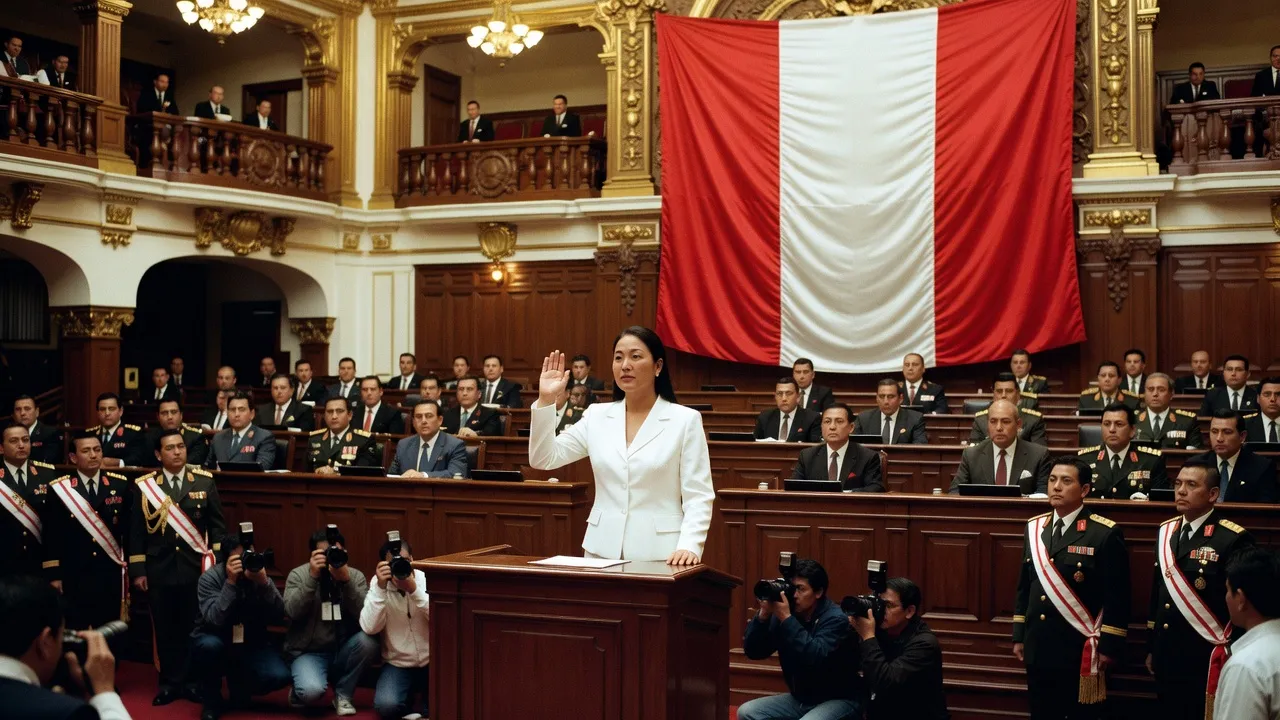
Keiko Fujimori, 51 years old, was sworn in on July 28, 2026 as the first woman elected to the presidency of Peru, following a victory on June 7 achieved with fewer than 50,000 votes ahead of Roberto Sanchez.
In her Message to the Nation, Fujimori announced the temporary deployment of the Armed Forces alongside the national police in emergency-declared zones to combat organized crime and extortion.
The ceremony in Lima brought together several heads of state and foreign leaders, including Javier Milei, José Antonio Kast, Daniel Noboa, and King Felipe VI.
Argentina and Chile interpret the presence of right-wing leaders (Milei, Kast) as a signal of consolidation of a conservative Latin American axis, while Venezuela emphasizes pragmatic diplomatic resumption initiated a few days earlier, transcending ideological divisions with Peru's new government.
While Chile and Ecuador send their sitting presidents to Lima to seal concrete bilateral agreements (security, energy), Mexico delegates former president Vicente Fox, a political opposition figure to Claudia Sheinbaum, which Mexico's press presents as the government's dissociation from the regional scene.
Argentine, Brazilian, and Peruvian coverage remains largely ceremonial, focused on the official speech and security announcements, while Spanish, French, and Mexican press emphasizes the Fujimori family's judicial past, parliamentary fragility, and low parity in the new cabinet.
This grouping describes the publications analysed, not the position of these countries’ populations or of their governments.
What the coverage of each country leaves aside, while others put it forward.
Argentina
Peru
Brazil
Preview: 3 of 9 media perspectives. Syntheses of the media analysed — not direct quotations. Method & limitations
Buenos Aires reads Keiko Fujimori's swearing-in as a consolidation signal for Latin American conservatism, exemplified by Javier Milei's presence at the Lima ceremony.
3 sources · View sources
Brasília reads Peru's election of Keiko Fujimori, the nation's first female president, as a signal of regional political realignment, focusing intently on the militarization of public security and the chronic institutional instability afflicting the neighboring state.
3 sources · View sources
Santiago reads Fujimori's inauguration as marking a bilateral reset that Kast personally cemented in Lima.
4 sources · View sources
DOMINANT ANGLE
Buenos Aires reads Keiko Fujimori's swearing-in as a consolidation signal for Latin American conservatism, exemplified by Javier Milei's presence at the Lima ceremony.
ANALYSIS
Buenos Aires, July 28, 2026.
DOMINANT ANGLE
Brasília reads Peru's election of Keiko Fujimori, the nation's first female president, as a signal of regional political realignment, focusing intently on the militarization of public security and the chronic institutional instability afflicting the neighboring state.
ANALYSIS
Brasília, July 29, 2026.
DOMINANT ANGLE
Santiago reads Fujimori's inauguration as marking a bilateral reset that Kast personally cemented in Lima.
ANALYSIS
Santiago, July 28, 2026.
DOMINANT ANGLE
Quito reads Keiko Fujimori's inauguration chiefly through security gains and regional energy dynamics affecting its own border region
ANALYSIS
Quito, July 28, 2026.
DOMINANT ANGLE
Madrid reads Keiko Fujimori's swearing-in as a carefully managed yet fragile return of Fujiorism, one promising firm governance while remaining bound to Alberto Fujimori's controversial legacy of authoritarian rule and human rights violations
ANALYSIS
Madrid, July 29, 2026.
DOMINANT ANGLE
France views Keiko Fujimori's security gambit through the lens of a still-controversial family legacy and a fragmented Parliament lacking the majority needed to advance her agenda.
ANALYSIS
Paris, July 28, 2026.
DOMINANT ANGLE
Mexico City separates the official South American scene from its own domestic politics: it is the ex-president Vicente Fox, a figure of opposition to the Fourth Transformation, not the Sheinbaum government, who embodies the Mexican presence in Lima.
ANALYSIS
Mexico City, July 28, 2026.
DOMINANT ANGLE
Lima reads Keiko Fujimori's inauguration as the nation's first female president elected by popular vote, spotlighting her pledge to deploy the armed forces against rising crime while describing a state weakened by improvisation and corruption.
ANALYSIS
Lima, July 29, 2026.
DOMINANT ANGLE
Caracas welcomes Keiko Fujimori's inauguration and bets on diplomatic momentum renewed just four days earlier, transcending ideological divides with Peru's new leadership.
ANALYSIS
Caracas, July 28, 2026.
Explore every perspective on this subject across 9 countries.
Compare viewpoints and see where they diverge.
published on
countries
sources
articles
gap
Keiko Fujimori was sworn in on July 28, 2026, as president of Peru for the 2026-2031 term, becoming the first woman elected by popular vote to lead the country. The ceremony was held in Lima, before Congress, in the presence of several foreign heads of state, including King Felipe VI of Spain. Elected by fewer than 50,000 votes over Roberto Sanchez, she announced the deployment of the armed forces alongside the national police in areas under a state of emergency against crime, as well as a rise in the minimum wage.
Measured with the previous method (distance between texts), on a different scale.