Common ground and differences in coverage across the media analysed.
What the media report in common
1
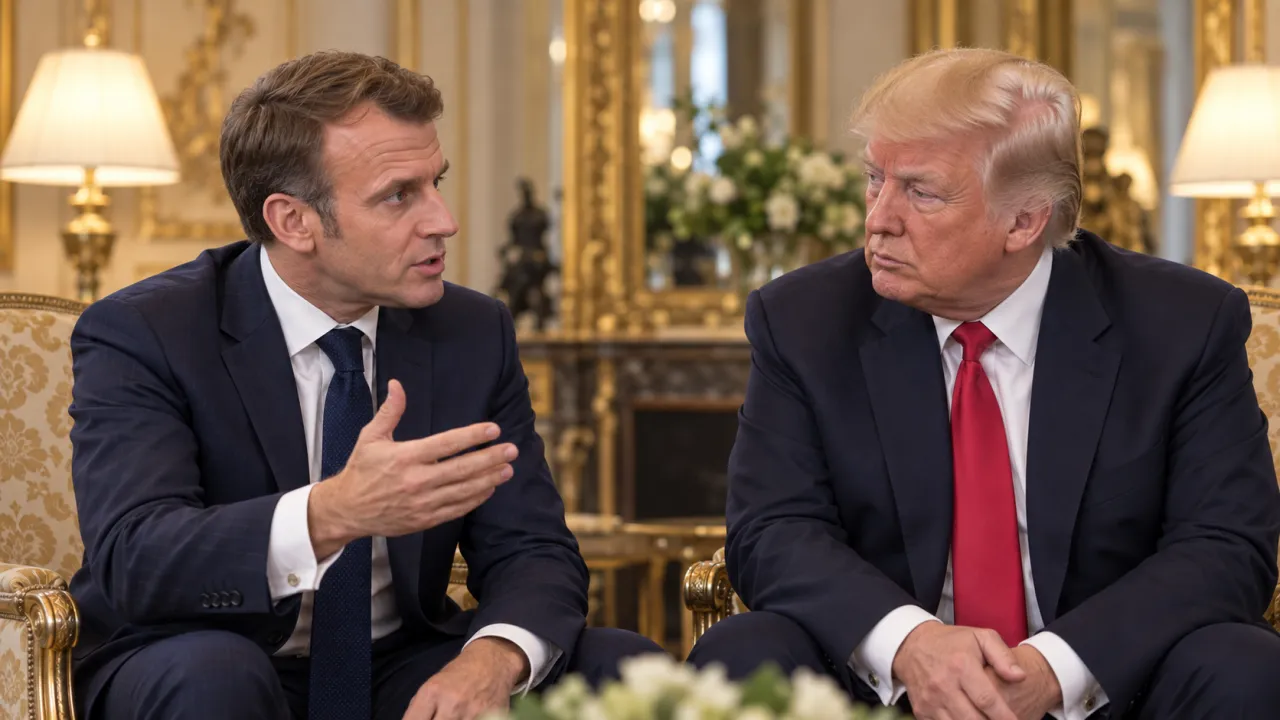
The meeting between Emmanuel Macron and Donald Trump took place on Monday, September 21, 2026, at the Trump Tower in New York, on the eve of their respective speeches before the United Nations General Assembly scheduled for Tuesday, September 22, 2026; Macron described it as 'very constructive'.
2
The strikes on Russian refineries and energy infrastructure, and their impact on fuel prices (notably diesel), are a common thread in much of the coverage of this New York diplomatic sequence.
Where media coverage diverges
Dominant angle of the meeting
Some news outlets present the Macron-Trump meeting primarily as a fuel price issue, while others see it as a sequence of diplomatic conditions and security guarantees between Kyiv, Washington, and Moscow.
On the question of whether a halt to energy strikes should be reciprocal, part of the coverage reiterates Kyiv's requirement for reciprocity before any de-escalation, while another relays the US demand for a halt to Ukrainian strikes on Russian refineries.
Buenos Aires distinguishes between two difficult-to-reconcile Macrons: the energy mediator negotiating in New York and the head of state contested by his own police reform in Paris.
Buenos Aires distinguishes between two difficult-to-reconcile Macrons: the energy mediator negotiating in New York and the head of state contested by his own police reform in Paris.
London is measuring Macron's proposal for a moratorium based on its immediate effect on fuel prices, more than as a simple diplomatic gesture.
ANALYSIS
London, Tuesday, 22 September 2026.
Finland
DOMINANT ANGLE
Helsinki is particularly focused on the trend in diesel prices during the New York week, between Trump's pressure call to Zelensky and the surge in global fuel prices.
ANALYSIS
Helsinki, Tuesday, September 22, 2026.
France
DOMINANT ANGLE
Paris first weighs the New York meeting in terms of the gas pump: the dialogue with Trump on Ukraine and the Red Sea is presented as a lever against the surge in diesel fuel that is fueling social discontent and disrupting the presidential campaign.
ANALYSIS
Paris, September 22, 2026.
Lithuania
DOMINANT ANGLE
Vilnius is weighing the moratorium mentioned by Macron in light of the security guarantees that Zelensky is setting as a condition before any negotiations with Putin.
ANALYSIS
Vilnius, September 22, 2026.
Latvia
DOMINANT ANGLE
Riga is focusing on the sole Zelensky-Trump meeting on September 22, leaving the French initiative for a moratorium on energy strikes out of the picture
ANALYSIS
Riga, September 22, 2026.
Romania
DOMINANT ANGLE
Bucharest notes a scheduling contradiction: Donald Trump praised the strikes that put Russian diesel refineries "out of service" on Monday, on the eve of discussions on an energy moratorium in New York, while Vladimir Putin is reserving his presence for Beijing rather than Washington.
ANALYSIS
Bucharest, September 22, 2026.
Sweden
DOMINANT ANGLE
Stockholm is deciphering Trump's admission about diesel: the price of Swedish fuel is as much due to the war in Ukraine as to the lesser-admitted one against Iran.
ANALYSIS
Stockholm, September 22, 2026.
Ukraine
DOMINANT ANGLE
Kyiv is conditioning any energy moratorium on strict reciprocity, refusing to offer Russia a simple reprieve for its refineries in exchange for a pause on its own infrastructure.
ANALYSIS
Kyiv, September 22, 2026.
United States
DOMINANT ANGLE
The United States is setting its own conditions ahead of the United Nations summit: Trump is already demanding that Zelensky stop targeting Russian refineries, while Macron is advocating for a negotiated pause.
ANALYSIS
The United States, Tuesday, September 22, 2026.
Explore every perspective on this subject across 11 countries.
Macron puts to Trump a moratorium on strikes against energy facilities in Ukraine and Russia
published on
September 22, 2026
11
countries
29
sources
41
articles
Not measured
gap
Even before the Macron-Trump meeting on September 21, Washington was privately calling for an end to Ukrainian strikes on Russian refineries. The day before, on Sunday, September 20, Ukraine had struck the Moscow region for the first time with a "Pelican" ballistic missile. This climate of cross-pressure surrounds the discussions opened in New York.
No formal agreement on the energy moratorium was announced; Kyiv sets the reciprocity of Russian strikes as a precondition.
Prior American pressure
According to Bloomberg, the relationship between Washington and Kyiv has experienced new tensions in recent days: Donald Trump is asking Volodymyr Zelensky to stop targeting Russian oil refineries, a previous and separate demand from the moratorium proposal put forward by Emmanuel Macron. According to the Financial Times, cited by the Finnish and Swedish press, Trump called Zelensky on the phone on Sunday, September 20, to pressure him to stop these strikes.
« diesel, diesel, diesel »
a high-ranking Ukrainian official present during the call, quoted by the Financial Times, on Sunday, September 20, 2026
A high-ranking Ukrainian official present during the call summarized the American message in three words, according to the Financial Times.
On Truth Social on Monday, September 21, Trump wrote that Russia had "lost control" of its diesel industry, that a large number of its refineries were "at least temporarily out of service", and described the war in Ukraine as "ridiculous and endless". According to Iltalehti, he also mentioned a death toll of 25,000 per month, mostly soldiers.
The brief exchange between CIA Director John Ratcliffe and Zelensky at Shannon Airport takes on particular significance: according to the New York Times, cited by the Romanian press, Ratcliffe had traveled to Moscow without announcement less than a month earlier to meet with high-ranking Russian officials and urge them to reach an agreement before their position deteriorated. He was also returning from a meeting with Egyptian President Abdel Fattah al-Sissi; Trump had described the trip to Moscow as "rather routine".
Kyiv strikes further
The weekend before the New York meetings, Ukraine took a step forward: according to Volodymyr Zelensky, on Telegram on Sunday, September 20, its forces used the "Pelican" (FP-7) ballistic missile for the first time, against a refinery and a logistics site in the Moscow region.
« billions of dollars that fuel the war machine »
Volodymyr Zelensky, on Telegram, Sunday, September 20, 2026
Russian authorities confirmed damage to the Kapotnia refinery and two deaths near Sofyino.
Asked by CBC News, Zelensky also specified the conditions for a possible meeting with Vladimir Putin: it would only be considered, according to him, if it has "practical scope". He continues to see Putin as an adversary whose goal would remain to occupy Ukraine if it is not strong enough or lacks security guarantees.
On the Russian side, Kremlin spokesman Dmitri Peskov mentioned the hope for a new trilateral meeting with the United States. Foreign Minister Sergei Lavrov, on his part, stated that Moscow is ready for a new stage of negotiation, without lifting its demands.
Fuel, a political trigger
In France, the rise in fuel prices is fueling a concern distinct from the diplomatic dossier: according to L'Obs, the executive fears the resurgence of a social movement comparable to the Yellow Vests, in the midst of a presidential campaign, against a backdrop of blockages of oil depots led by fishermen in the Mediterranean. Sébastien Lecornu held two ministerial meetings on Monday, September 21, one on oil and gas supplies, the other on supporting the French in the face of rising prices.
« don't forget to ask politely »
a former Macronist minister, targeting Jordan Bardella, quoted by the French press
The opposition mocks the government's argument that the price surge "is due to a distant war" rather than a fiscal choice; a former Macronist minister has ridiculed this line, targeting candidate Jordan Bardella, according to the French press.
In Sweden, Aftonbladet and Svenska Dagbladet note an inverse omission: Donald Trump links the surge in fuel prices to the war in Ukraine, without mentioning his own war against Iran, conducted alongside Israel, which has blocked part of the oil transport in the Strait of Hormuz.
In Belgium, La Libre reports that Macron also proposed to Trump a UN Security Council resolution on freedom of navigation in this strait, as well as "strictly defensive" security for Saudi oil infrastructure targeted by Houthi rebels, a component distinct from the Ukrainian-Russian energy moratorium.
Putin relies on Beijing
A sign of the distance between Moscow and Washington, Vladimir Putin's diplomatic trajectory is intriguing the Romanian press: according to Bloomberg, cited by Mediafax, the Russian president would attend the APEC summit in Shenzhen, China, on November 18 and 19, a first since 2017.
His presence at the G20 organized by Washington in Florida in December is deemed "very unlikely" by Bloomberg. Putin and Xi Jinping would have discussed the possibility of a three-way meeting with Trump on the sidelines of the APEC summit.
On the sidelines of the same week at the UN, Finland also has its own meetings: President Alexander Stubb is to speak on Tuesday, September 22, at the podium, alongside Foreign Minister Elina Valtonen and Minister of Foreign Trade Ville Tavio, on Ukraine, the Middle East, and artificial intelligence.
According to YLE Uutiset, the high-level week at the UN is also to decide on the succession to the post of Secretary-General of the United Nations, whose term begins in January.
Demand from Washington
Trump demands that Kyiv stop strikes on Russian refineries, prior to the French proposal.
Kyiv's condition
Zelensky calls for reciprocity: Russia must first stop targeting Ukraine's energy sector.
Stopover in Shannon
CIA Director John Ratcliffe met Zelensky at Shannon Airport (Ireland) on Monday.
Letter to Brussels
Macron wrote to von der Leyen on September 18 to produce 20% more fuel.
Key figures
6.51 $/gal
Record price of American diesel on Monday, versus $3.76 before the war