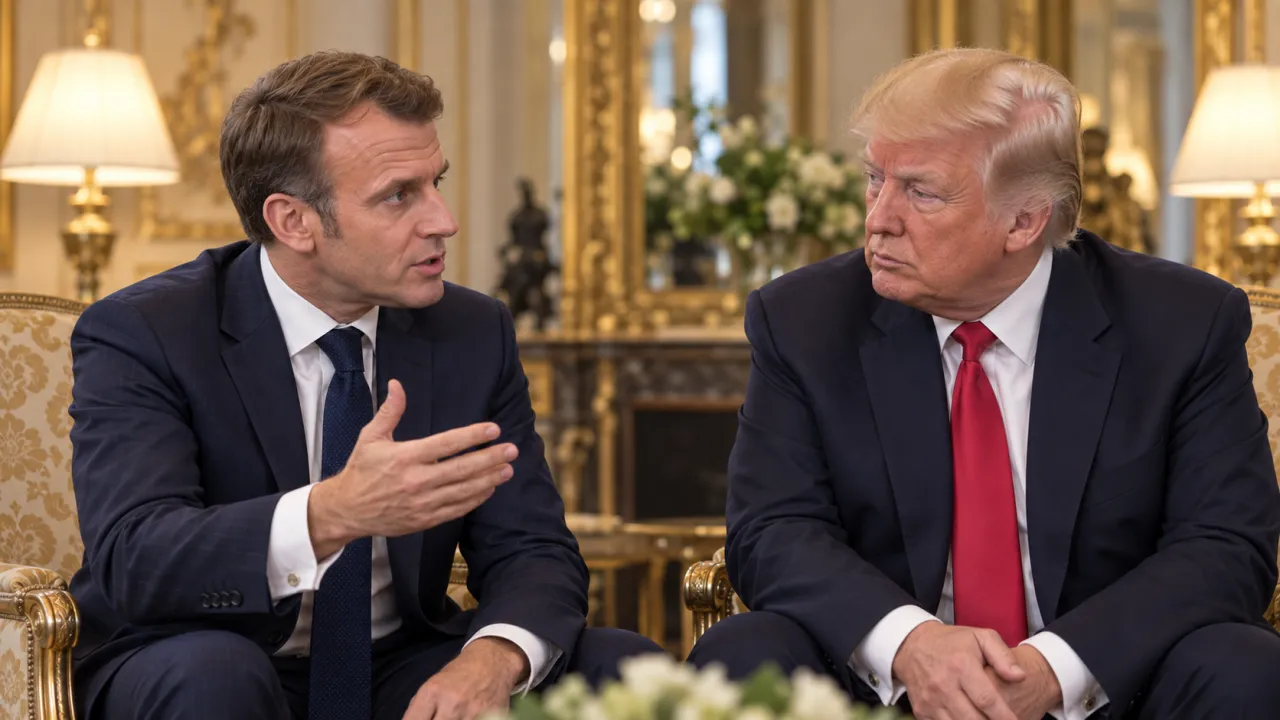
11 perspectives, each in the voice of that country's press.
Buenos Aires distinguishes between two difficult-to-reconcile Macrons: the energy mediator negotiating in New York and the head of state contested by his own police reform in Paris.
2 sources
Brussels is primarily focusing on the oil aspect of the Macron-Trump meeting in New York, more than the diplomatic schedule of the General Assembly.
2 sources
London is measuring Macron's proposal for a moratorium based on its immediate effect on fuel prices, more than as a simple diplomatic gesture.
2 sources
Helsinki is particularly focused on the trend in diesel prices during the New York week, between Trump's pressure call to Zelensky and the surge in global fuel prices.
3 sources
Paris first weighs the New York meeting in terms of the gas pump: the dialogue with Trump on Ukraine and the Red Sea is presented as a lever against the surge in diesel fuel that is fueling social discontent and disrupting the presidential campaign.
6 sources
Vilnius is weighing the moratorium mentioned by Macron in light of the security guarantees that Zelensky is setting as a condition before any negotiations with Putin.
Riga is focusing on the sole Zelensky-Trump meeting on September 22, leaving the French initiative for a moratorium on energy strikes out of the picture
Bucharest notes a scheduling contradiction: Donald Trump praised the strikes that put Russian diesel refineries "out of service" on Monday, on the eve of discussions on an energy moratorium in New York, while Vladimir Putin is reserving his presence for Beijing rather than Washington.
Stockholm is deciphering Trump's admission about diesel: the price of Swedish fuel is as much due to the war in Ukraine as to the lesser-admitted one against Iran.
Kyiv is conditioning any energy moratorium on strict reciprocity, refusing to offer Russia a simple reprieve for its refineries in exchange for a pause on its own infrastructure.
The United States is setting its own conditions ahead of the United Nations summit: Trump is already demanding that Zelensky stop targeting Russian refineries, while Macron is advocating for a negotiated pause.
2 sources
Cross-media analysis
What the comparison reveals
Common ground and differences in coverage across the media analysed.
What the media report in common
1
The meeting between Emmanuel Macron and Donald Trump took place on Monday, September 21, 2026, at the Trump Tower in New York, on the eve of their respective speeches before the United Nations General Assembly scheduled for Tuesday, September 22, 2026; Macron described it as 'very constructive'.
2
The strikes on Russian refineries and energy infrastructure, and their impact on fuel prices (notably diesel), are a common thread in much of the coverage of this New York diplomatic sequence.
Where media coverage diverges
Dominant angle of the meeting
Some news outlets present the Macron-Trump meeting primarily as a fuel price issue, while others see it as a sequence of diplomatic conditions and security guarantees between Kyiv, Washington, and Moscow.
On the question of whether a halt to energy strikes should be reciprocal, part of the coverage reiterates Kyiv's requirement for reciprocity before any de-escalation, while another relays the US demand for a halt to Ukrainian strikes on Russian refineries.
Coverage aligned with this reading
Coverage that diverges
This grouping describes the publications analysed, not the position of these countries’ populations or of their governments.
Buenos Aires distinguishes between two difficult-to-reconcile Macrons: the energy mediator negotiating in New York and the head of state contested by his own police reform in Paris.
KEY POINTS
Macron has promised Zelensky defense and energy aid for the winter, with "the signing of a contract for the supply of radars" and the delivery of interceptors (Infobae).
Macron discussed with Trump a possible energy truce between Russia and Ukraine and a hypothetical halt to strikes in the Black Sea, in addition to a moratorium on energy facilities (Infobae).
Deputy Mathilde Panot, quoted by Perfil, claims that since 2005, 162 people have died at the hands of the French police, in the debate on the police reform bill voted on "without debate".
ANALYSIS
Buenos Aires, September 22, 2026. The Argentine press has taken note of two different faces of Emmanuel Macron from the New York week, which are difficult to reconcile: that of the energy mediator and that of the contested head of state in his own country. In an EFE dispatch published on Tuesday, September 22, 2026, and picked up by Infobae, the French president appears to be in the midst of diplomatic mobilization as Zelensky and he are in New York for the UN General Assembly. Received by Macron, the Ukrainian president fears "a new campaign of massive Russian bombings" against his energy system as winter approaches. Macron has promised him aid in air defense and energy, with "the signing of a contract for the supply of radars" and the delivery of interceptors intended to shoot down Russian missiles. On X, he wrote that France "will be by Ukraine's side to face the winter," with the G7 Energy group mobilizing for Kiev.
The article specifies that Macron discussed this support with Donald Trump, as well as a possible energy truce between Russia and Ukraine and a hypothetical halt to strikes in the Black Sea — the same architecture as the moratorium announced by the French, but seen from Kiev: a truce that would first protect the Ukrainian energy network, in exchange for Western military deliveries. This, Macron insisted according to Infobae, "will be a key issue in the negotiations" leading to a just and lasting peace.
In the same week, Perfil devoted its Ronda de Corresponsales to a very different Macron: the one of police reform, adopted by the National Assembly "like a closed book, without debate," according to journalist Juan Luis Francia. He recalls a precedent from 2017 that, he says, "multiplied the deaths in France," and quotes Deputy Mathilde Panot: since 2005, 162 people have died at the hands of the French police. The most contested point, Francia emphasizes, is the presumption of legitimacy granted to police officers in the event of a fatal shooting.
For the Argentine press, these two accounts coexist without responding to each other: the Macron who negotiates the terms of an energy ceasefire in New York is never confronted, in the same column, with the one whose internal legitimacy is publicly questioned by his own opposition.
Belgium
DOMINANT ANGLE
Brussels is primarily focusing on the oil aspect of the Macron-Trump meeting in New York, more than the diplomatic schedule of the General Assembly.
KEY POINTS
Macron has proposed to Trump a UN Security Council resolution aimed at ensuring freedom of navigation in the Strait of Hormuz, through which 20% of global hydrocarbon trade passes (La Libre)
France says it is ready for the "securing", in a "strictly defensive" approach, of Saudi oil infrastructure targeted by Houthi rebels (La Libre)
Macron has pledged to strengthen Ukrainian air defense (radars, interceptors) after a meeting described as "diepgaand" (in-depth) with Zelensky (VRT NWS)
ANALYSIS
Brussels, September 22, 2026. The Belgian press first focuses on the oil aspect of the meeting held on Monday in New York between Emmanuel Macron and Donald Trump, on the sidelines of the UN General Assembly. According to La Libre, the French president proposed "several initiatives" to try to curb the surge in oil prices, including a resolution in the Security Council aimed at guaranteeing freedom of navigation in the Strait of Hormuz, through which 20% of global hydrocarbon trade passes. A diplomatic source specified that Paris wants to "work with the Americans and its partners" on this text, without a global agreement being necessary to "allow more container ships and tankers to pass".
The same meeting also discussed the protection of Saudi oil infrastructure targeted by Houthi rebels: France says it is ready for "securing", in an approach it itself describes as "strictly defensive". For Belgian diplomacy, which has been attentive to the energy file since the gas price surge in 2022, this abundance of verbal precautions - "strictly defensive", "without a global agreement" - signals Paris' caution not to appear as a party to an escalation in the Middle East.
On the Ukrainian aspect, VRT NWS reports a "very constructive" meeting between Macron and Trump, and a separate exchange, described as "diepgaand" (in-depth), between Macron and Volodymyr Zelensky. The French president promised that France will remain by Ukraine's side this winter and committed to strengthening Ukraine's air defense - radars and interceptors - to counter Russian strikes on energy infrastructure. Zelensky, who arrived in New York, is set to meet Trump on Tuesday afternoon, a source close to the file told AFP, as Washington showcases the relaunch of its mediation efforts in a war that has been ongoing since 2022.
United Kingdom
DOMINANT ANGLE
London is measuring Macron's proposal for a moratorium based on its immediate effect on fuel prices, more than as a simple diplomatic gesture.
KEY POINTS
US diesel has reached a record $6.51 on Monday, compared to around $3.76 before the war, according to the AAA (Daily Mail).
Trump wrote on Truth Social that a large number of Russian diesel refineries "have been destroyed and are, at least temporarily, out of service", after warning that Russia had "lost control" of its oil industry.
Zelensky is set to meet Trump on Tuesday to discuss a limited ceasefire protecting heating and electricity ahead of winter, after meeting Macron on Monday evening on the same subject.
ANALYSIS
London, Tuesday, 22 September 2026. The British press is covering the meeting between Emmanuel Macron and Donald Trump less as a diplomatic exercise than as a signal about fuel prices. According to The Independent, Volodymyr Zelensky arrived in New York with his wife Olena Zelenska for the UN General Assembly, where Ukraine wants to secure a freeze on strikes against the energy sector and a new agreement on drones. Zelensky is set to meet Trump on Tuesday to discuss a limited ceasefire protecting heating and electricity ahead of winter. Macron, who also arrived in New York, met with Zelensky on Monday evening and stressed the urgency of stopping strikes against energy infrastructure, as millions of Ukrainian families risk being left without heating or electricity.
The underlying theme retained by London, however, remains oil. Trump warned that Russia had "unfortunately lost control" of its oil industry, urging Kiev to stop its long-range strikes on refineries. "A large number of their diesel refineries have been destroyed and are, at the very least, temporarily out of service," he wrote on Truth Social. A senior White House official indicated, according to the Financial Times cited by The Independent, that Trump fears these strikes will exacerbate a global diesel shortage and drive up prices.
Finland
DOMINANT ANGLE
Helsinki is particularly focused on the trend in diesel prices during the New York week, between Trump's pressure call to Zelensky and the surge in global fuel prices.
KEY POINTS
According to the Financial Times as cited by MTV Uutiset, Trump called Zelensky on Sunday; a Ukrainian official summarizes the message as "diesel, diesel, diesel"
The average diesel price in the US exceeded $6 per gallon on September 11 and now surpasses $6.5 according to the AAA
YLE Uutiset reports that President Alexander Stubb is to speak at the UN podium on Tuesday, along with Minister Elina Valtonen and Minister Ville Tavio, on Ukraine, the Middle East, and artificial intelligence
ANALYSIS
Helsinki, Tuesday, September 22, 2026. The Finnish press is covering the opening of the UN General Assembly from the angle of fuel prices rather than diplomatic protocol. Three titles, Iltalehti, MTV Uutiset, and YLE Uutiset, converge on the same mechanism: Ukrainian strikes against Russian refineries have driven up the global diesel price, and it is these prices that are now pushing Donald Trump to intervene directly.
According to the Financial Times, cited by MTV Uutiset, Trump called Volodymyr Zelensky on Sunday to pressure him to stop the strikes against Russian refineries. A high-ranking Ukrainian official present during the call summarized the message in three words: "diesel, diesel, diesel". The White House has not commented on this information. Zelensky confirms an "important" exchange on energy security, without confirming pressure to cease the attacks. The two leaders are set to meet this week in New York.
Iltalehti notes that Trump himself exposed the problem on Truth Social: Russia would have "completely lost control" of its diesel industry due to Ukrainian drones, in a war he describes as "ridiculous and endless", recalling that 25,000 people, mostly soldiers, die every month. The average diesel price in the United States exceeded $6 per gallon on September 11 and now surpasses $6.5 according to the AAA, a politically sensitive subject for Trump and the Republican camp.
France
DOMINANT ANGLE
Paris first weighs the New York meeting in terms of the gas pump: the dialogue with Trump on Ukraine and the Red Sea is presented as a lever against the surge in diesel fuel that is fueling social discontent and disrupting the presidential campaign.
KEY POINTS
The Macron-Trump meeting at Trump Tower lasted about half an hour on Monday, September 21, and covered Ukraine, the Red Sea, and oil prices, deemed "very constructive" by Macron.
Diesel averaged 2.41 euros on Sunday, September 20, compared to 2.18 euros for SP95-E10 and 2.28 euros for SP98, according to L'Obs.
Macron wrote to Ursula von der Leyen on September 18 to request a relaxation of European rules to allow for a 20% increase in fuel production, according to a letter seen by BFMTV.
ANALYSIS
Paris, September 22, 2026. Emmanuel Macron walked across Manhattan on foot on Monday, September 21, to meet Donald Trump at the Trump Tower, where the two leaders exchanged for about half an hour on the sidelines of the UN General Assembly. "We had a very good discussion. It was very constructive," the French president assured journalists, referring to a conversation about the war in Ukraine, the situation in the Red Sea, and the surge in oil prices. The French press is mainly reading this meeting in light of a domestic urgency: prices at the pump.
On Sunday, September 20, diesel was approaching 2.41 euros on average, compared to 2.18 euros for SP95-E10 and 2.28 euros for SP98, levels that are fueling social unrest already marked by blockages of oil depots led by fishermen in the Mediterranean. The government fears the resurgence of a movement like the Yellow Vests, in the midst of a presidential campaign. Sébastien Lecornu held two ministerial meetings on Monday, one on oil and gas supplies, the other on supporting the French in the face of rising prices.
It is in this context that Macron wrote to Ursula von der Leyen on September 18 to demand a relaxation of European rules in order to produce "quickly 20% more fuel," according to a letter consulted by BFMTV. He mentions a contraction of the global oil supply, stocks down by "more than 500 million barrels," and the "targeting of Russian and Middle Eastern energy infrastructure."
Lithuania
DOMINANT ANGLE
Vilnius is weighing the moratorium mentioned by Macron in light of the security guarantees that Zelensky is setting as a condition before any negotiations with Putin.
KEY POINTS
Macron described the conversation with Trump as "very good" and "very constructive", mentioning a moratorium on strikes against Ukrainian and Russian energy facilities
Zelensky announced on Sunday the first use of the "Pelican" ballistic missile (FP-7) against a refinery and a logistics site in the Moscow region, resulting in two deaths according to Russian authorities
Asked by CBC News, Zelensky says he can consider a meeting with Putin only if it has "practical significance", calling him an enemy seeking to occupy Ukraine without security guarantees
ANALYSIS
Vilnius, September 22, 2026. On the eve of the United Nations summit, the meeting between Emmanuel Macron and Donald Trump at the Trump Tower in New York is holding Lithuanian attention less for its diplomatic backdrop than for what the mentioned moratorium would leave open. According to Reuters, cited by 15min, Macron described the conversation as "very good" and "very constructive", stating that the two leaders discussed an initiative to establish a moratorium on strikes against energy facilities, on both the Ukrainian and Russian sides. He specified that he wants to raise the issue with Zelensky on the same day and hopes for progress during the UN summit.
But the Lithuanian press is placing this moratorium alongside another event from the weekend: Ukraine's first use of the "Pelican" ballistic missile (FP-7), announced on Sunday by Zelensky on Telegram, against a refinery and a logistics site in the Moscow region. Russian authorities confirmed damage to the Kapotnia refinery and two deaths near Sofyino; Zelensky mentioned "billions of dollars that fuel the Russian war machine". The contrast is clear: Paris is seeking to freeze strikes on energy at a time when Kyiv has just expanded its strike range.
The other aspect that Vilnius is focusing on is the condition set by Zelensky. When asked by CBC News, relayed by RBC-Ukraina, he said he could consider a meeting with Putin only if it has "practical scope", recalling that he still sees him as an enemy whose goal remains to occupy Ukraine if it is not strong enough or lacks security guarantees. On the Russian side, Peskov is mentioning the hope of a new trilateral meeting with the United States, and Lavrov is stating that Moscow is ready for a new stage of negotiations, without lifting its demands.
Latvia
DOMINANT ANGLE
Riga is focusing on the sole Zelensky-Trump meeting on September 22, leaving the French initiative for a moratorium on energy strikes out of the picture
KEY POINTS
Volodymyr Zelensky is to meet Donald Trump on September 22 in New York, according to the Ukrainska Pravda agency cited by Jauns and TVNET
Zelensky was due to arrive in the United States Monday evening, on the eve of the meeting
The agreement on this meeting was concluded on Sunday, September 20, during a phone call between Zelensky and Trump
ANALYSIS
Riga, September 22, 2026. For the Latvian press, the opening of the United Nations General Assembly boils down to a series of bilateral meetings in New York, including the highly anticipated one between Volodymyr Zelensky and Donald Trump. The Jauns and TVNET portals, both picking up the same dispatch from the Ukrainian agency Ukrainska Pravda, report that the Ukrainian president is set to meet his American counterpart on Tuesday, September 22, after arriving in the United States on Monday evening. According to this source, the agreement in principle for this meeting was sealed as early as Sunday, September 20, during a phone call between the two leaders.
The Latvian coverage, sober and devoid of commentary, makes no mention of the meeting between Emmanuel Macron and Donald Trump at the Trump Tower the previous day, nor the French proposal for a moratorium on strikes against Ukrainian and Russian energy infrastructure. The focus is on the logistical schedule: who arrives when, who meets whom, and in what order. This reading reflects a distinctly transatlantic focus on the crisis: for Riga, a NATO member directly exposed to the Russian border, what matters most is whether Washington maintains its direct commitment to Kiev, rather than diplomatic initiatives from Western Europe.
By narrowing its attention to this single meeting, the Latvian press implicitly places Ukraine's fate in the bilateral relationship between Kiev and Washington, leaving in the shadows the role Paris is trying to play as an intermediary between Europeans and the Trump administration. No details are given about the expected content of Tuesday's exchanges, nor about the position Zelensky might take on a potential halt to energy strikes. The very format of the dispatch, brief and without analysis, suggests a straightforward reporting of the facts: the two Latvian titles are content to relay the Ukrainian information without attempting to corroborate it locally or put it into perspective with the regional Baltic issues, which are nonetheless directly affected by the outcome of the war.
Romania
DOMINANT ANGLE
Bucharest notes a scheduling contradiction: Donald Trump praised the strikes that put Russian diesel refineries "out of service" on Monday, on the eve of discussions on an energy moratorium in New York, while Vladimir Putin is reserving his presence for Beijing rather than Washington.
KEY POINTS
Donald Trump wrote on Monday that "Russia has lost control of its diesel industry" and that its refineries are "at least temporarily, out of service", on the eve of his meeting with Zelensky at the UN
Volodimir Zelensky briefly met CIA Director John Ratcliffe during a refueling stop at Shannon Airport in Ireland, en route to New York
Vladimir Putin would attend the APEC in Shenzhen (November 18-19) in person, a first since 2017, while his presence at the G20 in Florida in December is deemed "very unlikely" by Bloomberg
ANALYSIS
Bucharest, September 22, 2026. On the eve of the opening of the UN General Assembly, the Romanian press first notes a message from Donald Trump published on Monday on social media: "Unfortunately, Russia has lost control of its diesel industry due to the war with Ukraine. A large number of their diesel refineries have been destroyed and are, at least temporarily, out of service." The American president adds that "this ridiculous and endless war with Ukraine must stop" - a statement published on the eve of his scheduled meeting with Volodimir Zelensky on the sidelines of the General Assembly.
Zelensky's journey to New York is also of interest to Digi24 and Mediafax: the Ukrainian president made a technical stop at Shannon Airport in Ireland for refueling, and briefly met with CIA Director John Ratcliffe, who was returning from a meeting with Egyptian President Abdel Fattah al-Sissi. A source described the exchange as "informal"; neither the content nor the exact duration were specified.
This meeting comes less than a month after Ratcliffe's unannounced trip to Moscow, where he met with high-ranking Russian intelligence officials. According to Reuters, the discussions partly concerned Ukraine; The New York Times reported that Ratcliffe urged Russian officials to reach an agreement before their position deteriorates further. Trump had downplayed this trip, calling it "rather routine".
Sweden
DOMINANT ANGLE
Stockholm is deciphering Trump's admission about diesel: the price of Swedish fuel is as much due to the war in Ukraine as to the lesser-admitted one against Iran.
KEY POINTS
Trump wrote on Monday on Truth Social that "Russia has lost control of its diesel industry" due to the war in Ukraine, with a large number of Russian refineries out of service after strikes.
According to the Financial Times, Trump asked Zelensky by phone on Sunday to stop attacks on Russian refineries, a request already made publicly a few weeks earlier.
Zelensky responded on X that Ukraine's energy sector, critical infrastructure, and food exports must stop being targeted by Russia, in exchange for a "corresponding de-escalation" on the Ukrainian side.
ANALYSIS
Stockholm, September 22, 2026. The Swedish press first notes an unusual admission by Donald Trump. On Truth Social, on Monday, the American president wrote that "Russia has unfortunately lost control of its diesel industry due to its war against Ukraine", adding that a large number of Russian refineries have been targeted by strikes and are, at least temporarily, out of service. For Aftonbladet and Svenska Dagbladet, which pick up the same dispatch, the interest of the phrase lies in what it omits: Trump avoids linking the surge in fuel prices to the war he himself waged against Iran alongside Israel, a war that has blocked part of the oil and gas transport in the Strait of Hormuz. However, it is indeed this blockade, as much as the Ukrainian strikes on Russian refineries, that weighs on Swedish pumps.
According to the Financial Times, cited by Swedish titles, Trump asked Volodymyr Zelensky on Sunday by phone to cease attacks on Russian refineries, a request already made publicly a few weeks earlier. Zelensky responded on X that a "dialogue" is ongoing with Washington, posing a condition: that the energy sector, critical infrastructure, and Ukraine's food exports cease to be Russian targets, which would lead to "corresponding de-escalation" on the Ukrainian side. "Solutions are possible", he added, specifying that the issue will be discussed with Kiev's allies at the UN General Assembly this week.
Ukraine
DOMINANT ANGLE
Kyiv is conditioning any energy moratorium on strict reciprocity, refusing to offer Russia a simple reprieve for its refineries in exchange for a pause on its own infrastructure.
KEY POINTS
Zelensky conditions any de-escalation on a prior halt to Russian strikes on the energy sector, critical infrastructure, and Ukrainian food exports, before taking "corresponding de-escalation measures".
Macron described missile interceptors as a "key point from a defensive perspective" during his meeting with Trump on September 21 at the Trump Tower.
Zelensky met CIA Director John Ratcliffe at Shannon Airport in Ireland, a few weeks after the latter's discreet visit to Moscow.
ANALYSIS
Kyiv, September 22, 2026. On the eve of its own speech before the UN General Assembly, Ukrainian diplomacy is setting its conditions for the energy moratorium discussed in New York between Emmanuel Macron and Donald Trump.
On Monday, September 21, the French President met with Donald Trump at the Trump Tower before meeting with Volodymyr Zelensky the same evening at the residence of the French Permanent Representative to the UN. According to Macron, the exchange with Washington primarily focused on missile interceptors, which he described as a "key point from a defensive perspective," before discussing possible paths for a mutual moratorium on strikes targeting Ukrainian and Russian energy infrastructure. On X, he wrote that he wants to "unite our forces to obtain a moratorium on strikes against energy and civilian infrastructure in Ukraine."
On the Ukrainian side, adherence remains conditional. Zelensky repeats that Russia must first stop targeting Ukraine's energy sector, critical infrastructure, and food exports before Kyiv takes corresponding measures. "Solutions are possible," he wrote, while warning that the agreement must remain reliable and durable, and not just a temporary reprieve for Russian oil refineries. This caution follows reports from Axios that Trump had asked Kyiv to stop its own strikes against Russian refineries, while the American President claims on Truth Social that Moscow has "lost control" of its refining industry.
United States
DOMINANT ANGLE
The United States is setting its own conditions ahead of the United Nations summit: Trump is already demanding that Zelensky stop targeting Russian refineries, while Macron is advocating for a negotiated pause.
KEY POINTS
According to Bloomberg, Trump is demanding that Zelenskyy stop targeting oil refineries in Russia, a source of new tensions between Washington and Kiev
Donald Trump is set to meet Volodymyr Zelensky on Tuesday, the day of their respective speeches at the UN General Assembly
According to The Hill, CIA Director John Ratcliffe and Zelensky briefly crossed paths on Monday at Shannon Airport (Ireland) while their planes were refueling en route to the United States
ANALYSIS
The United States, Tuesday, September 22, 2026. On the eve of the opening of the United Nations General Assembly, the American press is not primarily focusing on the French diplomatic initiative, but rather on the long-standing tension between Donald Trump and Volodymyr Zelensky over the conduct of the war. According to Bloomberg, the Ukrainian relationship with the United States has experienced new tensions in recent days, with Trump demanding that Zelenskyy cease targeting oil refineries in Russia. This American requirement, prior to and distinct from the moratorium proposal put forward by Emmanuel Macron, sheds a different light on the New York summit: while Paris seeks to stop strikes on both sides of the front, Washington seems to want to contain those of Kiev, without a reciprocal commitment on Russian infrastructure targeting Ukraine.
The United States is set to see Donald Trump meet with Volodymyr Zelensky on Tuesday, the same day the Ukrainian president arrived in New York for the General Assembly. The meeting comes after a revealing logistical contact: according to The Hill, CIA Director John Ratcliffe and Zelensky briefly crossed paths on Monday at Shannon Airport in Ireland, while their respective planes were being refueled on the way to the United States. A source close to the meeting, who was not identified, confirmed the exchange without detailing its content or specifying whether the issue of energy strikes was discussed.
Explore every perspective on this subject across 11 countries.
Macron puts to Trump a moratorium on strikes against energy facilities in Ukraine and Russia
published on
September 22, 2026
11
countries
29
sources
41
articles
Even before the Macron-Trump meeting on September 21, Washington was privately calling for an end to Ukrainian strikes on Russian refineries. The day before, on Sunday, September 20, Ukraine had struck the Moscow region for the first time with a "Pelican" ballistic missile. This climate of cross-pressure surrounds the discussions opened in New York.
No formal agreement on the energy moratorium was announced; Kyiv sets the reciprocity of Russian strikes as a precondition.
Prior American pressure
According to Bloomberg, the relationship between Washington and Kyiv has experienced new tensions in recent days: Donald Trump is asking Volodymyr Zelensky to stop targeting Russian oil refineries, a previous and separate demand from the moratorium proposal put forward by Emmanuel Macron. According to the Financial Times, cited by the Finnish and Swedish press, Trump called Zelensky on the phone on Sunday, September 20, to pressure him to stop these strikes.
« diesel, diesel, diesel »
a high-ranking Ukrainian official present during the call, quoted by the Financial Times, on Sunday, September 20, 2026
A high-ranking Ukrainian official present during the call summarized the American message in three words, according to the Financial Times.
On Truth Social on Monday, September 21, Trump wrote that Russia had "lost control" of its diesel industry, that a large number of its refineries were "at least temporarily out of service", and described the war in Ukraine as "ridiculous and endless". According to Iltalehti, he also mentioned a death toll of 25,000 per month, mostly soldiers.
The brief exchange between CIA Director John Ratcliffe and Zelensky at Shannon Airport takes on particular significance: according to the New York Times, cited by the Romanian press, Ratcliffe had traveled to Moscow without announcement less than a month earlier to meet with high-ranking Russian officials and urge them to reach an agreement before their position deteriorated. He was also returning from a meeting with Egyptian President Abdel Fattah al-Sissi; Trump had described the trip to Moscow as "rather routine".
Kyiv strikes further
The weekend before the New York meetings, Ukraine took a step forward: according to Volodymyr Zelensky, on Telegram on Sunday, September 20, its forces used the "Pelican" (FP-7) ballistic missile for the first time, against a refinery and a logistics site in the Moscow region.
« billions of dollars that fuel the war machine »
Volodymyr Zelensky, on Telegram, Sunday, September 20, 2026
Russian authorities confirmed damage to the Kapotnia refinery and two deaths near Sofyino.
Asked by CBC News, Zelensky also specified the conditions for a possible meeting with Vladimir Putin: it would only be considered, according to him, if it has "practical scope". He continues to see Putin as an adversary whose goal would remain to occupy Ukraine if it is not strong enough or lacks security guarantees.
On the Russian side, Kremlin spokesman Dmitri Peskov mentioned the hope for a new trilateral meeting with the United States. Foreign Minister Sergei Lavrov, on his part, stated that Moscow is ready for a new stage of negotiation, without lifting its demands.
Fuel, a political trigger
In France, the rise in fuel prices is fueling a concern distinct from the diplomatic dossier: according to L'Obs, the executive fears the resurgence of a social movement comparable to the Yellow Vests, in the midst of a presidential campaign, against a backdrop of blockages of oil depots led by fishermen in the Mediterranean. Sébastien Lecornu held two ministerial meetings on Monday, September 21, one on oil and gas supplies, the other on supporting the French in the face of rising prices.
« don't forget to ask politely »
a former Macronist minister, targeting Jordan Bardella, quoted by the French press
The opposition mocks the government's argument that the price surge "is due to a distant war" rather than a fiscal choice; a former Macronist minister has ridiculed this line, targeting candidate Jordan Bardella, according to the French press.
In Sweden, Aftonbladet and Svenska Dagbladet note an inverse omission: Donald Trump links the surge in fuel prices to the war in Ukraine, without mentioning his own war against Iran, conducted alongside Israel, which has blocked part of the oil transport in the Strait of Hormuz.
In Belgium, La Libre reports that Macron also proposed to Trump a UN Security Council resolution on freedom of navigation in this strait, as well as "strictly defensive" security for Saudi oil infrastructure targeted by Houthi rebels, a component distinct from the Ukrainian-Russian energy moratorium.
Putin relies on Beijing
A sign of the distance between Moscow and Washington, Vladimir Putin's diplomatic trajectory is intriguing the Romanian press: according to Bloomberg, cited by Mediafax, the Russian president would attend the APEC summit in Shenzhen, China, on November 18 and 19, a first since 2017.
His presence at the G20 organized by Washington in Florida in December is deemed "very unlikely" by Bloomberg. Putin and Xi Jinping would have discussed the possibility of a three-way meeting with Trump on the sidelines of the APEC summit.
On the sidelines of the same week at the UN, Finland also has its own meetings: President Alexander Stubb is to speak on Tuesday, September 22, at the podium, alongside Foreign Minister Elina Valtonen and Minister of Foreign Trade Ville Tavio, on Ukraine, the Middle East, and artificial intelligence.
According to YLE Uutiset, the high-level week at the UN is also to decide on the succession to the post of Secretary-General of the United Nations, whose term begins in January.
Demand from Washington
Trump demands that Kyiv stop strikes on Russian refineries, prior to the French proposal.
Kyiv's condition
Zelensky calls for reciprocity: Russia must first stop targeting Ukraine's energy sector.
Stopover in Shannon
CIA Director John Ratcliffe met Zelensky at Shannon Airport (Ireland) on Monday.
Letter to Brussels
Macron wrote to von der Leyen on September 18 to produce 20% more fuel.
Zelensky meets Trump; Macron and Trump speak before the General Assembly
The Belgian coverage, built on AFP dispatches relayed by La Libre and VRT's live feed, does not mention the expected content of Trump's speech to the Assembly or the Spanish position on the presidential reception. It assembles a series of French announcements - Hormuz, Houthis, energy moratorium, air defense aid - without prioritizing them, revealing a dense diplomatic agenda where the fate of oil and that of the Ukrainian energy front remain treated as two facets of the same file.
The Daily Mail goes further and directly links the surge in prices to Trump's own war against Iran: American diesel reached a record $6.51 on Monday, compared to around $3.76 before the war, according to the AAA. The newspaper recalls that US and Israeli strikes against Iran have effectively closed the Strait of Hormuz, through which about a fifth of the world's oil supply passes. According to a Ukrainian official cited by the Financial Times, Trump's message during a call with Zelensky boiled down to a single repeated word: "diesel, diesel... diesel". A second official clarifies that Washington wants to see Russian oil return to the global market to bring prices down.
For the British press, the pressure on fuel prices, just weeks ahead of the US midterm elections, weighs as heavily in Trump's calculations as the Ukrainian diplomacy being promoted by Macron.
YLE Uutiset reports on Macron's comments after his meeting with Trump on Monday in New York, deemed "very constructive", focused on Ukraine and the Red Sea, a dossier also related to global prices. YLE highlights that Finnish President Alexander Stubb is set to speak on Tuesday at the podium, alongside Foreign Minister Elina Valtonen and Minister of Foreign Trade Ville Tavio, on Ukraine, the Middle East, and artificial intelligence. The high-level week is also expected to decide on the succession to the post of UN Secretary-General, whose term begins in January.
Despite repeated announcements of an energy truce, the strikes continue: Ukraine again targeted a refinery in the Moscow region over the weekend.
In New York, Macron pleaded for "better securing" of oil sites in the Red Sea and for reopening the Strait of Hormuz, through which 20% of global hydrocarbon trade passes, by working on a UN Security Council resolution. On Ukraine, he insisted on the need to "help our Ukrainian friends even faster and stronger in terms of [missile] interceptors."
The executive is hammering home that the price increase "is due to a distant war," rather than a fiscal choice, an argument already ridiculed by the opposition: "don't forget to politely ask" Trump to stop the war, ironized a former Macronist minister targeting Jordan Bardella.
Finally, 15min is linking American pressure to an economic motive acknowledged by Trump himself: Ukrainian strikes on Russian refineries, he says, are exacerbating the global diesel shortage and the rise in fuel prices, an argument he would have already made to Zelensky over the phone before their meeting scheduled for Tuesday, September 22, in New York. Vilnius is reading this as a two-speed moratorium: suspended on the Ukrainian side under American pressure, without a clear symmetrical counterpart on the Russian side.
In parallel, Vladimir Putin's diplomatic trajectory is of interest to Mediafax: the Kremlin leader would personally attend the APEC summit in Shenzhen, China, from November 18 to 19 - a first since 2017 - while his presence at the G20 organized by Washington in Florida in December is considered "very unlikely" by Bloomberg. Putin and Xi Jinping would have discussed the possibility of a three-way meeting with Trump on the sidelines of APEC.
For the Romanian press, this set of indicators - Russian refineries targeted, discreet intelligence shuttle, Putin's agenda turned towards Beijing rather than Washington - forms the backdrop against which the New York discussions are opening, without the European initiative for a moratorium on energy strikes finding, for the time being, a direct echo in Romanian headlines.
Expressen notes, on its part, that Trump seems to have taken note of the extent of Ukrainian attacks on the Russian oil industry, going so far as to judge that Putin has "lost control". Zelensky is to meet Trump on Tuesday afternoon, New York time, according to an AFP source cited by Aftonbladet.
In this landscape, the Macron-Trump meeting on Monday, in New York, occupies a secondary place in Swedish headlines: Macron judged the discussion "very good" and "very constructive", mentioning the Red Sea and the war in Ukraine, but without the Swedish press detailing the French proposal for a moratorium on energy strikes. The retained angle remains that of the price at the pump, closer to the Swedish wallet than to Parisian diplomacy.
The week promises to be busy for Ukrainian diplomacy: Zelensky, who arrived in New York with his wife Olena Zelenska, is set to meet with Trump on Tuesday, September 22, before speaking before the General Assembly on Wednesday, September 23, with about twenty meetings scheduled. On the sidelines of the trip, Zelensky also met with CIA Director John Ratcliffe at Shannon Airport in Ireland, just a few weeks after the latter's discreet visit to Moscow. Kyiv finally recalls that the discussions have not suspended anything on the ground: Zelensky mentioned a strike that he described as "deliberate" on Zaporijjia and a deadly drone strike in Lozova, in the Kharkiv region.
The American press pool does not mention at this stage either the Macron-Trump meeting at the Trump Tower or the initiative for a moratorium on energy infrastructure mentioned by the French. The angle retained in Washington remains that of the bilateral balance of power with Kiev: the presidential demand to cease strikes on Russian refineries, formulated even before the summit, puts Zelensky in a position where he must arbitrate between American pressure and European support. For the Ukrainian executive, the challenge on Tuesday is therefore twofold: obtaining a gesture from Trump on aid and mediation, while defending its own energy strategy against Russia, even as Paris tries to make this issue a lever for transatlantic cooperation rather than an additional point of friction. The sequence of stops and informal meetings, from Shannon to New York, outlines an American agenda that precedes and exceeds the framework proposed by French diplomacy.