
DOMINANT ANGLE
Tokyo hails a Japanese Nobel laureate in chemistry, the second in a row, by placing Kenso Soai, a child of Hiroshima, at the centre of the story, before the enigma of mirror molecules.
Dominant angle identified — does not reflect unanimity of this country’s media
KEY POINTS
- 01
Kenso Soai, 76, born in Hiroshima and emeritus professor at the University of Science in Tokyo, shares the 2026 Nobel Prize in Chemistry with Henri Kagan, 95 (announced on Wednesday, October 7).
- 02
According to Kyodo, this is the second consecutive year a Japanese national has won the chemistry prize, after Susumu Kitagawa in 2025.
- 03
Heiner Linke, chairman of the Nobel Committee for Chemistry, refers to the solution to "a chemical enigma over a century old" through "spectacular" reactions.
ANALYSIS
Tokyo, October 8, 2026. Japan's press is hailing this Nobel Prize as a national victory. Kyodo leads with "Japan's researcher Soai": Kenso Soai, 76, an emeritus professor at the University of Tokyo's science department, born in Hiroshima, shares the chemistry prize with Frenchman Henri Kagan, 95, for "the discovery of non-linear effects and autocatalysis in asymmetric organic synthesis," the Royal Swedish Academy of Sciences announced on Wednesday, October 7.
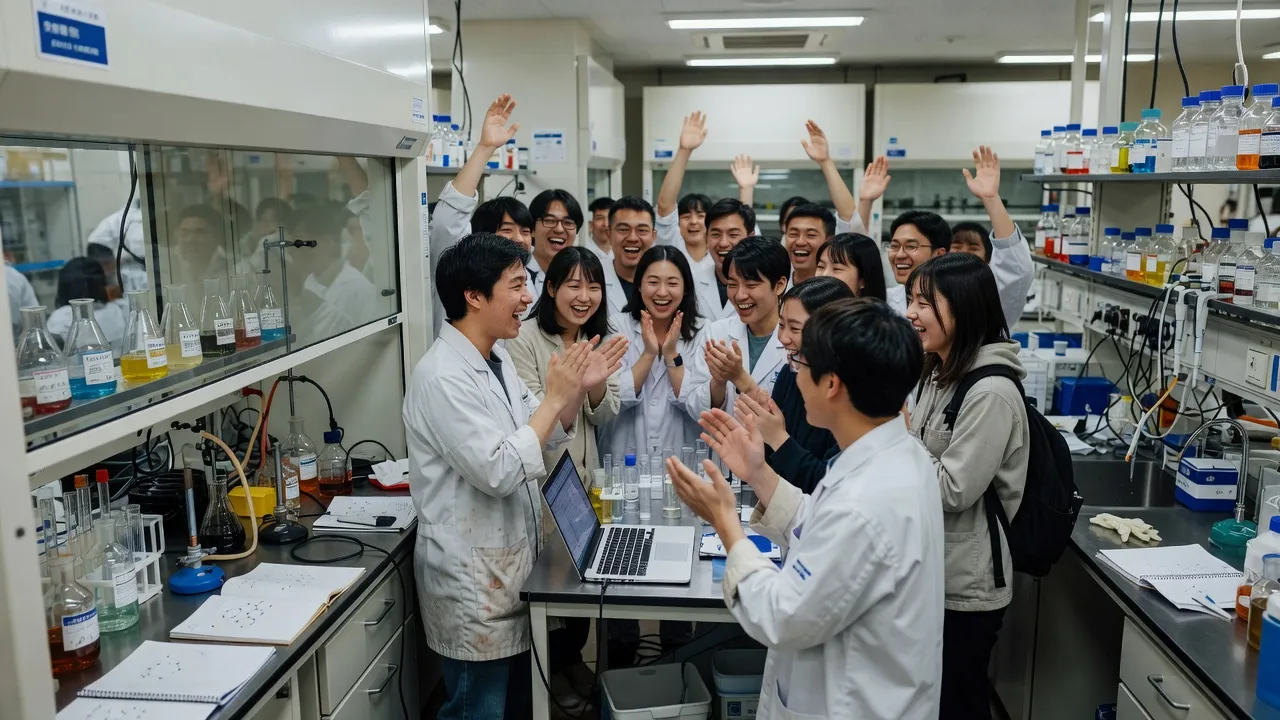
Kyodo highlights the continuity: this is the second consecutive year a Japanese researcher has won the chemistry prize, after Susumu Kitagawa, from Kyoto University, who won in 2025 along with two other researchers for porous materials capable of storing and releasing gases. The agency also describes the reaction on the ground: joy in Hiroshima and at the University of Tokyo, where students deem the news "unexpected." Soai, reached by phone during a press conference, says he is "very happy" to share the prize with Kagan; he was shopping when the Nobel committee called.
On the substance, the three media outlets explain the enigma of homochirality: certain molecules exist in two forms that are mirror images of each other, like hands, but living organisms use almost exclusively one of them. Heiner Linke, chairman of the committee, speaks of "a chemical enigma over a century old" and "spectacular" reactions. News On Japan devotes a lengthy educational article to chirality, from the Greek "hand," and presents Soai's reaction as proof that a tiny imbalance between left and right molecules can become an overwhelming preference for one form. The article mentions applications in pharmaceutical chemistry, perfumes, flavors, and advanced materials.
The Mainichi, which reprints an AP dispatch, chooses a concrete image: carvone smells like mint in one form, caraway in the other; in pharmacy, one wants the version that treats the cold rather than the one that aggravates a runny nose. Peter Somfai, a committee member, describes the experiment as "probably the coolest in organic chemistry." The committee notes that Soai created the first reaction producing a single mirror image, something no one, except living organisms, had achieved.
Kagan's role, whose work in the 1980s showed that one could design reactions favoring one form, is presented as the precursor that Soai later concretized.